Categories
Uncategorized

A Unique Geography

What makes the Sierra Nevada de santa Marta most unusual is that the summit of such a large mountain is so close to the sea, and the Caribbean at that, not usually considered to be a deep sea, unlike it’s nearby biiiiiger brother, the Pacific, whose ring of fire is famous for tectonic activity that has created a ring of uniformly tall mountains, ranging from 12,000 ft.-ish (4000 m) mountains in places like the American West and Canada, Japan, and even New Zealand, Hawaii, and Indonesia to ranges that peak taller like the Alaska Range and the Andes.
The Andes are considered the second tallest mountain range in the world, but dropping from there, only the Alaska range, the nearby Wrangell-St Elias Range and the Caucasus’ reach such heights as this above sea level as Pico Cristobal Colon (you do kick ass, Mauna Loa, at like 35000 ft all told, but half of you is hiding under the Pacific..), so if we go with the maximum height of each range, and consider the Sierra Nevada de Santa Marta to be a separate range from the Andes, which it is as far as I can tell geologically, despite proximity (I gotta read about tectonics now!?.. it’s like having a girlfriend that get’s angry at you don’t know her first pet’s name..), then by my rough math, it’s the 5th highest range in the world… wait, it might be taller than Mt. Elbrus, in the Caucus’…
holy crap it is, by 200 ft or so.. there we have it… it’s the 5th tallest range in the world by highest peak above sea level, since I forgot the Alaska Range (which is a bit absurd if you knew where I kind of live, but it’s funny how I start to take the old girl for granted, forgetting how special she really is) after:
The Himalayas, with Everest at above 29,000 ft.
The Andes with Aconcagua at 23,000
The Alaska Range with Denali at 20,000
The Wrangell-St Elias Range, with Mt. Logan at 19,000
Colon, like I have said, is 18,701, although I also see it listed on Wikipedia as 18,947..

Honorable mention goes to Popocapatel, smoking all the time, and Orizaba, the highest peak in Mexico but both slightly shorter than Colon, although both of which might be visible from the Gulf of Mexico coast. But they are also both well inland. The mountain of my visual dreams, Mt. St Elias, next to Logan, and also quite close to the Gulf of Alaska in the North Pacific Ocean.. it’s a stunning mountain, white from toe to cap with snow, and to see it on a clear day from the gulf or Yakitat or an airplane is a spiritual experience.. it get’s climbed once every three years or so by an intrepid few, but returns me to the Sierra, since the two share this odd distinction of being so tall and so close to Salt Water, but it might be a good 5 miles further from the coast, 30 miles to Colon’s 25, although from the sea it looks like it’s only 2 miles from shore. I am definitely revealing a bias towards St. Elias.
Anyhow, the Caribbean, if I know it well, bottoms out at like 12,000 ft, not terribly deep, but not shallow either.. again, the Pacific goes to like 30,000 ft down… and of course James Cameron has been there..
So facet number 2, the seaside location, is another point for the sierra, because who the heck would guess that anything that tall could be so close to the Caribbean. I have traveled extensively the sea’s edges, and all through the US, and mostly Pacific Coast of Latin America, and it is marked by it’s flatness in the US and Central America, mangroves and unsettled areas like the mosquito coast of Honduras, with mountains kind of close as aforementioned but hardly hovering over it in Mexico. But then you get to Colombia, and flat flat flat going counterclockwise, and then Boom, where the hell did this come from!? It’s descends into the Sea from Cienega to Palomino more or less, all around Santa Marta, like the north side of Maui (yes it really does take 2 hours to drive to Hana, even though it looks like it’s right there!). Palomino offers kind of the first ocean plane, about a mile wide at the town, which widens by the time you get to Riohacha south of which the Sierra is petering out into (dangerous) hills, ending by Maicao.
So to harp on this, imagine starting at the sea, and weaving up through jungle river canyons, then encountering people living as high as 7500 ft who are dependent upon sea shells for their biggest fix (more about the habits of the Indigenous of the Sierra in other posts, but that weird gourd thing you see them rubbing with a stick all the time, it’s made of boiled sea shells…then still being within sight of the sea, at about 8 degrees north of the equator, and encountering snow and then a glacier.. there might be this kind of proximity in Ecuador, or down in Patagonia, but I am not sure that such an abrupt juxtaposition of all the climactic zones exists anywhere else on earth.. maybe Hawaii, but I am afraid to look, but wait, sure, Mauna Loa is likely as close to the ocean, and at a similar latitude.. maybe 10 or 12 north, but it’s 4000 ft lower…
and then the odd fact that this range is so small… you could drive in a circle around it in a day, and likely not break 2000 ft… it’s literally a pyramid by the sea.. and unlike anything else in the Caribbean. Now throw in a dry side and a wet side, and the truly old school indigenous groups, and you have something unique.. 30 something major rivers running down from it, in every direction creating countless valleys, the most lush and interesting to me in the north and west sides, where the culture and biodiversity likely abounds.
In Colombia, let alone the sierra, I have seen a new bird species just about every day, something markedly different each time.. I am dazzled by it, and I remember decompressing in a little resort in Pueblo Bello, on the south side of the Sierra, sunbathing by a pool that cows also drink out of (moderate your vision of luxury for northern colombia, they were also drying coffee on the cement near the pool, and there was a squad of soldiers camped out in a nearby shack.. I also let a mule into the nearby field by accident and had to chase him out with a teenager who worked there, past the pool..), and trying to distinguish the different bird calls I was hearing led me to see about 8 different species… I was a bit stunned, because I can’t imagine many back yards in the US that could offer more than 4 or 5 at any one time…
Throw in the variety of human experiences occurring on the slopes of the mountains.. Soldiers fighting the last vestiges of a guerilla war, with guerillas snooping about in it’s eastern extremes.. an almost modern city tucked between it’s ridges by the sea, with a port alive with commerce and likely some of it illicit, ranchers and victims of the paramilitaries licking their wounds in Valledupar while a corrupt little government goes about it’s business, and there occur the daily events of a social club that birthed one of the most important music genre’s in Colombia, Vallenato, which was originally the musical storytelling of ranchers until some oligarchs, including a former Colombian President I believe, got ahold of it and started to record it in the ’60’s after paying these guys to sing for them for a bit. Then of course the mestizo coffee growers, and the possible coca growing on the east flanks, a smattering of cattle ranchers, but then of course the three remaining old school indigenous groups living up in the hills, calmly awaiting the time when history proves their method of living correct over ours, acting as if the fools with all the metal contraptions in the valleys will someday figure it out, pensively chewing their coca and seashells and admiring the view.
I wish I could say that there was a bunch of scuba diving all around the Sierra, but it’s mostly in Tayrona park, since the rivers there don’t pump out the amount of mud they seem to on the western and north-eastern shores of the Sierra, but yes, there are tropical reefs and glaciers within I would guess maybe 35 miles of each other.. would have to play with google maps for a good answer… there you have it, tall, small in footprint, and towering over the odd ball laconic majesty that is the Caribbean Sea..not a place anyone associates with mountains, outside of a few volcanos and a few nice hills in Jamaica, all right, they are mountains..
Categories
Uncategorized

The Bane of the Sierra: Picos (Bug Bites), Infections, and Diseases

It’s the jungle.. There are some bad diseases about.. But in fact, the jungle ain’t the worst of it.. It’s the disturbed areas, where there is ranching and forest and food web fracturization that the bad shit really lives in…human contact is usually necessary for human diseases.. How do I know this.. because I am sitting in an emergency room right now, likely being diagnosed with leishmaniasis, in Medellin…it’s better than Chagas which was my first fear.. I don’t have swollen organs other than perhaps my colon, which in Latin American can come from any number of things, ask ol Montezuma.

So now writing from Cali, a few weeks later, I will fill in the distillation of my understanding of the disease threats in the Sierra Nevada de Santa Marta. this might be a bit horrifying, but there are problems everywhere.. this is not an impediment to a succesful climb, but it is interesting and perhaps helpful to know. As you have already figured out, in the immediate area, since mountains make their own weather, especially big ones like these, there are like 6 different biomes, from Humid Tropical (Wet Tropical would be the wettest, along the Pacific coast of Colombia, where they set world records for rainfall, but to the uninitiated Humid Tropical might as well be rainforest.. it is rainforest, it can just rain even more if you ever imagined it possible…) to arid to arctic. The variety of diseases possible seems fairly uniform, but I am no expert, but the things I know to exist are Chagas, possibly Malaria, and certainly contamination of water sources due to domestic animal and human waste. Chagas is present enough that studies have been done on the north side of the Sierra especially, charting infection by villages, and the numbers tend to be around 30%. I am not sure I can find the dang study again, but it was filled with graphics of the range.

The method of infection for most of the infections would be bug bites, or ingestion in the case of the gastrointestinal.

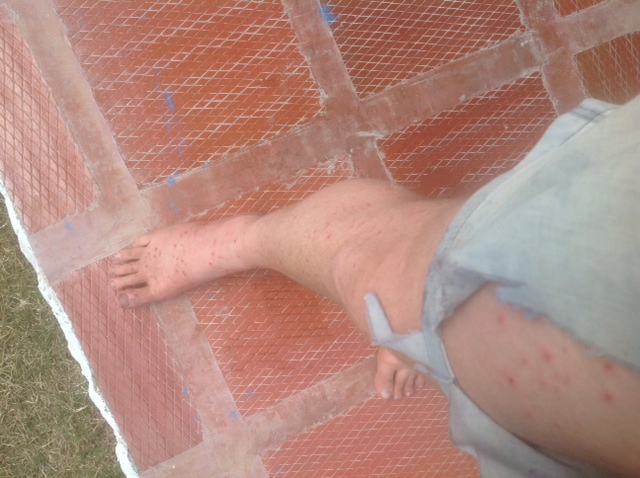
Here is a photo of someone after three days in the sierra without gumboots:

photo (3)

it might be hard to tell, but this persons legs are riddled with sand flea and mosquito bites. they spent 2 nights and three days up there.. they slept on the ground in a Kogi farm, instead of the recommended hammock, and due to the heat kept pulling out of their sleeping bag which was rated for two much heat.. most of these bites started to itch, indicative of Sand Fleas, and took about two weeks to heal once the poison was out of them (it is a pleasant sort of itch, the blood aside). A Cortisone shot was refused, but this likely would have accelerated healing. One of the bites got infected, and then blew up after another incursion into the sierra above Guatapuri, just due to the pounding on the feet somehow perhaps creating bruising where the infection could grow.

photo (4)

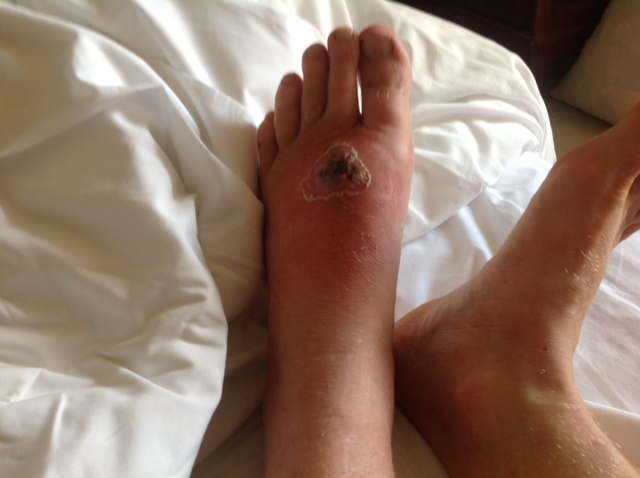
the bite in question became something called cellulosis I believe, it swelled up like a golf ball, then burst spontaneously while the individual was bed resting:

photo (5)

it was like a volcano of dark brown fluid, indicative of a blood infection. Eventually the scab was checked for something called Leismaniasis, a disease that enters through skin infection, but came up negative, but Staphylococus, also known as flesh eating disease, was present, and was eventually treated with doxycycline.

With more care this is all easily avoidable, but it points out the issues of especially sand fleas, kissing bugs and mosquitos, which are in many areas of the Sierra, from the beaches at sunset thru sunrise, to the newly cleared areas, to even Kogi and Arawaku homes. I never understood two things until now.. why South American natives often clear everything around heir homes down to dirt (I figured they just didn´t like putting effort in to landscaping, Mexican crews charge a lot to get here!) and why new Third World Homes are always made of Cement.. it turns out the thatch roofed homes we are so intrigued by end up being havens for disease carrying insect. Chagas in particular is carried by something called the Kissing Bug which bites people’s exposed faces at night. The classic photo of Chagas is this kid with a swollen lump over one eye.

389px-Chagoma

Alright, I will now link to real info if you are still curious on the possibilities:

http://en.wikipedia.org/wiki/Chagas_disease

So there are multiple strains of Chagas, and more than one vector, basically, different bugs carry it in different places.. but it is generally the Kissing bug, the Pito they call it in colombia. It is nocturnal like I said. The disease comes from it defecating near the bite. Pretty stuff. Wikipedia obviously describes this better than me.

Alright, Leishmaniasis. I recently met a guy who had been in the army in Amazonas for three years, on this beautiful river, and he got it once.

http://en.wikipedia.org/wiki/Leishmaniasis

LEishmaniasis comes from the Sand Fly, which is one of the banes here, and I guess it lays its eggs in you, so if it has bitten you, sometimes you will see a little black bump in the middle of the scrape.

Can´t forget ol malaria.. he gets all the attention, incurable and all.

http://en.wikipedia.org/wiki/Malaria

Categories
Uncategorized

The Climbing Possibilities of Colombia Today

Bogatenos are the most likely to be involved in climbing and mountaineering in Colombia due to what I will describe as facts associated with Sociology, not solely wealth, but Bogota is the Intellectual city. There is money in Medellin and in pockets around the country, but the type of counter-culture it takes to create a kind of climbing fervor seems to exist only in Bogota. To put it in perspective, people want their kids, including Botero when he was a kid, to be bullfighters in Medellin. Obviously Sir Edmund Hillary wasn’t exactly a counter-culture figure, he was just a dude who liked to climb, but in Colombia, a culture like this, both conservative and a bit risk averse, climbing is the kind of thing that comes from an upper class rebellious youth to some degree.
All the developed climbing is from what I can tell north from Bogota to Bucaramanga along the Cordillera Oriental, the Eastern Mountain Range that hovers over the Amazon. Bucaramanga is kind of the capital of all this, with an active paragliding scene there as well from what I can tell. There are also a set of snow-capped mountains in El Cocuy National Park within a few hours of there, unfortunately melting fast. Climbing Magazine profiled a scene in Suesca, about an hour north of Bogota it appears, which is alleged to be the best developed location in the country, with very hard sandstone.
climbing.com/route/ghosts-the-rock-gods-and-colombian-climbing/
this article also mentions an underground salt mine nearby with a Cathedral carved out of salt.. that’s pretty cool.

The Cordillera Central from what I have seen is stunningly beautiful, with waterfalls and rivers like one dreams of seeing, but it is mostly jungle and dirt,and well, perhaps there are lots of illegal activities going on in it’s hills. I have yet to see the Sierra Occidental except if you might describe the mountains west of Medellin as part, but they do look stunning, but again might not be climber country. To the South I know that there is a lot of FARC activity amongst the ranges closer to Cali, and as the ranges come together towards the Ecuadorian Border. As footnotes, there are places in the Amazon with exposed Limestone that look stunning, but I have no idea about security or climb-ability, and there is a small range of mountains in Sur de Bolivar that I glimpsed from the Magdalena, but this area is surely a no go zone, some hostages were taken just recently, as, to quote a boat mate, “That place makes some pretty high quality Coca!” and the FARC have conveniently chosen it as a good spot for the continuation of the people’s rebellion that COMINTERN even forgot about 23 years ago.
http://en.wikipedia.org/wiki/Serran%C3%ADa_de_San_Lucas
The up side is that they have kept it from becoming another of the vast cattle ranches that is Northern Colombia, and that are even creeping into the Sierra Nevada de Santa Marta.
Which brings us here.. There is plenty of climbing and mountaineering from what I can see in the Sierra, and if it was developed much, it has been years since anyone enjoyed it much, at high altitudes fortunately or unfortunately, but the weather can be crisp and dry even if the sun might bear down, but this brings us back to the subject of this blog.

Categories
East River Eastport Maine Hydrokinetic Power New Jersey New York Ocean Power Technology Oregon RITES Project River Power SPECTER Organization Tidal Power Verdant Power Wave Power

Hope Unda’ Da East Riva!? Yu serious!? Serious as a tidal rip…

When you think of NYC you actually do think of environmentalism, but it’s usually along the lines of efficiency and quality of life. With it’s progressive mayor for life, Michael Bloomberg (now replaced, but the impact of his 12 years of policies likely won’t be undone by new Mayor DeBlasio), party notwithstanding, making dictates that are in the public interest, no matter how annoying they might have become, and it’s quite settled limo liberal upper class, and just it’s car free big building lifestyle, New Yorkers actually have perhaps the lowest carbon footprints in the United States, about 9 tons a piece I once read, compared to 20 for the rest of the country on average. The way New Yorkers inevitably share walls with each other during hot days and cold winter nights serves in part to make them more efficient, it’s like a big Adobe Pueblo with a great public transportation system, and shows, did I mention the shows!
http://en.wikipedia.org/wiki/Ancient_Pueblo_Peoples
(if the above link were perfect, i would have thrown in a subway car with photoshop, but I have forgotten how!)
But when you think of the big projects, the big ambitious stuff, you inevitably think of the vast American West, of the West Coast, places where Pick Up Truck Engineers mix with Cash Drunk Entrepreneurs and dream up harebrained schemes that somehow eventually work… these are open land projects, heartland ambitions.. people who will deny global warming until some tornado or freak weather event finally convinces them otherwise, so they throw on their Carhardts and come up with a solution on AutoCad while the kid is asleep and the horses have been fed… but never count out the romanticism of America’s most ambitious city (sorry Chicago, you do go big, but you rarely go refined!) because sure enough, despite New York’s, and especially Manhattan’s distinctly white collar reputation, da workin’ stiffs who risk a bit of slight at a cocktail party for admitting they do something tangible, create a concrete and not just intellectual product, have been up to something on the bottom of the East River.. the East Frikin’ River.. can you believe dat! Get da F%$ outtta here! Right next da FDR.. drive by dere every day! up from da UN, like 50 sometin’! Across from dat frinkin’ Roosevelt Island.. who da hell lives dere? And dat’s like the most polluted river in the world eva! (Translation: I am having a hard time believing you. it’s in the East River alongside the Franklin Delano Roosevelt Drive. I know the Location well. It’s north of the United Nations. Approximately in the area of the streets numbered 50 to 59. The location is alongside Roosevelt Island, whose residents I have never met and have always been a mystery to me. It’s Ironic because the river is alleged by New York conventional wisdom to be highly polluted.)
http://verdantpower.com/what-initiative/
http://www.bloomberg.com/news/2012-01-23/tidal-energy-project-in-new-york-s-east-river-wins-license.html

now as I research, it turns out that these were perhaps the first Tidal Turbines in operation, and the first US federal permit to install such a device (hey, it’s New York, always regulations!) as they move to phase 5 after struggling with the fortunate problem of torn off blades because there was MORE power than they originally expected,
http://www.nytimes.com/2007/08/13/nyregion/13power.html?pagewanted=all
(note that that article is from 2007, and they have been moving ahead since..)
but that there is such a proliferation of tidal energy, going back to the first modern commercial project in France in the 60’s, that this one gets last mention in Wikipedia:
http://en.wikipedia.org/wiki/Tidal_power
http://www.theecologist.org/News/news_analysis/678082/how_france_eclipsed_the_uk_with_brittany_tidal_success_story.html
but the turbines made by Verdant are perhaps among the least intrusive, as some of these projects actually require damning an entire estuary… but it also turns out, ambitious though New Yorkers may be, that it isn’t the first operation to go on grid in the states.. leave that to a company from Florida and a location in Maine:
look at the back, above the crowd to see the interesting helical design chosen there…
http://www.bostonglobe.com/business/2012/07/24/nation-first-tidal-energy-project-dedicated-eastport-maine/y477E7mCnIpfBPod5hfKXL/story.html
http://www.nytimes.com/2012/08/10/us/turbine-to-harness-the-tides-to-generate-power.html?_r=0
And they are not alone.. Projects in Canada and Europe are installed, producing, and moving ahead with innovation, and there is even a wave power project moving in off the coast of Oregon..
http://www.nytimes.com/2012/09/04/us/project-aims-to-harness-wave-energy-off-the-oregon-coast.html
http://www.oceanpowertechnologies.com/reedsport.html
http://www.oceanpowertechnologies.com/coos.html
this promises to be 100 MW.. that’s huge, and in a funny way, it’s kind of a de-facto marine reserve as well because you can’t drift net or bottom trawl if they are close enough together without a lot of difficulty either..
turns out that despite my having heard of the Oregon projects first, these guys are actually all over the world now with these SPECTER Organization looking things (5 minutes to world destruction, all personnel clear the area…), and the first one was in none udda den Atlantic City! If only Don Rickles had lived long enough to have his microphone be tidal powered…
http://www.oceanpowertechnologies.com/projects.html
http://www.oceanpowertechnologies.com/ac.html
Respect, New York metro area.. respect.. thank’s for pulling your weight.. no wonder there is always a guy from Brooklyn in every WWII movie.. New Yorkers do get excited in a crisis.

It’s been a debate between myself and a friend.. are we @#$%ed, and should we all head to the hills and start canning rutabagas and hoarding ammo, or will technology solve this problem like it has solved so many others, perhaps both, perhaps neither, but this is promising…

Categories
Uncategorized

Land Mines in the Sierra?

Categories
CFC's Global Warming improving NOAA Ozone Hole Ozone Watch status steady

Remember The Ol’ Hole in the Ozone Layer? How’s He Doin’!?

Steady and Improving..Doctor…
Remember the Ozone Hole.. remember how scary it was.. like that guy in high school who seemed so intimidating.. what’s he up to now, now that you have gotten your life together and faced some significantly bigger challenges, kind of can’t wait to see him at Reunion to stare him down, ha.. Ozone Hole.. what a prick he was!

Well, I’m proud to report he is kind of what you expected.. he’s gone nowhere…sure he got worse for a while, but now he’s kind of stuck.. it’s the equivalent of him staying at home and becoming an overly friendly rental car salesman now with a bit of a paunch and a widows peak.. he drinks when he feels guilty about high school, and just smiles a lot and tries to make jokes when you talk to him…he’s gone from being Freddie Kruger to that Pixar Monster in the imagination of your soul compared to the new challenges you are facing with global warming and it’s 3 horsemen buddies, Glacial Melt, Ocean Acidification, and interruptions to the Food Supply when the world’s population is peaking.. you’ll be eating him for Soylent Green in a few years..
So really, what’s he up to, in the 80’s and 90’s he was such a big deal, back when only egg heads and college professors were squawking about global warming?
Seriously!?
He peaked in 2006, later than you might have imagined.. you know, the equivalent of a bully playing some college ball, or moving to a city that is actually desirable and dating the hottest girl in your high school,
http://ozonewatch.gsfc.nasa.gov/Scripts/big_image.php?date=2006-09-24&hem=S

but for 7 years, nothing, flat, gonzo…
http://www.nasa.gov/home/hqnews/2012/oct/HQ_12-371_2012_Ozone_Hole.html
http://idealab.talkingpointsmemo.com/2012/10/ozone-layer-hole-smallest-its-been-in-20-years.php
it’s how the mechanisms of the chemistry worked that the CFC’s had to work themselves through the atmosphere, but we seem to have successfully halted the production of CFC’s, so as refrigerators die say in a place like India, are thrown into a landfill or recycled, and the CFC’s leak out and make their way to the South Pole through the normal movements of the atmosphere,where in the extreme colds of the southern polar spring, with sunlight however increasing, they combine with hundreds of ozone molecules to tear them from the sky… but the rate of destruction has not increased, the hole never got bigger, our bully seems to have stopped getting meaner and bigger, and enviously more successful. And one thing that’s true, we are making more ozone to replace it one old car at a time, and I wonder, not knowing enough about the mechanisms,if this might not be working in our favor as well..as we age and start to take the position of the bully, learn perspective taking, we ask ourselves “hmm, I wonder what his home life was like?” and things like that, I start to wonder why it never was a factor in the North Pole. was it the lack of altitude of any land mass below it? I have no idea, but obviously we have moved on to bigger and worse things, but we do keep an eye on it.. that satellite I guess hangs out up there watching, and some office at NOAA or the UN keeps adding up the numbers, like that other guy you went to high school with, that ally, who never quite left town, but does cool stuff, owns a bar and hosts parties, he keeps you up on it, satisfies your sceidenfreund by helping you make fun of the bully by telling you how he gets drunk now and complains about how his life has gone nowhere for 7 years.. and you can’t help but see it as, well, hopeful..
Today’s Hole Size:
http://ozonewatch.gsfc.nasa.gov/
Wikipedia, of course, has all the answers..luckily it has no sense of humor, otherwise I would just post a damn wikipedia link, but it says some interesting things.. were it not for the Montreal Protocols, which banned CFC’s in 1987 (celebrated, no doubt, by the celebration of another type of hole on St.Catherines Street..), the whole earth would have been as depleted as the hotle above Antractica by 2060, but they are now calling for a statisticallysignificant recovery by 2024, and pre 1980 levels, where they set the bar, by 2068 worldwide.. the Hole in the South Pole During spring.. gone around 2050…
http://en.wikipedia.org/wiki/Ozone_depletion
Whew..glad that’s over with.. now we have nothing to worry about atmospherically.. wait.. what!?
http://en.wikipedia.org/wiki/Ozone_depletion

Categories
Uncategorized

The Sierra Nevada de Santa Marta in Film

This is no IMDB, I am just poking around on YouTube, and found a few things. things seem to fall into three categories. Mamo worship, a kind of new age interest in the Natives of the Sierra, Shots from Airplanes or Airplane cockpits, and tourist stuff from Minca and the Ciudad Perdido..
Actually a friend of mine, after I told him I was poking around here, sent me this, since he was actually hanging out with a guy in Mexico at the time who happened to be one of the few ‘Civilizados’ who live in the sierra.. it was a neat coincidence.. the guy lived above Palomino, and was just taking a vacation to explore Mexico sometime around New Years of 2013. This guy who rented from my buddy Ozzy in Mexico for a few weeks, just happened to come by, actually knew some of the civilizados I met on my first excursion, who do live quite remotely, a days walk from the nearest drivable road, on the north flanks of the Sierra..
all this serendipity shouldn’t necessarily act as an endorsement of some of the cheesyness of this video, it’s a bit 80’s new age, actually, 1992 it turns out, but it’ the sierra, and this seems to be a good insight into some Kogi culture, since they seem to have been able to find a competent translator:
http://www.youtube.com/watch?v=U2tIVwGwiDc

To show how I kind of end up scraping the bottom of the Barrel pretty quickly when it comes to good documentation of the Sierra, here is an Italian film trailer with some good footage:

here’ some other stuff off of YouTube.. perhaps a bit like me, this guy could use some fact checking, but his comments are somewhat interesting, as are his blue (green!?) beard and zeal!

He actually references the above movie, which he says was made by a BBC director..

Here are two good examples of the genre of footage from planes transiting the Sierra, kind of proof that everyone is a bit surprised to see it there, and it puts in relief the idea that no one really has filmed from above treeline that I can tell:


One of them shows what appears to be the 5 blue lakes, and also demonstrates that the high peaks appear to be quite inhospitable as well as perhaps not of the best rock quality.
I did, by the way, do an IMDB search, just out of guilt for writing that I hadn’t when it is just a few key strokes away, and it turns out the Sierra Nevada de Santa Marta has two somewhat obscure references.. to use a concept from the book the Moviegoer, not many places are left un-certified by the rapacious appetite of the film industry, but unlike nearby Cartagena, it wasn’t exactly in a fantastic blockbuster like Romancing the Stone (c’mon, you loved that movie.. Turner and Douglas, what more could you ask for?!)
http://www.imdb.com/search/title?locations=Sierra%20Nevada%20de%20Santa%20Marta,%20Magdalena,%20Colombia
Here’s some short film that IMDB didn’t directly connect to the Sierra:
http://www.imdb.com/title/tt2201808/

Categories
Charlie Crist Everglades Restoration Plan Governor Charlie Crist Shark Slough Tamiami Trail Tamiami Trail Modifications TamiamiTrail Bridge The Everglades United Sugar Company

Everglades Restoration Project Pt. 3: Restoring the Flow

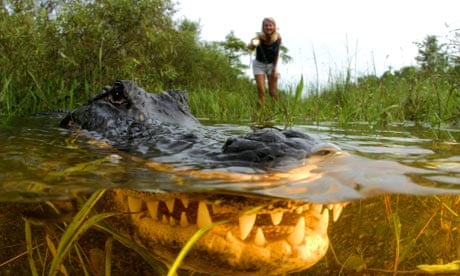
So when last we left this story, I believe we were discussing how they were a makin’ improvements on the edges, kind of cleaning things up, like a surgical tech prepping the patient, cleaning up little, and not so little odds and ends created by 100 or so years of American habitation of the Florida Peninsula (that’s all it took to screw it up.. industrious people, Flagler and them!).. but you young kids, you whipper-snappers, who haven’t been waiting 60 years for a drink of fresh water like us old alligator types. We know how to just lull ourselves and sit in the sun and not eat for a year or so, but you kids want satisfaction, you want to know about the big show, the big problem, you rush right in..well, I gotto admire that.. you kids got guts.. you realize that unless the flow is restored, the icon of the Everglades, Everglades National Park, is gunna shrivel up, succumb to nitrogen overload and invasive species onslaughts, world sea level rise, and, well, won’t be much left to see..
Now a tourist might not know the difference.. to them, brown grass is well, brown grass, and a gator can survive just about anything, but it’s the million subtle differences we are talking about, Okeechobee being almost dry, and the ‘glades themselves being just about dry as well.. what to do, what to do..

Alright, I’m a torturing you a bit.. it’s an old gator’s job… what to do? A lot.. and finally, it’s happening, and not just on the edges like I described before in part II, but on the Tamiami Trail, and in the sugar lands.. sure we got a bit of a, well, how do they describe it, a budget crisis going on.. but somehow them boys up in Tallahassee and Warsh-ington, DC managed to find just enough bucks to really do two big things.. well, to do the start of two big things.. they kind of pulled short of the ideal, the full restoration, but I think you are going to see that it’s a great start, and there is nothing to keep them from continuing with the two major steps I am about to describe, the two major steps that are essentially restoration as close to complete as one could ask for if taken to the n-th, and for me, the day they open up Shark Slough, maybe in about 6 months, I might have a piece of Key Lime pie or a shot o’ Conch Republic Rum to celebrate.. although I just might make em with sugar from Cuba..

So let’s start with the Sugar Deal, and a sweet deal it would have been… Charlie Crist, the democratic governor that drew a lot of flak, but had a kind of adolescent innocence that made him try things for heck’s sake, he tried something big once.. he tried to make a huge deal to save the everglades, and it didn’t quite work, but it did set the stage a bit..
So Charlie knew all the problems, he’s Governor for Pete’s sake, and he also knew all the guys at United Sugar.. since they are, umm.. big political supporters.. and he knew that the market cap of the business, it wasn’t huge, and the people love business solutions.. they buzzwords back then were ‘Running Government Like a Corporation’, so heck, Charlie decided, why not think like a CEO, since United Sugar owns all this land around Lake Okeechobee that is basically cutting The Everglades in two, and they are farming the crap out of it, dumping more nitrogen than God ever could into the shallow flow that should exist there, and that makes it to the areas south to change the makeup of the plant life that does ever receive water, so why not just buy em out for 2 Billion Dollars, dissolve all domestic sugar production into the lemonade of our global economy, and just call it fixed.. heck, anyone can see that Florida can afford to do that.. well, that was the original intent, but somehow, like a wave crashing against a breakwater, it never made it to it’s final destination.. what ended up happening was a 500 million dollar deal instead of the 2 billion or so full purchase, that was, well, a pretty sweet deal for United Sugar, which never had to dissolve.. wait, scratch that, we are down to a 200 million dollar deal, with options.. it just had to give up a patch work of some of it’s likely less productive lands, but only after being allowed to use them for some 6 more years or so, so that the land could go fallow and help restore the link between the upper and lower everglades.. kind of.. starting I guess in 2016 (lord help us..):
http://enr.construction.com/infrastructure/environment/2010/extras/0818.asp
http://southeast.construction.com/southeast_construction_news/2010/0818_FlaWaterMgmt.asp
http://en.wikipedia.org/wiki/US_Sugar_Corporation
please note that at the bottom there, they are going pretty green, using their waste products for production and even perhaps for biofuel..

anyhow, the deal got done, with options pending, Charlie got in a mess running for Senate, but here we are with the land now kind of close to going fallow, not all of it mind you, and according to one environmental scientist from Florida, not any lands that were critical, it’s not a clear corridor from the Kissimmie Side to the National Park, but hey it’s Florida, it takes a lot of lard to make a good Cuban sandwich… so that was step one, but what about step two.. the ‘glades are down there starving for water.. they would drink nitrogen soup if it meant they wouldn’t thirst to death, and soon they will have their salvation.. well, in part, but to me, this is the best step of all:

So that system of ditches and dikes I have been talkin’ about, includes a few highways, and sure, again, around the edges, they have been closing off and modifying a few ditches (canal’s as they are referred to) like mentioned before in part two, and a few minor project I haven’t mentioned like changing the flow of water into Biscayne Bay National Wildlife Refuge, not to be forgotten next to his bigger federal brother the Everglades National Park, or the big tank they are building to replenish the everglades aquifers with settling waste water after they get pumped away to satisfy south Florida’s thirsts, but if you had to identify one dyke and canal combo that is stopping the main flow to that aforementioned bigger federal brother, the poster child, the golden hope, it is the Tamiami Trail, US 41, the classic everglades highway, dotted with air boat tours and alligator farms where you can watch some good cracker on gator wrestlin’ action for what might set ya back 30 bucks or so.. it’s the least obscure but perhaps most iconically satisfying of the Florida back roads, the road so interesting it seems to even give the traffic guy a smile every day to say it’s name.. the Tamiami Trail. It’s got Indian Casinos that got their tacky second rate infamy for claiming the Marylin Monroe of the 90’s, Anna Nicole Smith (Bigger, Bustier, and Uncut!), Goodland where the west coast of Florida Midwesterners troop for a good time show, and the subtropical forests where the orchid thief plied his trade, it’s a regular Florida icon bonanza, but it might as well be the Glen Canyon Dam to the Everglades NP’s Grand Canyon. It is blocking off the flow of water to such a degree that along with all it’s northerly cousins, it’s been estimated that in total the lands in the park are getting 5% of their original flow… and that that is changing the composition of the ecosystem so dramatically, with everything from salt water intrusion to species composition change, that it might as well be a different park for all who have to live there even though to the untrained eye it is the same place, hot, flat, buggy and filled with some sort of grass…
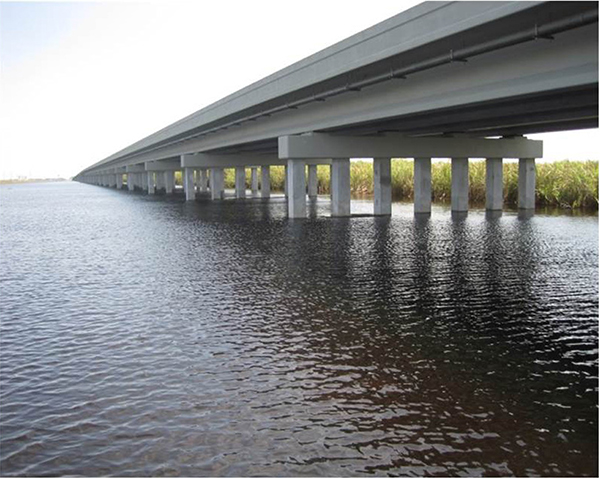
So who is the savior that is coming in to change a problem that the experts see.. well, none other than Ken Salazar, the Department of the Interior, the South Florida Water Management District, various funding sources of the Federal Government, and of all things the Florida Department of Transportation… and how are they going to start restoring the flow, as all the culverts on the Tamiami trail now spout with huge head pressure during the rainy season but it still isn’t enough.. you got it! Another big public works project, but you gotta spread the fat around to get something done in Florida.. Here it is, the Shark Slough Restoration Project elevated road bed!

http://photojournalclydeniki.blogspot.com/2011/10/society-of-environmental-journalists.html
http://www.tampabay.com/news/environment/wetlands/tamiami-trail-bridge-restores-flow-to-everglades-but-it-wont-be-enough/1198510
http://www.naplesnews.com/news/2009/dec/04/work-starts-81-million-bridge-part-florida-evergla/
http://media.naplesnews.com/media/static/bridge_project_plan_view.jpg
well, doesn’t look completely stunning.. umm.. well here was the original set of options
http://www.nps.gov/ever/naturescience/upload/009032009FinalPowerPoint.pdf
You can see, if you wade through some 90 pages of, well, actually, kind of geeky cool graphics, that they had a lot of options put on the table..one of them called for 6.5 miles of bridging, likely a 2 billion dollar project… and heck, if we had all the money in the world, might be fun to make the whole thing a causeway, or pay for planes or hovercraft to take you from Naples to Miami so you can put some money on that Jai Alai match in Dania and make it back in time for Bingo, but umm.. times are tough, and a start is a start..so they.. umm.. picked the cheapest option… but a start is a start!
if that 90 pages wasn’t enough for you, vacuum brain, here is the rest of the discussion:
http://www.nps.gov/ever/naturescience/nessrestoration.htm
now since I am pretending to be the expert here, I must admit that I can’t for the life of me figure out what the Miccusokee’s are crowing about, not sure what their angle is, but I will say for the record, reservations on a bunch of nitrogen being dumped in as well aside, that this must be good for the Everglades, but in Florida, God bless it, nothing is ever quite what you expect.. but hey, the gator’s don’t complain, the law man does what he will, and I bet the fishin’ improves.. in fact, that reminds me.. I’m gunna grab my rod and head out..
The 1 mile bridge is set for completion this summer some time, 2013.. they are a workin’ on it as we speak:
http://www.saj.usace.army.mil/Media/NewsReleases/tabid/6071/Article/6614/early-morning-road-closure-on-tamiami-trail-dec-3-and-dec-5.aspx
they’ll lift up the barriers and let her rip.. we’ll see what happens then..
T minus 3-9 months and counting, sometme from Summer to December of 2013 the one mile bridge should be flowing. They are building the road deck as we speak, then they pull out the old levee/road and voilâ:
http://www.evergladesplan.org/pm/projects/non_cerp_sf_projects_tamiami.aspx
Oh by the way, them government boys are already askin’ for them 5.5 additional miles of bridges.. so don’t worry, us gators are waiting patiently..
http://parkplanning.nps.gov/showFile.cfm?projectID=26159&docType=public&MIMEType=application%252Fx%252Dpdf&filename=EVERTamiamiTrailModifications_FEIS_post_chpts1to6%2Epdf&clientFilename=EVERTamiamiTrailModifications_FEIS_post_chpts1to6%2Epdf

Epilogue:
Finally, May 15, 2013.. the scoop that set it free!

Oh and, I guess it was considered a success, even by Tea Party standards,
http://www.keysnet.com/2013/09/04/489780/90m-okd-for-glades-bridges.html
because the Governor found 90 million to match federal cash for a 180 mil total to build 2.2 more miles of bridge during the 1013 budget season.. I guess fiscal austerity will have to wait a bit. Thankfully this swampland boondoggle will make a few gators happy, and not just a few construction companies!

Categories
Uncategorized

Why So Long? The 2 interconnected reasons why the Sierra has gone unclimbed for 20 or more years

So why so long.. in so many countries,maybe it’s Yuppie ambition, a chance to prove the leisure pursuits of your society, but it’s rare a mountain that is a superlative in a place goes unclimbed for too long. Heck, I once climbed the highest mountain in East Timor, which is a country of 1 million, but it had infrastructure to get to the top and a trail. A guide was 10 bucks for a half day affair.
The Highest Mountain in the United States and North America, perhaps in part due to the 7 Summits phenomenon launched by the Texas Billionaire Bass Brothers with their endeavor and book by the same name back in the 80’s, is called Denali or Mt.McKinley, and it has 5 guide services plus independent parties from all over the world attempt it, usually about 1300 people per year attempt, and annually about 500 make the summit, sometimes dragged along by their guides, but nonetheless successful. Such infrastructure exists all over the world, from the Himalayas to the Alps to the Rockies, and in South America in places like Aconcagua, Bolivia, Ecuador and Peru, and in Colombia supposedly in Bucaramanga.. so why not the sierra…
Well, i’ll toss out a first casual reason, not the two I plan to explore in greater depth in a moment, but it’s an 18,000 ft mountain, 5700 meters, and that is about 1000 meters or 3000 feet past anything an armature would want to polish off in a day or two.. it’s up there in a realm that puts it amongst the biggest things on earth, and even though it is in a tropical zone, it’s high enough to be very tough from the perspective of altitude, the possibilities of HAPE and HACE, and the sun in punishing.. It’s not in the much vaunted ‘Death Zone’, the stuff of Men’s Health and Outdoor Magazine tabloidal legend, which lies about 26,000 ft.. in fact, I’ll legitimize all the hype with an actual Wikipedia Article about it..
http://en.wikipedia.org/wiki/Effects_of_high_altitude_on_humans
but it’s high enough that it isn’t a Colorado 14er on a weekend.. not to be, well, tabloidal,but you can die at these altitudes from exposure and altitude issues alone, even if preserved from the additional hazards of alpinism. But these reasons enough haven’t prevented people from climbing many a similar and higher mountain in thousands of places around the world.. so what is it preventing people from going up there?

Two Buzz Words..Sacredness, and the FARQ.
For the uninitiated, Colombia has been engaged in a Civil War for some 50 years, and longer if you delve into what is a long national history of fratricide, driven by a theme that will be familiar to many Americans, two political parties, one of the landed gentry for a long time, and the other of the lower class and intellectuals, basically the conservatives and liberals, a bit more complex than this, but the conservatives drawing their lineage from the beliefs of the National Liberator, Simon Bolivar, and the Liberals believing in the somewhat more law based opinions of his main rival, Santander.
http://en.wikipedia.org/wiki/Francisco_de_Paula_Santander
To place them in another context, in Mexico, Santander would be Benito Juarez, and Bolivar some combination of Cortez and Porfirio Diaz, or in the US, Santander as a vindictive Thomas Jefferson to Bolivar’s somewhat less restrained George Washington. All this to say, that at some point, the followers of Santander and a more extreme group that started to consider itself communist, broke off after an incident in a place called Marquetalia
http://en.wikipedia.org/wiki/Marquetalia_Republic
and began waging a war against the government organized as a group called the FARQ.They fully embraced a communist ideology supposedly in 1980 at their 7th congress. There were two other significant Left wing insurgent groups in Colombia, M-19 and ELN, but the FARQ and the Colombian Army are the Major Role Players in the Sierra Nevada, and the paramilitaries were but are no longer a significant factor that I could find, other than as a persistent memory for some.
As the FARQ expanded, financed by some assumed combination of cocaine revenue, protection rackets, and support from Soviet Block countries and perhaps even the Peruvian and Venezuelan Governments at times as has been alleged, they opened what they called Fronts around the country in Rural Areas. The one in the Sierra Nevada De Santa Marta, Front 59, at one point had more than 800 members I was told. I will reveal the present disposition in a post entitled Current Security Situation.
In 2002 there were major combat operations, with the military moving into the sierra to displace the FARQ. They removed them from many a town, including Pueblo Bello without a fight, but between La Minah and Guatapuri, 200 people were killed in everything from Executions to Infantry Combat. The people there are relaxed enough, but there is a way in which they can be comically indifferent which seems to be a defense mechanism against the trauma, and this behavior just a few valleys away on either side of the Sierra was not evident. The Operations were ordered under the NEw Administration of President Uribe, who got elected promising to take down the FARC, who amongst other things had killed his father when he was younger in rural Antioquia. The FARC at it’s high point literally administered to some degree 10% of the municipalities in Colombia, and it wasn’t all in once place, they were all over, including Guatepuri, Pueblo Bello, and i have even heard they ran Palomino to some degree, and definitely the villages above it. I have seen the same phenomenon at work in the Darien Gap, where the FARC are the de facto big brothers of the Indigenous groups who live closest to the colombian border, away from Panamanian infrastructure. The Sierra Marta was a FARC territory, and they liked and treated the Koguis quite well from what I have been told, but killed more than a few Arawaku and Kancuamos, and I would assume they treated the Wiwa’s similarly to the Koguis.. I have had Arawaku’s and Kancuamos tell me they were quite pleased to have the Army come in 2002, although it has accelerated the forces of westernization in some of the towns, the Koguis and Wiwas are blissfully indifferent to this, and the Arawaku’s have a sophisticated combination of ways to deal with maintaining their lifestyle while working with the outside world. Like I will describe later, the Kancuamos have been westernized since long before the FARC came around.
All this to say, that as nice as the FARC might have been to some, most mountain climbers tend to be from the Elite or Bougoise, and these are not people who should be messing with the FARC, it’s like a mouse teasing a cat, and it didn’t happen. There was one famous exception, a group headed to the Ciudad Perdido (Lost City of the Tayrona Culture, the predecessor culture to the present day indigenous groups which peaked and fell in pre colombian times, rediscovered in the 70’s, and a popular tourist trek from near Santa Marta and Minca), which seems to have continued tour operations even as the war raged in some sort of truce, were kidnapped by a combination of the FARC and ELN in September 2003, no doubt when the Uribe ordered offensives were creating pressure, officially as a protest of alleged human rights violations by the military and paramilitaries. The last of the 8 individuals was released after 3 months. There was paramilitary involvement in the incident as well. Tours resumed in 2005 to the ciudad perdido. I haven’t looked too hard, but I haven’t heard of any other incidents between the Guerrillas and Climbers.
But now I must introduce the Sacredness concept. Many of these tribes will argue that the Mountains are sacred, and cannot be visited by outsiders. This is a tricky ball of wax… Sometimes when I hang out with an indigenous group, i sometimes wonder how much of what I am being told is what they think I want to hear, how much of it might be regurgitated hooey that NGO’s and occasional hippies that come begging for validation from the Mamo’s, because their dad was some businessman prick who didn’t teach them about spirituality, the local term for Religious Leaders or Shamans. Hang out in traveled areas of The Sierra a bit, and you will see these guys, hippies from Bogota looking for answers and a mouth full of Coca focus. Every time I heard this term, I wondered if the whole Sagrado thing was pumped up by outsiders, which the Arawaku’s seem to take seriously on occasion, or was it an excuse to keep people from getting kidnapped by the FARC which would create hassle for everyone. You will notice in Colombia that a lot of people are quite more disposed than would normal in a lot of places in the world to putting up with problems, since for 50 years anyone who complained ended up with a bullet in their head. This sacredness thing gets tossed about a bit.. oh, the Koguis up there won’t let you to the snows, it’s sacred.. oh, well, you’ll never get permission for that particular spot, it’s sacred.
When i hang out with the Arawakus, I feel like if I made a strong enough argument, proved the FARC were gone, and offered to involve them in an ascent, I could get through. With the Koguis around Guatepuri, I feel as if a little help from the military in terms of conversation with the leaders to say there is no danger, maybe even an escort, the Alcalde (the municipal government) and a little money in the local leaders pocket might get me access as well. One Soldier told me i could get up there through Minca, but I am not sure if he was confusing the Ciudad Perdida with the High Peaks region, but I kept hearing the sacredness thing, and I wonder how true it really is, how much they would hold to it, and what combination of gifts, involvement and logic might break through this barrier.. I have some hunches…

Categories
Charlie Steen Cleanup Colorado River Mi Vida Mine Moab Moab Tailings Pile TARP Funds Train Uranium Mine Utah

Move 16 (Million) Tons…: The Shrinking of the Moab Tailings Pile

Merle Travis might have written it:

Paul Robson might have done it best:

Here’s a mining themed version some guy did:

Hell, the Red Army Choir gave it a try:

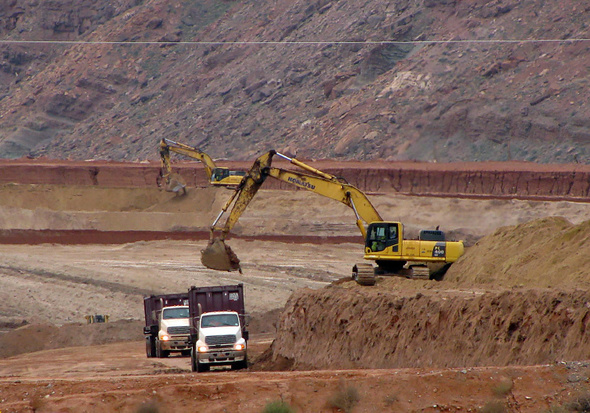
but no one is doing it quite like the Department of Energy, UMTRA, and Portage Inc. of Idaho are in Moab, Utah right now, times a million, about 5000 tons a day worth..
What the heck am I talking about? None other than the Moab Tailing’s Pile, the byproduct of some 30 years of Uranium Mining, that currently sits in the flood plain of the Colorado River next to one of Utah’s biggest tourist destination hubs.

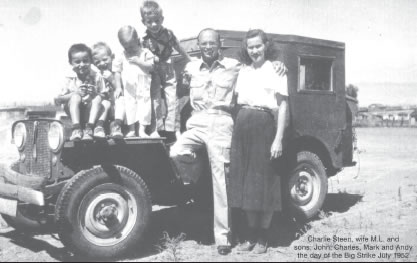
Before I tell a sad but hopeful story about the pile, lemme set a time and place with the rags to riches to rags story of Charlie Steen, the man who found the mother lode of Uranium in the United States, the Mi Vida Mine in the Lisbon Valley of Utah, about 40 miles to the South East, near the little Mormon berg of La Sal. Don’t confuse him with the Tiger Blood swilling TV hack that never would have made it in this man’s old west! He’s Sheen, not Crazy ‘ol Charlie Steen, who is a legend of a different sort.
Image result for moab tailings pileWhen America started the Nuclear Age with a series of experiments in places like the University of Chicago, Oak Ridge, TN, Idaho, Hanford, Washington, and Los Alamos, NM, culminating in the Big Bang at White Sands (“Now I am become Death, Destroyer of Worlds” quoteth Robert Oppenheimer at the time). From what I can tell, we had to get our Uranium from the former Belgian Congo for the most part to do the dirty deed in White Sands, Nagasaki and Hiroshima. I will leave the meditations on this act to Oppenheimer and John Hersey, because I am trying to depict the Gee Whiz exuberance of the birth of the Atomic age and the Money Money Money that caught up a guy named Charlie Steen, the Charlie Sheen of Moab, who took the town into it’s third incarnation from Indian Village to Mormon Settlement to Nuclear Mecca, which paved the way for the final incarnation, Gateway to Canyon Lands, but not without a little environmental impact.
Image result for moab tailings pileCharlie Steen was a geologist, and at about the time that the US government started promising beaucoup bucks for Uranium, to make our Nuclear Age a home grown affair, in the Aftermath of World War II, he moved his family to south west Utah,because for some reason, from Australia to Namibia to Canada, Uranium seems to like the red rock areas, and Utah turned out to be no exception. Charlie had his own theories about Uranium and Anticlines, a geological feature that is a bit like a dome, and some hole he had dug down 200 feet proved to be his fortune when his family was broke as could be.Charlie couldn’t afford a Geiger counter, so the guy at the Moab Gas Station had to spot it for him when he pulled up in his beat up old truck with a load from 80 feet deep, when he was well past it to 200 ft… He had struck it rich, the counter went nuts, and from this moment was born the crazy legends of how Steen was so sick of doing laundry by hand he would have all his clothes flown to Grand Junction to be Dry Cleaned, and he would fly up over the canyons to watch TV from the back of his plane too, since he could catch signals from Denver and Salt Lake up there… it was a grand time, and Charlie helped fuel the flood of Uranium, sold at top dollar until 1960 when the US Government finally figured out how to buy Wholesale, that gave us the Dr. Strangelove era of a 20,000 warhead arsenal and the growth of the Nuclear age that ended one morning in the 70’s on Three Mile Island.
http://en.wikipedia.org/wiki/Charles_Steen
http://en.wikipedia.org/wiki/Uranium_mining
http://en.wikipedia.org/wiki/Uranium_mining_in_Utah
unfortunately, if you’ll pardon the pun, there was a bit of fallout from all this.. Moab got rich, which is channeled into such cultural gifts and indulgences as Milt’s Stop & Eat:
http://www.miltsstopandeat.com/
people started to discover Moab and Parks were created and the tourists came, and the bottom fell out on the price of Uranium, leading to a pretty seamless transition, violence only being done in the written world, by Ed Abbey who just might have assumed that Moab would have been left just the way it was:
http://en.wikipedia.org/wiki/Edward_Abbey
photoBut the most tangible piece of fallout was this huge pile of Uranium, and given the Merle Travis Song it almost seems too perfect to be true, an estimated 16,000,000 tons of it, so tall you didn’t used to be able to see Moab from north of town when you came in on the Highway from Green River. You see, like in so much mining, The Uranium didn’t come in pure veins, maybe some of it was pretty dense, but they were processing 1400 tons of rock a day on average right there north of Moab to get the Uranium they wanted, and the rest was tossed in this pile on a flat spot by the river, loaded with heavy metals and lower grade radioactive materials, heck, probably some missed uranium as well, and there it has sat, kind of like the chunk of almost pure uranium they once found in a guys back yard in Moab after a fly by with a helicopter sporting a Geiger counter, not obviously hurting anybody, but likely not in the best spot.. as people started to come to Moab for recreation more and more, not just filming westerns and mining bomb bricks , and the nation’s environmental consciousness started to invade even the last redoubts of old school industry like Utah, a plan was hatched to clean it all up. Now the Moab Tailings Pile ain’t a Superfund Site, people point that name around like a rattlesnake points his snout,
http://www.epa.gov/region8/superfund/ut/index.html
but it is being supervised and paid for by the Federal Government, the Department of Energy, as they are to some degree the guys who caused the whole mess to be made in the first place. They are moving the whole pile to some big hole far from rivers where it might even be reprocessed to get just a wee bit more uranium out of it. How much have they moved, well, 36% at last count, about 6 million Tons, so while we’re all another day older and perhaps, due to the TARP spending, truly deeper in debt, I can’t say it didn’t need to be done.
They post updates often. Due to running out of Stimulus Money, they are no longer working winters but are on the move 4 days a week, maintain equipment one day a week schedule, and oh yeah, you can see Moab from the crest of the highway now…
http://www.grandcountyutah.net/pdf/UMTRA_Status.pdf
http://www.gjem.energy.gov/moab/
http://www.new.ans.org/pubs/magazines/download/a_838
Maybe someday soon, the natives of the Future, some funny combo of Mormon, Hippie Raft Guide and Navajo, will be banging drums on that very spot unaware of what had occurred, safely smokin’ dope, makin’ sacred undergarments out of river reeds, and having fun as the river floods once again, free of the contamination Charlie Steen and The Space Age unleashed upon the river.. 2025 if not before…

Colorado River Canyonlands National Park
Colorado River in Canyonlands NP just down from tailings pile

Image result for colorado river