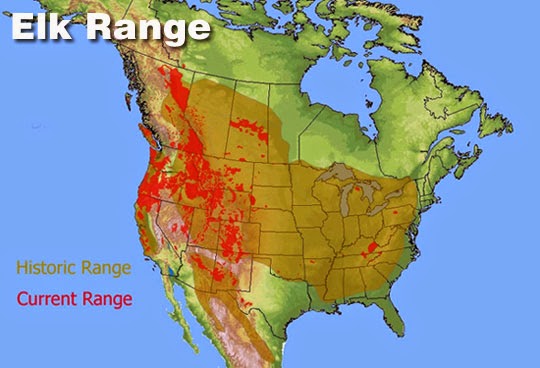
One of the Most popular posts on this Blog has been my writing on The Return of the Elk to the East. It’s been so popular that I feel a follow up is called for.
I said about everything I knew at the time in that post, so I figured why not dig in some more and provide some more raw information for the autodidacts out there. As a service of information, I thought it might be fun to list where the elk are now as public herds (there are a lot of meat and trophy herds, which is great, but the public herds are more likely to be free roaming and an act of wide scale species restoration, although not to take it away from the Ted Turners of the world who are privately trying to bring about ecological restoration, but their neighbors might complain, and it’s harder to complain to city hall). I also searched news stories and the rumor mill as to where they might go as states and parks make active plans, and where they could go by my observations of places in the east that are wild enough. As I research, it turns out that it doesn’t take a huge area.. Virginia placed their herd on 3 square miles of recovered coal mine where most of them will stay if they manage for numbers, but many of the herds are much more woodland and widely ranging.
let’s start with where they started:
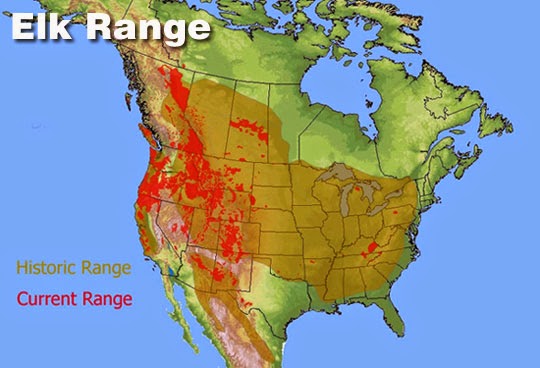
As many of you know, the Eastern Elk subspecies, Cervus canadensis canadensis, has been extinct since 1880, but bloodlines are ideally being brought east from the closest relatives in Alberta and the Rockies but some have come from as far as Arizona and Utah. They have been thriving and producing huge specimens.. the ones in Kentucky are considered to be some of the largest in the country, as the forage is so great compared to the west, they aren’t pressured out of rich bottom lands by Mountain Lions, Grizzlies and Wolf (yet, although maybe some black bear take an interest in the young) and the Eastern Elk subspecies was also known for being the largest of the species, perhaps due to the richness of the thick forage and the fruit bearing trees like the old American Chestnut.
There have been a few phases of the modern history of the Elk. They were extinct in the east by the Civil War is seems, and by the east I mean East of the Mississippi, although you could argue that the great planes separate the east from the west and therefore Iowa and it’s north to south rank of states, from Minnesota down to Louisiana, and even the next rank, Oklahoma up to North Dakota, are Eastern States.
The First phase of restoration came in the age of conservation brought on by Teddy Roosevelt and the realization that the great ages of logging and the beginning of the machine age had almost completely stripped America of it’s above ground natural resources by the beginning of the 20th century. Because of the destruction of wolves in Yellowstone National Park, there was a crisis of overabundance of Elk in the park which led to the exportation of Elk by train to about 11 eastern states,
 |
|
this map is about 5 years old and reflects reintroductions going back to the early 1900’s and is already outdated by great successes in the recent 2000’s
|
but they survived in only 2 to the present. In the rest they were hunted to extinction during the depression or in the 50’s for food or due to conflicts with agriculture, and little was known about what they needed in terms of habitat and territory. The dawn of the Environmental age in the 70’s and 80’s brought more sophisticated management to the two herds that did survive, Michigan and Pennsylvania, but it was the bold act dreamed up by some wildlife officials in Hazard County Kentucky (yes, the Hazard County immortalized by the Dukes of Hazard! ) that led to the major initiatives now in about 6 other states and hopefully will keep steamrolling into a full scale elk reintroduction to all the wilder recesses of the east. I was just told by one wildlife biologist that it’s the hot topic in the upper Midwest as budgets loosen with the end of the great recession. Hopefully we are entering The Golden Age of the Eastern Elk Restoration.
Number of Public Elk in the East as of March 2015 from internet sources:
Kentucky 14,000 + 40=14,040
Pennsylvania 900
Michigan 650
Arkansas 500
Tennessee 400
Wisconsin 235
North Carolina 140
Missouri 125
Minnesota 120
Virginia 90 +10=100
West Virginia 100 + 24=124
Illinois 23
South Carolina 1
Total 17,293 or so totals for 2014 from public records I could find, and current efforts alone are expected to exceed 20,000 in the allocated areas. A far cry from the millions of yesteryear but a good start.
Arkansas has had one herd come and go since the extinction of the Eastern Elk, but efforts in the early 1980’s led to a second herd along the Buffalo River in the North West part of the state (flowing out of the Ozarks to the White river which connects with the Mississippi near Memphis), that has grown healthily from 112 individuals from Colorado and Nebraska to the nearly 500 individuals running around this National Park Service protected river basin today. Arkansas Manages to keep increasing the population while allowing a hunt for about 30 individuals annually outside the National River area which is where the core of the population resides.
http://www.uaex.edu/publications/pdf/fsa-9099.pdf
http://www.nps.gov/buff/learn/nature/elk.htm
Illinois
This one will surprise you. There was a town called Elk Grove, that felt a bit dumb not having any elk, so they decided to remedy that, in 1925. If that’s not quite the story, here are the facts. There is a herd of elk, more a zoo display than a wild herd, in the suburbs of Chicago just north of the town of Elk Grove, just past O’Hare Airport, the Busse Woods, Officially the Ned Brown Forest Preserve. The Elk are on a pasture that allows for about one acre for animal, with some woods, for a usual rotating total of 20-30 animals. There is a guy who get’s paid to drop off and pick up individuals every so often to mix it up genetically with wild populations and farm populations. The Manager told me it’s an ideal mix of 70% field and 30% forest, and Cook County maintains the fenced in population by popular demand on this ring of parks that surround the city about 4 miles from it’s center, I believe as the execution of a plan by Frederic Law Olmsted. I have been to see them, and it’s definitely unique given that you can almost see Sears Tower over your shoulder. Despite Trophy buck in the south part of the state, this is the only Elk herd I know of in Illinois.
http://fpdcc.com/busse-woods/
Kentucky
The major Kentucky herd is the big eastern herd.. rumor has it there are 14,000, many more than the 10,000 officially stated, and they are spilling from SE Kentucky around Daniel Boone NF into Virginia, West Virginia, and Tennessee, forcing those states to take steps and legitimize their herds. The seed herd came from Kansas in 1997, then hundreds more from Utah with goal of importing 200 per year for 9 years until they could reach 7,000 with domestic births, but they stopped after 6, having gathered others from New Mexico and even Nebraska. I have read that 1550 was the final number imported but I might be wrong. There is hunting now with ’bout 30,000 applicants for 1000 permits.. 1 to 30 are actually good odds given the other possibilities east of the Rockies.
http://fw.ky.gov/Hunt/Documents/1314ElkReport.pdf
Great Article on the Kentucky Elk effort in the late 90’s
There is a minor herd at the west end of Kentucky at the Land Between the Lakes National Recreation Area, that mix with Bison in a 700 acre enclosure within the park area. I have driven past it, and it’s a nice big field, and it’s neat to see perhaps the only area where Bison and Elk commingle publicly east of the Mississippi, but It wasn’t much more impressive to me than the Elk Pasture in Illinois until I learned from the article above that it was part of an experiment to see if the other subspecies of Elk from further west could survive brain worm. This was before the Fish and Game guys in Kentucky knew about the herds in Michigan and Pennsylvania, which experienced fatality rates of 2-3 percent due to the malady. They should have read this blog post!
http://www.landbetweenthelakes.us/elk-bison-prairie-story/
About 650 elk in North Central part of lower Michigan (the second knuckle of the middle finger of the mitton). Like in Pennsylvania, this herd has been around for a long time but suffered from ups and downs of neglect, but has been on the up as states became more ecologically minded since the 70’s.
http://www.michigan.gov/dnr/0,4570,7-153-10363_10856_10893-28275–,00.html
http://www.michigan.gov/documents/dnr/Elk_Management_Brochure_429864_7.pdf
Minnesota
This massive but agriculturally strong state has 2 small herds or under 100-120 individuals total that seem to be a blending of imports from the west in much the same way as Pennsylvania, around the times of the population explosions in Jackson Hole due to predator extinction that had Tetons and Yellowstone park managers shipping elk east on trains. There might be some Eastern Elk Blood left because those imports occurred in the teens before the last wild elk were shot elsewhere in the state in the 1930’s but I could be wrong.
The Grygla herd is close to the NW corner of the state, but the Kittson herd is literally on the Canadian Border and get’s some occasional blood from Canadian Elk drifting south. Compared to what is going on in Wisconsin, this herd seems over hunted and unappreciated, and it makes one wonder why not move it to someplace like Boundary Waters or at least dedicate more space to it. Without much research, it feels like it’s a bit mismanaged or neglected politically or otherwise.
http://www.dnr.state.mn.us/hunting/elk/index.html
http://blogs.twincities.com/outdoors/2013/01/10/1720/
But there is some greater hope for this in Minnesota coming from a unique direction. I am going to write below about a neat opportunity that is being generated by the Fon Du Lac band of the Chippewa Tribe and their resident Wildlife Biologist to create either one large or two more herd’s on lands they have ancestral hunting rights to that cover large parts of North East Minnesota.
As a neat foot note, there used to be Caribou even just 100 years ago in the Voyageurs National Park area and maybe other areas of Northern Minnesota, and attempts were considered to restore them in the 1980’s, but it was hard to put together the full coalition needed there in Northern Minnesota and White Tail Deer were present in such densities that the transfer of diseases like I believe Brainworm which are fatal to all cervids but deer made it difficult, and now it is felt that Global Warming would make a herd in this range of just 100 years ago un-viable, to use the lingo. there is evidence of Elk in the area perhaps 2000 years ago, but while a large wild area, it’s only due to global warming that perhaps ideal elk conditions will occur here in the near future, as they would more likely be to the south and west of this area under the normal climate and ecology patterns of the last few hundred years.
Missouri
“As goes Missouri, so goes the Nation” goes the saying. In 2010-2012 they imported 110 elk from Kentucky to South Central Missouri, an area around a place called the Peck Ranch, and as of the winter of 2014-15 they supposedly have about 125, and they expect the population to start to explode soon, with only an occasional mountain lion floating around to hunt them. Human hunts are being held off until the number fills out the territory.
http://mdc.mo.gov/node/10867
http://krcu.org/post/missouri-elk-herd-grows-no-hunting-yet
North Carolina
It was felt that the Red Wolf reintroduction to the park in from 1991 to 1998 failed because there wasn’t sufficient game. The Elk don’t roam much beyond the Cataloochie but it’s hoped they will recolonize the whole park, and maybe someday there would be something to keep a wolf’s attention for more than a few months in the park.
http://www.nps.gov/grsm/learn/nature/elk-progress-report-49.htm
Oklahoma
Oklahoma has wild elk in 30 of it’s 77 Counties, and has since their reintroduction with just 6 elk in the early 1900s, 1906 I believe. They were only extinct in Oklahoma for 28 years, since they were extirpated in 1880. I would assume mostly to the west and in the Panhandle, and just had it’s first public statewide hunt in 2014. Populations are centered around the Wichita Mountains of South West Oklahoma where the 1906 releases occurred.
http://digital.library.okstate.edu/oas/oas_pdf/v43/p229_232.pdf
in 2014 the first hunt was approved with 60 takes allowed, but for the life of me I can’t find any published reports of the actual population in the state.
http://newsok.com/commission-approves-elk-hunting-season/article/3939464
Pennsylvania
A Thorough History of the PA Elk herd
South Carolina
Sometime in October 2016 a Bull elk decided to kick off self introduction to South Carolina, by trotting south from either the Cherokee Reservation or Great Smokey Mountain National Park..
Let’s hope this even prompts South Carolina to cement it’s gains.. it’s a great and wild state and Elk would fit in quite well!
Agh, by January 2017 they brought it to Charles Towne Landing, a state park that is the Jamestown of South Carolina, the oldest settlement, just across from modern Charleston to be part of the Zoo there. Free the Elk! Bring in More!
Tennessee
I used to live in the Volunteer state, but I hadn’t caught wind of this until now. Although both of Kentucky’s her’s come within the width of a gnat’s ass of being in Tennessee, the one at Land Between the Lakes is confined, so it would hve taken an Elk Jail Break, but it turns out that Tennessee has done a full on wild herd on the Cumberland Plateau, which runs across Eastern Tennessee like a ribbon NE to SW, in addition to what might spill out of SE Kentucky on it’s own. So chalk one up for TN.
Between 2000 and 2008, 201 elk were released in Eastern T-N, 6 releases in four locations for a total of 201. I don’t see evidence of more releases despite a plan to import 400 total, which might mean it was a victim of the great recession that began later in 2008. but 201 is plenty.. The Elk came from Alberta, and Land Between the Lakes provided a few, which were also said to originally be from Alberta.
The Three release spots were Horsebone Ridge, nearby Montgomery Fork Creek, The Sundquist release site east of I-75 which also includes the Hatfield Knob Viewing Platform and Sanctuary , and Hickory Creek which runs right through the heart of Sundquist. and and they have been given what looks like 1000 or so square miles to play in which looks like it bumps up to the Kentucky border where there must be other herds in the Daniel Boone National Forest, all within an hour or two drive NW of Knoxville around the town of aptly named Huntsville.
http://www.tn.gov/twra/pdfs/elkzonemap.pdf
in 2014 TN gave out 6 permits, I think about the same amount they have been giving since 2009, and they estimate that the population has doubled to around 400 since the first releases in 2000. They estimate that this area alone, the only area that TN seems to be actively reinstating Elk on, could handle 2000 individuals. This is a neat celebratory video with a lot of detail from the 2009 first hunt:
http://www.tnelkhunt.org/tn-elk-program.html
http://www.tn.gov/twra/elkmain.html
If those Elk in North Carolina decide to do some mountain climbing through Smokey Mountain National Park, they would be added to the TN side as crossing the major ridge in the park also puts them across the state line. I don’t see any mention that this has happened yet, but it’s just a matter of time, and TN will join Wisconsin and Kentucky (and Minnesota although I don’t want to put them on a pedestal) with two populations.
Virginia is a recent success story, but it turns out it has has a tiny herd for almost a century, a bit like illinois, for years, so two stories to tell. Someone beat me to telling the story in exceptional mapping detail on this page:
http://www.virginiaplaces.org/natural/elk.html
so I will just paraphrase with the major facts, but first the little oddity of the Bellwood Elk Herd.
http://www.aviation.dla.mil/userweb/pao/elk/elk.htm
http://www.aviation.dla.mil/userweb/pao/elk/WebBellwood%20Elk%202013.pdf
As you can see, especially if you click that brochure link, the Department of Defense’s Defense Logistical Agency bought a beautiful farm during World War II near Richmond, which is a big hub for military equipment storage, that already had a resident Elk population imported by Mr. James Bellwood, a wealthy naturalist who was the last private owner of Bellwood Estates. When it was sold it was insisted that the Army Department as it was then maintain the herd, which they still do on a 20 acre enclosure on the compound, although it appears they used to let the elk mow the lawns before it likely became a safety issue.
The DLA maintains the herd at 7-10, and as with the Cook County Herd in Illinois, excess are traded to other conservation herds.
But now onto the main event, which is the recent establishment of a herd in an area called South West Virginia, the pointy part that ends in the famed Cumberland Gap that was the easiest route through the Alleghenies, now more commonly know as the Appalachians. Virginia knew it’s hand was pressed by Kentucky, whose herd would keep growing into this exact area, and you can bet some progressive members of the state wildlife commission and likely some employees decided why not be proactive. A Plan was drawn up in 2010 to make it happen, and a budget was set of about a half million dollars over two years to import elk and prepare the territory.
http://www.dgif.virginia.gov/wildlife/elk/management-plan/elk-restoration-operational-plan.pdf
and they wrote out as many of their options as they could come up with in a detailed study:
http://www.dgif.virginia.gov/wildlife/elk/management-plan/elk-restoration-and-management-options-for-southwest-virginia.pdf
In may of 2012, 16 were radio collared and released in Buchanon county (pronounced Buck-A-Non down in those parts) which is the county that tops the little spur of SW Virginia the pokes up around the bottom ebb of West Virginia and has Kentucky on it’s west border. They established the herd on some old Coal Mining land, a big field of about 2000 acres that as seeded with forbes for restoration near War Fork that serves as a home territory the same way it is done In Pennsylvania with Winslow Hill and now Tennessee with Hatfield Knob. There are now 90 elk in the area, of I believe 70 brought in from Kentucky, the east’s Elk Breeder Reactor, in three deliveries over 2012 to 2014, the last totaling 45, and they are hoping to get to about 400 before they start up hunting in earnest although it has begun, especially with farmers in nearby counties like Tazwell worried about their crops being expropriated to the Bugle Brigade. The Management ambitions were also downsized to that 400 from a bigger dream of 1000 or more with the protests of hunters in the more ag dominated Counties to the South East. Buchanon County, along with Dickson, Wise, and tiny Norton County, are part of the Cumberland Plateau, hilly and more suitable for woods than fields, that runs all the way down to Alabama and has been the site of the KY and TN major releases. the Area where there is resistance is part of the Ridge and Valley geographic area that runs all the way up to the Shenandoah and has about ten times the agriculture per similar sized county. The state hopes to contain the Elk to those Cumberland Plateau counties. The state appears also to be intent upon a once every two year helicopter study of where populations might have gone all along the Kentucky border areas of Virginia, as has been happening since just years after the Ky release in 97. In a way, the Buchanon County effort is just making it official.
West Virginia
I know the Appalachian Mountains very well, and can brag to have once walked their length, but when people makes jokes about them, I can think of a lot of impenetrable places in them, but the deepest and most impenetrable spots to me, as someone who knows them, is southern West Virginia and the adjacent areas of Kentucky. Nothing comes out but coal, timber, and chickens, and some good football players.. the people are loyal, despite some hardships, and stay put. it’s perfect elk country.
Now West Virginians are a cautious people, and although they started with plans at the same time as Virginia, they are moving at their own speed, but moving as we speak. Just days ago, in March of 2015 their legislature passed plans to make elk restoration happen, and RMEF just gave them the first of the grant money that will likely pave the way, 50,000 dollars.
There are already elk from Kentucky in West Virginia, so I am going to keep them in this column and estimate there are 100 already, and I look forward to that number growing. Now I have a reason to pop into southern West Virginia one of these days, which remains as exotic to me as Northern Burma or Bolivia even though I have been all around it.
Update January 2017: There are 24 Elk living in a pen-stock at Tomblin Wildlife Management area, known as the Big Ugly Wildlife Management Area (I’m not sure if this is true, it appears the area was renamed for the current governor.) which were recently brought in from Land Between the Lakes in Kentucky and are settling into their 3 acres before the gates come open on a paradise of acres and acres of southern West Virginia Elk Land. Two areas are selected to receive 75 elk each in an area near the heart of southwest West Virginia, the second not yet selected, but likely to be the Wyoming and Mingo County line areas near the VA/WVA/KY tri border. I would expect that these herds will eventually mingle with the Kentucky and Tennessee herds, although it could take a decade or two, and perhaps with the Smokey Mountain Herd, to make a Great Southern Appalachians Herd.
Wisconsin
The Badger State has had one small herd in it’s North Central Wilds since 1995 near a place called Clam Lake, closer To Duluth than any of the states major cities, when 25 Elk were imported from the old Michigan herd , due to an effort by students at U of W Stevens Point. They have grown to around 160 but the Wolves have circled, and the population has struggled to grow and remain genetically viable. As I write however, two groups of elk are being imported from Kentucky on orders from the top, the Governor and Legislature and are either in roundup or quarantine or traveling as I sit, the first group of 75 to be released in an area near the Black River State Forest between Minneapolis and Milwaukee, not too far off of interstate 94 and a second in the next few years to join the Clam Lake herd and give it the boost it needs to spread out and grow despite the demands of being perhaps the only eastern herd to have it’s age old natural predator.
http://dnr.wi.gov/topic/wildlifehabitat/elk.html
It’s fair to say that Wisconsin is Jumping in in a big way like Kentucky did, and it’s great for the environment of their state. They don’t expect the two herds to touch, which they will manage at about 2000 individuals collectively, but it’s a serious effort to restore Elk, and it might dovetail with effort’s in Minnesota I am about to write about below near Duluth to create a multi state area as has begun to occur in the Cumberland gap area where Virginia, West Virginia, Tennesee and of course Kentucky are all tending herds, with North Carolina’s Smokey’s herd likely to someday expand and join.
Where they are talking about or planning on having them:
In Annapolis and in the western part of the state, they talked about it but took a pass, for now:
http://rmefblog.blogspot.com/2013/07/maryland-passes-on-elk-reintroduction.html
Minnesota
It’s hot off the presses that the Fon Du Lac Indian Reservation near Duluth, not too far from Wisconsin, is considering a herd on tribal managed lands. They are one of 6 Chippewa reservations in Northern Minnesota, and are the one closest to Duluth.

Now the Reservation in it’s self is not huge, maybe 80 square miles, and is spotted with tribal and non tribal land, although there are some small suitable spots on it’s west side, but the bigger story is that the Fon Du Lac have negotiated tribal hunting rights since they agreed to a small reservation in the 1854 that give them legal right and even authority to manage over some huuuge areas of North West Minnesota:


New York
In the late 1990’s there were a flurry of papers and articles on the idea of restoring Wolf to the Adirondacks, as well as Elk to there and the Catskills. There is now occasional voices advocating, but nothing official.
Wisconsin
Repeating from above, Wisconsin is going to open a second herd in the next few years in the middle of the state Near Black river State Forest, off of I-94, and they are hoping that the seed herd of 75 from Kentucky turns into 390 or so given the projected carrying capacity of the area.
The Missing States:
Maine ?
New Hampshire ?
Vermont ?
Massachusetts ?
Rhode Island ?
Connecticut (all of New England! Why wouldn’t elk cross the Hudson? were they extirpated by Native Americans prior to European settlement starting in 1620, or is there no archaeological record? )
New York
New Jersey
Delaware
Maryland
South Carolina
Georgia
Alabama
Mississippi
Louisiana (up north!?)
Iowa
Indiana
Ohio
I’ve seen every state in the union, so I know some of the nooks and crannies.. by my estimation, here is where you could put em without too much rukus.
Southern Indiana
Southern Illinois
South East Ohio
The Adirondacks
The Pisgah
North Georgia
North West Alabama
The Ozarks
Isle Royale National Park
Wild areas of the Upper Peninsula of Michigan
Land Between the Lakes National Recreation Area
The Roan Highlands of North Carolina/ Tennessee
Grayson Highlands of Virginia
Green Mountain National Forest
White Mountains of New Hampshire
Northern Maine & Baxter State Park The North Woods as it is described by some. is it too cold in New England or did they once roam here?
Western Maine
Arcadia National Park
Mississippi bottom lands from Louisiana, Mississippi, and Arkansas all the way back up to Minnesota, although they might not prefer this habitat
Voyagers National Park/Quetico/Superior NP (see discussion above under Minnesotta)
Delaware Water Gap NRA New Jersey


.jpg)

.jpg)
