Categories
Uncategorized

A Unique Geography

What makes the Sierra Nevada de santa Marta most unusual is that the summit of such a large mountain is so close to the sea, and the Caribbean at that, not usually considered to be a deep sea, unlike it’s nearby biiiiiger brother, the Pacific, whose ring of fire is famous for tectonic activity that has created a ring of uniformly tall mountains, ranging from 12,000 ft.-ish (4000 m) mountains in places like the American West and Canada, Japan, and even New Zealand, Hawaii, and Indonesia to ranges that peak taller like the Alaska Range and the Andes.
The Andes are considered the second tallest mountain range in the world, but dropping from there, only the Alaska range, the nearby Wrangell-St Elias Range and the Caucasus’ reach such heights as this above sea level as Pico Cristobal Colon (you do kick ass, Mauna Loa, at like 35000 ft all told, but half of you is hiding under the Pacific..), so if we go with the maximum height of each range, and consider the Sierra Nevada de Santa Marta to be a separate range from the Andes, which it is as far as I can tell geologically, despite proximity (I gotta read about tectonics now!?.. it’s like having a girlfriend that get’s angry at you don’t know her first pet’s name..), then by my rough math, it’s the 5th highest range in the world… wait, it might be taller than Mt. Elbrus, in the Caucus’…
holy crap it is, by 200 ft or so.. there we have it… it’s the 5th tallest range in the world by highest peak above sea level, since I forgot the Alaska Range (which is a bit absurd if you knew where I kind of live, but it’s funny how I start to take the old girl for granted, forgetting how special she really is) after:
The Himalayas, with Everest at above 29,000 ft.
The Andes with Aconcagua at 23,000
The Alaska Range with Denali at 20,000
The Wrangell-St Elias Range, with Mt. Logan at 19,000
Colon, like I have said, is 18,701, although I also see it listed on Wikipedia as 18,947..

Honorable mention goes to Popocapatel, smoking all the time, and Orizaba, the highest peak in Mexico but both slightly shorter than Colon, although both of which might be visible from the Gulf of Mexico coast. But they are also both well inland. The mountain of my visual dreams, Mt. St Elias, next to Logan, and also quite close to the Gulf of Alaska in the North Pacific Ocean.. it’s a stunning mountain, white from toe to cap with snow, and to see it on a clear day from the gulf or Yakitat or an airplane is a spiritual experience.. it get’s climbed once every three years or so by an intrepid few, but returns me to the Sierra, since the two share this odd distinction of being so tall and so close to Salt Water, but it might be a good 5 miles further from the coast, 30 miles to Colon’s 25, although from the sea it looks like it’s only 2 miles from shore. I am definitely revealing a bias towards St. Elias.
Anyhow, the Caribbean, if I know it well, bottoms out at like 12,000 ft, not terribly deep, but not shallow either.. again, the Pacific goes to like 30,000 ft down… and of course James Cameron has been there..
So facet number 2, the seaside location, is another point for the sierra, because who the heck would guess that anything that tall could be so close to the Caribbean. I have traveled extensively the sea’s edges, and all through the US, and mostly Pacific Coast of Latin America, and it is marked by it’s flatness in the US and Central America, mangroves and unsettled areas like the mosquito coast of Honduras, with mountains kind of close as aforementioned but hardly hovering over it in Mexico. But then you get to Colombia, and flat flat flat going counterclockwise, and then Boom, where the hell did this come from!? It’s descends into the Sea from Cienega to Palomino more or less, all around Santa Marta, like the north side of Maui (yes it really does take 2 hours to drive to Hana, even though it looks like it’s right there!). Palomino offers kind of the first ocean plane, about a mile wide at the town, which widens by the time you get to Riohacha south of which the Sierra is petering out into (dangerous) hills, ending by Maicao.
So to harp on this, imagine starting at the sea, and weaving up through jungle river canyons, then encountering people living as high as 7500 ft who are dependent upon sea shells for their biggest fix (more about the habits of the Indigenous of the Sierra in other posts, but that weird gourd thing you see them rubbing with a stick all the time, it’s made of boiled sea shells…then still being within sight of the sea, at about 8 degrees north of the equator, and encountering snow and then a glacier.. there might be this kind of proximity in Ecuador, or down in Patagonia, but I am not sure that such an abrupt juxtaposition of all the climactic zones exists anywhere else on earth.. maybe Hawaii, but I am afraid to look, but wait, sure, Mauna Loa is likely as close to the ocean, and at a similar latitude.. maybe 10 or 12 north, but it’s 4000 ft lower…
and then the odd fact that this range is so small… you could drive in a circle around it in a day, and likely not break 2000 ft… it’s literally a pyramid by the sea.. and unlike anything else in the Caribbean. Now throw in a dry side and a wet side, and the truly old school indigenous groups, and you have something unique.. 30 something major rivers running down from it, in every direction creating countless valleys, the most lush and interesting to me in the north and west sides, where the culture and biodiversity likely abounds.
In Colombia, let alone the sierra, I have seen a new bird species just about every day, something markedly different each time.. I am dazzled by it, and I remember decompressing in a little resort in Pueblo Bello, on the south side of the Sierra, sunbathing by a pool that cows also drink out of (moderate your vision of luxury for northern colombia, they were also drying coffee on the cement near the pool, and there was a squad of soldiers camped out in a nearby shack.. I also let a mule into the nearby field by accident and had to chase him out with a teenager who worked there, past the pool..), and trying to distinguish the different bird calls I was hearing led me to see about 8 different species… I was a bit stunned, because I can’t imagine many back yards in the US that could offer more than 4 or 5 at any one time…
Throw in the variety of human experiences occurring on the slopes of the mountains.. Soldiers fighting the last vestiges of a guerilla war, with guerillas snooping about in it’s eastern extremes.. an almost modern city tucked between it’s ridges by the sea, with a port alive with commerce and likely some of it illicit, ranchers and victims of the paramilitaries licking their wounds in Valledupar while a corrupt little government goes about it’s business, and there occur the daily events of a social club that birthed one of the most important music genre’s in Colombia, Vallenato, which was originally the musical storytelling of ranchers until some oligarchs, including a former Colombian President I believe, got ahold of it and started to record it in the ’60’s after paying these guys to sing for them for a bit. Then of course the mestizo coffee growers, and the possible coca growing on the east flanks, a smattering of cattle ranchers, but then of course the three remaining old school indigenous groups living up in the hills, calmly awaiting the time when history proves their method of living correct over ours, acting as if the fools with all the metal contraptions in the valleys will someday figure it out, pensively chewing their coca and seashells and admiring the view.
I wish I could say that there was a bunch of scuba diving all around the Sierra, but it’s mostly in Tayrona park, since the rivers there don’t pump out the amount of mud they seem to on the western and north-eastern shores of the Sierra, but yes, there are tropical reefs and glaciers within I would guess maybe 35 miles of each other.. would have to play with google maps for a good answer… there you have it, tall, small in footprint, and towering over the odd ball laconic majesty that is the Caribbean Sea..not a place anyone associates with mountains, outside of a few volcanos and a few nice hills in Jamaica, all right, they are mountains..

Categories
Uncategorized

The Bane of the Sierra: Picos (Bug Bites), Infections, and Diseases

It’s the jungle.. There are some bad diseases about.. But in fact, the jungle ain’t the worst of it.. It’s the disturbed areas, where there is ranching and forest and food web fracturization that the bad shit really lives in…human contact is usually necessary for human diseases.. How do I know this.. because I am sitting in an emergency room right now, likely being diagnosed with leishmaniasis, in Medellin…it’s better than Chagas which was my first fear.. I don’t have swollen organs other than perhaps my colon, which in Latin American can come from any number of things, ask ol Montezuma.

So now writing from Cali, a few weeks later, I will fill in the distillation of my understanding of the disease threats in the Sierra Nevada de Santa Marta. this might be a bit horrifying, but there are problems everywhere.. this is not an impediment to a succesful climb, but it is interesting and perhaps helpful to know. As you have already figured out, in the immediate area, since mountains make their own weather, especially big ones like these, there are like 6 different biomes, from Humid Tropical (Wet Tropical would be the wettest, along the Pacific coast of Colombia, where they set world records for rainfall, but to the uninitiated Humid Tropical might as well be rainforest.. it is rainforest, it can just rain even more if you ever imagined it possible…) to arid to arctic. The variety of diseases possible seems fairly uniform, but I am no expert, but the things I know to exist are Chagas, possibly Malaria, and certainly contamination of water sources due to domestic animal and human waste. Chagas is present enough that studies have been done on the north side of the Sierra especially, charting infection by villages, and the numbers tend to be around 30%. I am not sure I can find the dang study again, but it was filled with graphics of the range.

The method of infection for most of the infections would be bug bites, or ingestion in the case of the gastrointestinal.

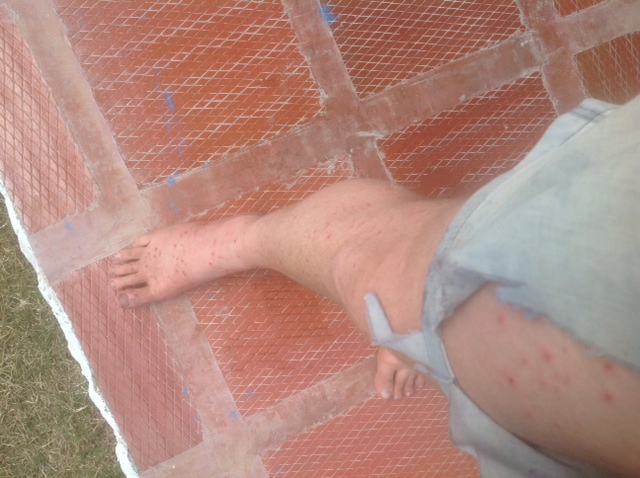
Here is a photo of someone after three days in the sierra without gumboots:

photo (3)

it might be hard to tell, but this persons legs are riddled with sand flea and mosquito bites. they spent 2 nights and three days up there.. they slept on the ground in a Kogi farm, instead of the recommended hammock, and due to the heat kept pulling out of their sleeping bag which was rated for two much heat.. most of these bites started to itch, indicative of Sand Fleas, and took about two weeks to heal once the poison was out of them (it is a pleasant sort of itch, the blood aside). A Cortisone shot was refused, but this likely would have accelerated healing. One of the bites got infected, and then blew up after another incursion into the sierra above Guatapuri, just due to the pounding on the feet somehow perhaps creating bruising where the infection could grow.

photo (4)

the bite in question became something called cellulosis I believe, it swelled up like a golf ball, then burst spontaneously while the individual was bed resting:

photo (5)

it was like a volcano of dark brown fluid, indicative of a blood infection. Eventually the scab was checked for something called Leismaniasis, a disease that enters through skin infection, but came up negative, but Staphylococus, also known as flesh eating disease, was present, and was eventually treated with doxycycline.

With more care this is all easily avoidable, but it points out the issues of especially sand fleas, kissing bugs and mosquitos, which are in many areas of the Sierra, from the beaches at sunset thru sunrise, to the newly cleared areas, to even Kogi and Arawaku homes. I never understood two things until now.. why South American natives often clear everything around heir homes down to dirt (I figured they just didn´t like putting effort in to landscaping, Mexican crews charge a lot to get here!) and why new Third World Homes are always made of Cement.. it turns out the thatch roofed homes we are so intrigued by end up being havens for disease carrying insect. Chagas in particular is carried by something called the Kissing Bug which bites people’s exposed faces at night. The classic photo of Chagas is this kid with a swollen lump over one eye.

389px-Chagoma

Alright, I will now link to real info if you are still curious on the possibilities:

http://en.wikipedia.org/wiki/Chagas_disease

So there are multiple strains of Chagas, and more than one vector, basically, different bugs carry it in different places.. but it is generally the Kissing bug, the Pito they call it in colombia. It is nocturnal like I said. The disease comes from it defecating near the bite. Pretty stuff. Wikipedia obviously describes this better than me.

Alright, Leishmaniasis. I recently met a guy who had been in the army in Amazonas for three years, on this beautiful river, and he got it once.

http://en.wikipedia.org/wiki/Leishmaniasis

LEishmaniasis comes from the Sand Fly, which is one of the banes here, and I guess it lays its eggs in you, so if it has bitten you, sometimes you will see a little black bump in the middle of the scrape.

Can´t forget ol malaria.. he gets all the attention, incurable and all.

http://en.wikipedia.org/wiki/Malaria

Categories
Uncategorized

The Climbing Possibilities of Colombia Today

Bogatenos are the most likely to be involved in climbing and mountaineering in Colombia due to what I will describe as facts associated with Sociology, not solely wealth, but Bogota is the Intellectual city. There is money in Medellin and in pockets around the country, but the type of counter-culture it takes to create a kind of climbing fervor seems to exist only in Bogota. To put it in perspective, people want their kids, including Botero when he was a kid, to be bullfighters in Medellin. Obviously Sir Edmund Hillary wasn’t exactly a counter-culture figure, he was just a dude who liked to climb, but in Colombia, a culture like this, both conservative and a bit risk averse, climbing is the kind of thing that comes from an upper class rebellious youth to some degree.
All the developed climbing is from what I can tell north from Bogota to Bucaramanga along the Cordillera Oriental, the Eastern Mountain Range that hovers over the Amazon. Bucaramanga is kind of the capital of all this, with an active paragliding scene there as well from what I can tell. There are also a set of snow-capped mountains in El Cocuy National Park within a few hours of there, unfortunately melting fast. Climbing Magazine profiled a scene in Suesca, about an hour north of Bogota it appears, which is alleged to be the best developed location in the country, with very hard sandstone.
climbing.com/route/ghosts-the-rock-gods-and-colombian-climbing/
this article also mentions an underground salt mine nearby with a Cathedral carved out of salt.. that’s pretty cool.

The Cordillera Central from what I have seen is stunningly beautiful, with waterfalls and rivers like one dreams of seeing, but it is mostly jungle and dirt,and well, perhaps there are lots of illegal activities going on in it’s hills. I have yet to see the Sierra Occidental except if you might describe the mountains west of Medellin as part, but they do look stunning, but again might not be climber country. To the South I know that there is a lot of FARC activity amongst the ranges closer to Cali, and as the ranges come together towards the Ecuadorian Border. As footnotes, there are places in the Amazon with exposed Limestone that look stunning, but I have no idea about security or climb-ability, and there is a small range of mountains in Sur de Bolivar that I glimpsed from the Magdalena, but this area is surely a no go zone, some hostages were taken just recently, as, to quote a boat mate, “That place makes some pretty high quality Coca!” and the FARC have conveniently chosen it as a good spot for the continuation of the people’s rebellion that COMINTERN even forgot about 23 years ago.
http://en.wikipedia.org/wiki/Serran%C3%ADa_de_San_Lucas
The up side is that they have kept it from becoming another of the vast cattle ranches that is Northern Colombia, and that are even creeping into the Sierra Nevada de Santa Marta.
Which brings us here.. There is plenty of climbing and mountaineering from what I can see in the Sierra, and if it was developed much, it has been years since anyone enjoyed it much, at high altitudes fortunately or unfortunately, but the weather can be crisp and dry even if the sun might bear down, but this brings us back to the subject of this blog.

Categories
East River Eastport Maine Hydrokinetic Power New Jersey New York Ocean Power Technology Oregon RITES Project River Power SPECTER Organization Tidal Power Verdant Power Wave Power

Hope Unda’ Da East Riva!? Yu serious!? Serious as a tidal rip…

When you think of NYC you actually do think of environmentalism, but it’s usually along the lines of efficiency and quality of life. With it’s progressive mayor for life, Michael Bloomberg (now replaced, but the impact of his 12 years of policies likely won’t be undone by new Mayor DeBlasio), party notwithstanding, making dictates that are in the public interest, no matter how annoying they might have become, and it’s quite settled limo liberal upper class, and just it’s car free big building lifestyle, New Yorkers actually have perhaps the lowest carbon footprints in the United States, about 9 tons a piece I once read, compared to 20 for the rest of the country on average. The way New Yorkers inevitably share walls with each other during hot days and cold winter nights serves in part to make them more efficient, it’s like a big Adobe Pueblo with a great public transportation system, and shows, did I mention the shows!
http://en.wikipedia.org/wiki/Ancient_Pueblo_Peoples
(if the above link were perfect, i would have thrown in a subway car with photoshop, but I have forgotten how!)
But when you think of the big projects, the big ambitious stuff, you inevitably think of the vast American West, of the West Coast, places where Pick Up Truck Engineers mix with Cash Drunk Entrepreneurs and dream up harebrained schemes that somehow eventually work… these are open land projects, heartland ambitions.. people who will deny global warming until some tornado or freak weather event finally convinces them otherwise, so they throw on their Carhardts and come up with a solution on AutoCad while the kid is asleep and the horses have been fed… but never count out the romanticism of America’s most ambitious city (sorry Chicago, you do go big, but you rarely go refined!) because sure enough, despite New York’s, and especially Manhattan’s distinctly white collar reputation, da workin’ stiffs who risk a bit of slight at a cocktail party for admitting they do something tangible, create a concrete and not just intellectual product, have been up to something on the bottom of the East River.. the East Frikin’ River.. can you believe dat! Get da F%$ outtta here! Right next da FDR.. drive by dere every day! up from da UN, like 50 sometin’! Across from dat frinkin’ Roosevelt Island.. who da hell lives dere? And dat’s like the most polluted river in the world eva! (Translation: I am having a hard time believing you. it’s in the East River alongside the Franklin Delano Roosevelt Drive. I know the Location well. It’s north of the United Nations. Approximately in the area of the streets numbered 50 to 59. The location is alongside Roosevelt Island, whose residents I have never met and have always been a mystery to me. It’s Ironic because the river is alleged by New York conventional wisdom to be highly polluted.)
http://verdantpower.com/what-initiative/
http://www.bloomberg.com/news/2012-01-23/tidal-energy-project-in-new-york-s-east-river-wins-license.html

now as I research, it turns out that these were perhaps the first Tidal Turbines in operation, and the first US federal permit to install such a device (hey, it’s New York, always regulations!) as they move to phase 5 after struggling with the fortunate problem of torn off blades because there was MORE power than they originally expected,
http://www.nytimes.com/2007/08/13/nyregion/13power.html?pagewanted=all
(note that that article is from 2007, and they have been moving ahead since..)
but that there is such a proliferation of tidal energy, going back to the first modern commercial project in France in the 60’s, that this one gets last mention in Wikipedia:
http://en.wikipedia.org/wiki/Tidal_power
http://www.theecologist.org/News/news_analysis/678082/how_france_eclipsed_the_uk_with_brittany_tidal_success_story.html
but the turbines made by Verdant are perhaps among the least intrusive, as some of these projects actually require damning an entire estuary… but it also turns out, ambitious though New Yorkers may be, that it isn’t the first operation to go on grid in the states.. leave that to a company from Florida and a location in Maine:
look at the back, above the crowd to see the interesting helical design chosen there…
http://www.bostonglobe.com/business/2012/07/24/nation-first-tidal-energy-project-dedicated-eastport-maine/y477E7mCnIpfBPod5hfKXL/story.html
http://www.nytimes.com/2012/08/10/us/turbine-to-harness-the-tides-to-generate-power.html?_r=0
And they are not alone.. Projects in Canada and Europe are installed, producing, and moving ahead with innovation, and there is even a wave power project moving in off the coast of Oregon..
http://www.nytimes.com/2012/09/04/us/project-aims-to-harness-wave-energy-off-the-oregon-coast.html
http://www.oceanpowertechnologies.com/reedsport.html
http://www.oceanpowertechnologies.com/coos.html
this promises to be 100 MW.. that’s huge, and in a funny way, it’s kind of a de-facto marine reserve as well because you can’t drift net or bottom trawl if they are close enough together without a lot of difficulty either..
turns out that despite my having heard of the Oregon projects first, these guys are actually all over the world now with these SPECTER Organization looking things (5 minutes to world destruction, all personnel clear the area…), and the first one was in none udda den Atlantic City! If only Don Rickles had lived long enough to have his microphone be tidal powered…
http://www.oceanpowertechnologies.com/projects.html
http://www.oceanpowertechnologies.com/ac.html
Respect, New York metro area.. respect.. thank’s for pulling your weight.. no wonder there is always a guy from Brooklyn in every WWII movie.. New Yorkers do get excited in a crisis.

It’s been a debate between myself and a friend.. are we @#$%ed, and should we all head to the hills and start canning rutabagas and hoarding ammo, or will technology solve this problem like it has solved so many others, perhaps both, perhaps neither, but this is promising…

Categories
Uncategorized

Land Mines in the Sierra?

Categories
CFC's Global Warming improving NOAA Ozone Hole Ozone Watch status steady

Remember The Ol’ Hole in the Ozone Layer? How’s He Doin’!?

Steady and Improving..Doctor…
Remember the Ozone Hole.. remember how scary it was.. like that guy in high school who seemed so intimidating.. what’s he up to now, now that you have gotten your life together and faced some significantly bigger challenges, kind of can’t wait to see him at Reunion to stare him down, ha.. Ozone Hole.. what a prick he was!

Well, I’m proud to report he is kind of what you expected.. he’s gone nowhere…sure he got worse for a while, but now he’s kind of stuck.. it’s the equivalent of him staying at home and becoming an overly friendly rental car salesman now with a bit of a paunch and a widows peak.. he drinks when he feels guilty about high school, and just smiles a lot and tries to make jokes when you talk to him…he’s gone from being Freddie Kruger to that Pixar Monster in the imagination of your soul compared to the new challenges you are facing with global warming and it’s 3 horsemen buddies, Glacial Melt, Ocean Acidification, and interruptions to the Food Supply when the world’s population is peaking.. you’ll be eating him for Soylent Green in a few years..
So really, what’s he up to, in the 80’s and 90’s he was such a big deal, back when only egg heads and college professors were squawking about global warming?
Seriously!?
He peaked in 2006, later than you might have imagined.. you know, the equivalent of a bully playing some college ball, or moving to a city that is actually desirable and dating the hottest girl in your high school,
http://ozonewatch.gsfc.nasa.gov/Scripts/big_image.php?date=2006-09-24&hem=S

but for 7 years, nothing, flat, gonzo…
http://www.nasa.gov/home/hqnews/2012/oct/HQ_12-371_2012_Ozone_Hole.html
http://idealab.talkingpointsmemo.com/2012/10/ozone-layer-hole-smallest-its-been-in-20-years.php
it’s how the mechanisms of the chemistry worked that the CFC’s had to work themselves through the atmosphere, but we seem to have successfully halted the production of CFC’s, so as refrigerators die say in a place like India, are thrown into a landfill or recycled, and the CFC’s leak out and make their way to the South Pole through the normal movements of the atmosphere,where in the extreme colds of the southern polar spring, with sunlight however increasing, they combine with hundreds of ozone molecules to tear them from the sky… but the rate of destruction has not increased, the hole never got bigger, our bully seems to have stopped getting meaner and bigger, and enviously more successful. And one thing that’s true, we are making more ozone to replace it one old car at a time, and I wonder, not knowing enough about the mechanisms,if this might not be working in our favor as well..as we age and start to take the position of the bully, learn perspective taking, we ask ourselves “hmm, I wonder what his home life was like?” and things like that, I start to wonder why it never was a factor in the North Pole. was it the lack of altitude of any land mass below it? I have no idea, but obviously we have moved on to bigger and worse things, but we do keep an eye on it.. that satellite I guess hangs out up there watching, and some office at NOAA or the UN keeps adding up the numbers, like that other guy you went to high school with, that ally, who never quite left town, but does cool stuff, owns a bar and hosts parties, he keeps you up on it, satisfies your sceidenfreund by helping you make fun of the bully by telling you how he gets drunk now and complains about how his life has gone nowhere for 7 years.. and you can’t help but see it as, well, hopeful..
Today’s Hole Size:
http://ozonewatch.gsfc.nasa.gov/
Wikipedia, of course, has all the answers..luckily it has no sense of humor, otherwise I would just post a damn wikipedia link, but it says some interesting things.. were it not for the Montreal Protocols, which banned CFC’s in 1987 (celebrated, no doubt, by the celebration of another type of hole on St.Catherines Street..), the whole earth would have been as depleted as the hotle above Antractica by 2060, but they are now calling for a statisticallysignificant recovery by 2024, and pre 1980 levels, where they set the bar, by 2068 worldwide.. the Hole in the South Pole During spring.. gone around 2050…
http://en.wikipedia.org/wiki/Ozone_depletion
Whew..glad that’s over with.. now we have nothing to worry about atmospherically.. wait.. what!?
http://en.wikipedia.org/wiki/Ozone_depletion

Categories
Uncategorized

The Sierra Nevada de Santa Marta in Film

This is no IMDB, I am just poking around on YouTube, and found a few things. things seem to fall into three categories. Mamo worship, a kind of new age interest in the Natives of the Sierra, Shots from Airplanes or Airplane cockpits, and tourist stuff from Minca and the Ciudad Perdido..
Actually a friend of mine, after I told him I was poking around here, sent me this, since he was actually hanging out with a guy in Mexico at the time who happened to be one of the few ‘Civilizados’ who live in the sierra.. it was a neat coincidence.. the guy lived above Palomino, and was just taking a vacation to explore Mexico sometime around New Years of 2013. This guy who rented from my buddy Ozzy in Mexico for a few weeks, just happened to come by, actually knew some of the civilizados I met on my first excursion, who do live quite remotely, a days walk from the nearest drivable road, on the north flanks of the Sierra..
all this serendipity shouldn’t necessarily act as an endorsement of some of the cheesyness of this video, it’s a bit 80’s new age, actually, 1992 it turns out, but it’ the sierra, and this seems to be a good insight into some Kogi culture, since they seem to have been able to find a competent translator:
http://www.youtube.com/watch?v=U2tIVwGwiDc

To show how I kind of end up scraping the bottom of the Barrel pretty quickly when it comes to good documentation of the Sierra, here is an Italian film trailer with some good footage:

here’ some other stuff off of YouTube.. perhaps a bit like me, this guy could use some fact checking, but his comments are somewhat interesting, as are his blue (green!?) beard and zeal!

He actually references the above movie, which he says was made by a BBC director..

Here are two good examples of the genre of footage from planes transiting the Sierra, kind of proof that everyone is a bit surprised to see it there, and it puts in relief the idea that no one really has filmed from above treeline that I can tell:


One of them shows what appears to be the 5 blue lakes, and also demonstrates that the high peaks appear to be quite inhospitable as well as perhaps not of the best rock quality.
I did, by the way, do an IMDB search, just out of guilt for writing that I hadn’t when it is just a few key strokes away, and it turns out the Sierra Nevada de Santa Marta has two somewhat obscure references.. to use a concept from the book the Moviegoer, not many places are left un-certified by the rapacious appetite of the film industry, but unlike nearby Cartagena, it wasn’t exactly in a fantastic blockbuster like Romancing the Stone (c’mon, you loved that movie.. Turner and Douglas, what more could you ask for?!)
http://www.imdb.com/search/title?locations=Sierra%20Nevada%20de%20Santa%20Marta,%20Magdalena,%20Colombia
Here’s some short film that IMDB didn’t directly connect to the Sierra:
http://www.imdb.com/title/tt2201808/