Categories
Carl and Lewis Stokes Cleanup Cuyahoga River Dam Removal fish free flowing John Kasich randy newman Restoration Symbol

From Flames to Free: The Symbolic Restoration of the Mighty Cuyahoga River

Soundtrack: Burn On by Randy Newman

There must be a thousand rivers like the Cuyahoga in America, and ten thousand around the world.. it runs only 84 miles, only drops 500 feet, drains only 809 miles of America’s 3 million.  On top of that it drains in the ignominious City of Cleveland, which Eddie Murphy implied many years ago in Beverly Hills Cop was not much of a place for classy execution, well before I ever got to see it with my own eyes and give it a personal judgment of coming back but hardly Paris.  Never been off the highway in Akron, but they did produce LeBron. The River Cuyahoga might be able to flow a half million CFM into Lake Erie, and it’s got a reputation for some pretty scenery and ledges in it’s upper reaches, so impressive they were made a National Park, but it’s hardly a world class waterway. What made if famous beyond Ohio was this:

This is a picture of the Cuyahoga someplace I am pretty sure in Cleveland, on fire in 1952. It caught on fire some 13 times between 1868 and 1969 it is reported, about every 7 years it sounds like, and who knows how many minor fires were snuffed out that didn’t make the broadsheets.

The Cuyahoga wasn’t famous for this:

it was famous for this:

and this:
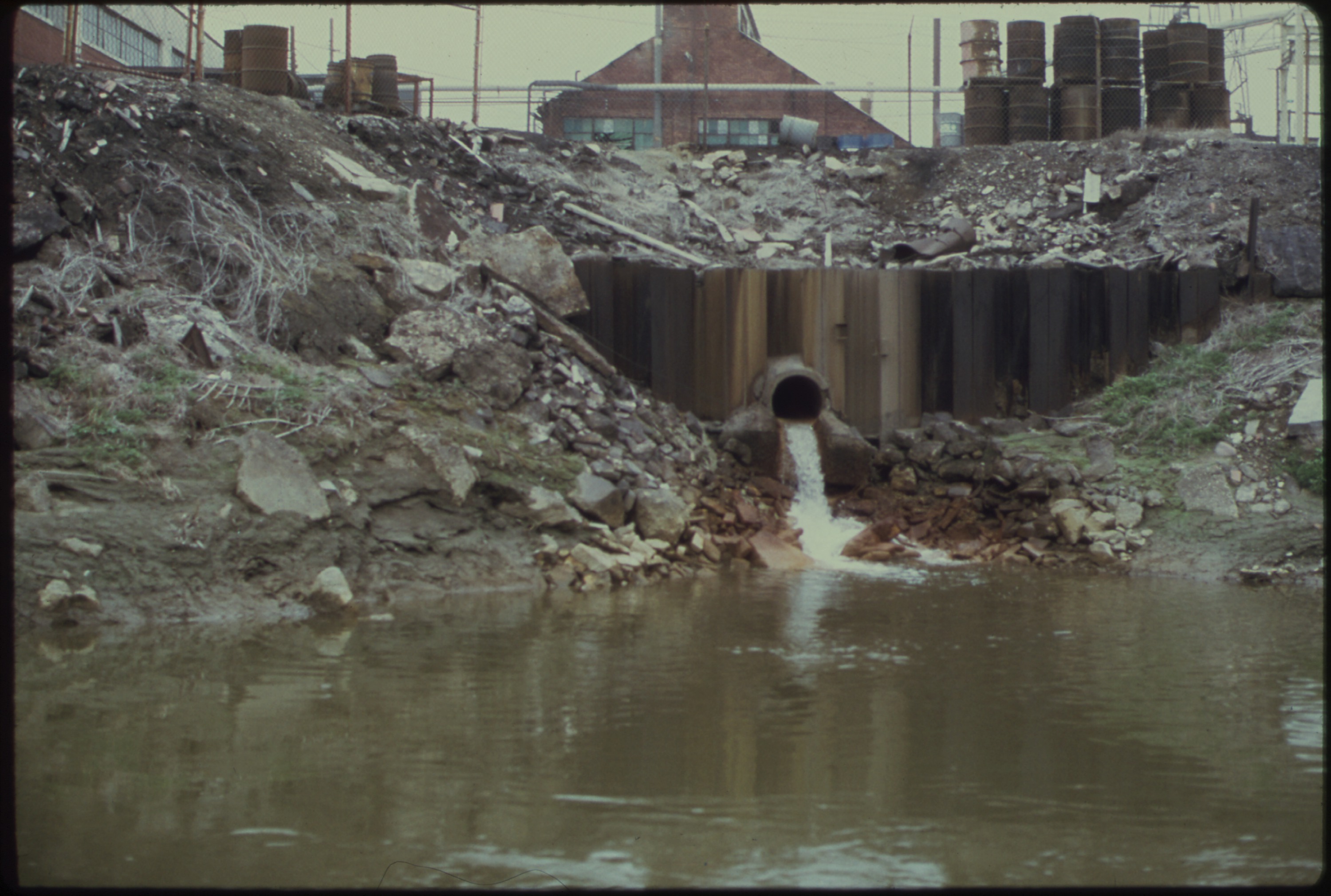
Image result for cuyahoga river environmental problems
it was biologically dead from Akron to Cleveland, some 50 river miles, toxic and anaerobic, unable to support life, and more a gutter than a river as it ran between these two famous industrial cities, dredged for navigation, dammed some 9 times a sluice for pollution going out and raw materials coming in, looking like this:

but even that didn’t make it famous, that wasn’t an uncommon sight in America either back then, as rivers from the Delaware, to the Hood Canal, to the LA River became sad reflections of themselves, sooty industrial monstrosities.. that was about every urban river in America and a few rural ones to boot in places like coal country. What made it special was catching on fire some 13 times ( how the F@#$ does water catch on fire!?), and finally that picture above of the fire making it into Time Magazine in 1969 ( August 1, 1969 America’s Sewage System and the Price of Optimism), right when America’s optimism for the moon landing made it particularly embarrassing how shabby we had let things become. We had perspective now, we had photographed the world from above, and to quote the famous adage, if we can out a man on the moon, why the heck can’t we fix a problem like this!

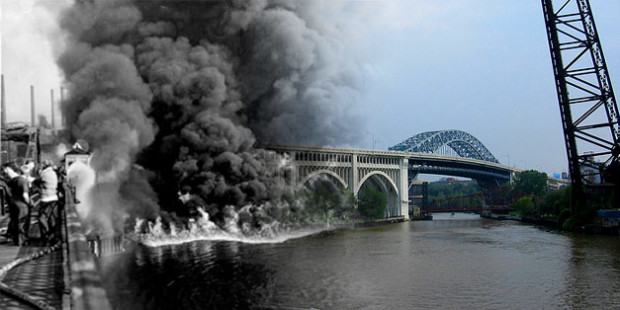
The fire and the Time article some 48 years ago have been commemorated many times, having helped launch Earth Day and mass adaptation of environmental values that were channeled by Richard Nixon into some very important pieces of legislation including the Clean Water Act..  that was the nadir, nationally even, and now things are perfect nationwide. Done and done, right?
Well, not really, because the Clean Water Act focuses on pollution, and pollution was only the most obvious problem back then.. frikin’ river catches on fire, and people got some explainin’ to do, right Tommy Boy, but think about it, pollution is only part of the problem, but the only part the Clean Water Act had a real mission to solve in 1972 when it passed, most publicly as a result of this event.
Sure the Cuyahoga still has pollution issues, it runs through two major cities Akron and Cleveland.  Impervious surfaces, sewage, automotive and industrial run off are just a few to mention almost anyplace people live near water, and where you find water, you almost always find man. While we have controlled the old boogie men of industrial waste and pollution, we came up with more nuanced bad guys like the aforementioned, contamination not just from major big bad factories, which they call major point source pollution, but leaky car oil pans and radiators and fecal matter from walked pets are the potent but somehow less menacing and horrifying new bad guys; fix a big problem and move onto the next one down the list, and that is what makes what is happening on the Cuyahoga so impressive, because they are moving down the list well past where anyone might expect for a river that had so many problems, nor resting on their laurels. They have blown past storm water runoff and are now taking on derelict dams! Them kids at Patagonia just told the Starbucks set that dam’s were bad three years ago, but them Trump voting hard heads in Ohio have been ripping out dam’s for more than ten!
What am I talking about?
 We’ve come a long way baby.. enter again one of my favorite new themes, dam removal, stage right.
Why I became curious to research this is I was poking around looking at data from American Rivers for a previous post on Dam Removal going Prime Time, and I kept noticing a particular river on the lists of the 60 or so dam’s removed every year. it wasn’t high profile projects like the Klamath or the Penobscott, where Endangered Species Act and blue state political inertia is making things happen, it was a river in Ohio with a familiar name. For one river this small, no matter what the reputation or location, to have 5 dam’s removed or diverted in the last 15 years with at least one if not two more in planning might be a record, per river mile or by any measurement. To have this happen in the perennially environmentally distracted heartland is almost astounding. And the to such a iconic river. What was happening on the Cuyahoga? I had to ask myself.. a whole lot it seems, in the right direction after a whole lot of industrial might made it such a laughing stock.

Cuyahoga River Dam Status
Upriver to Downriver:

1. Lake Rockwell Dam  no plans.. upriver of Akron, and provides the city with it’s drinking water

2. Kent Dam   removed 2004  Kent
3. Munroe Falls Dam   Removed 2006

Cuyahoga Falls Dams:
4. LeFever  removed 2013
5. Sheraton Mill Dam 2013

6. Gorge Dam ( AKA First Energy) removal 2019 ( waiting for funding)   Akron
7. Brecksville Dam  State moving to remove it in 2017 or 2018

multiple tributary dam’s have been removed as well.

What’s powerful about this from a narrative perspective is that there are large water falls behind the Gorge Dam, just yards behind it. If it is removed, they will be restored in some form!

If that dam is taken down, there will be something like 60 miles essentially wild flowing river running from Lake Rockwell Dam all the way down to Lake Erie.. this would be a huge benefit to the Lake, which is experiencing horrible algae blooms in part due to the increased water temperatures that come with stagnant waters.
State Government and the EPA have so much momentum to fix this river to a bar set high for water quality scores that they seem to be heading towards a wild restoration, which no one would have dreamed of so long ago when the river was dead and on fire less than 50 years ago. It’s like going from Quadruple Bypass to Marathons.. turning Calcutta into Copenhagen ( if that’s progress…). Making William Hung actually sing and dance like Ricky Martin, it’s almost seems implausible. If you figure on the 30-80,000 dams nationwide that the greenies keep trumpeting about, there are very few free running stretches of anything, especially this close to population sources, industry, and agriculture and east of the Mississippi & Rockies, all situations that demanded river control in the old school tradition.

Mayor Carl and Cong.Lewis Stokes of Cleveland

What also impresses is that you have a state with a politically adept and not foolhardy Republican There might be a thread of inevitable progress here. Ohio is pretty far east.. it’s a place where people have made mistakes and had time to move away from them.. while the west stumbles into the reinvention of the wheel, perhaps Ohio is joining the east coast in acts of societal maturity, watching aging infrastructure through it’s decrepitness impose something different, and a place so long from it’s wild roots somehow recognizing intuitively what might change it’s moribund economic state, a return to a pre-industrial environmental state. While so may rivers in America languish without momentum fighting runoff, dam’s, diversion, and neglect, the Cuyahoga seems to be benefiting from how bad it got, but in some ways it isn’t.. It is benefiting from how bad it got that it might have contributed to laws and programs that fix the problem, but they weren’t intended for it. The US and Ohio might recognize the symbolic significance of this river but they don’t necessarily account for it’s momentum. If you talk to those involved as I was able to do a few busy months ago, they will tell you that the laws and efforts that are setting the Cuyahoga free as as much from the regular band of state employees and local activists as from any celebration. It all supposedly started with a pair of power brothers, the mayor of Cleveland and his brother a long serving US congressman Carl and Louis Stokes. When Carl became mayor a year before the ’69 fire he was on fire himself and talented to do what the city needed to recover from strife and decay brought along by so many things from pollution to racial issues to urban decay and steelbelt economic woes. He saw the river as a worthy way to turn the town around and his emphasis flowed not only up river but around the country. The Cuyahoga as the symbol of pollution became the focus of improvement, and guys like his brother pushed those ideas in Washington as well. A framework built locally but to the benefit of all.

Gov.John Kasich signing a bill to give ODNR more power in Lake Erie 

Governor in John Kasich who hasn’t tried to strip or hamstring these efforts as happens out west, where water going anywhere but into a dam or onto a plant is argued as wasted by a cranky contingent of industrialists. While Ohio DNR might have cash flow issues like any well meaning state bureaucracy is bound to, it’s still doing it’s job, it hasn’t been politicized or stripped bare so much that Dam Removal projects couldn’t happen on his watch. Fish don’t know party, and clean water doesn’t only impact one side or the other, and it’s neat to see the wheels of government doing what they are supposed to in such a famously contested state. In the traditional narrative so espoused right now by partisans, African American Politicians aren’t known for prioritizing the environment no more than Republican Governors are. It appears that a cleaner Cuyahoga has become a shared value.
And don’t forget the activists. Their work progresses, to the point of celebration, and is now moving through hurdles to an almost pristine state that barely any other river this size could imagine benefiting from east of the Mississippi, let alone west of it.
This river, diminutive though it may be, runs through so many populations, rural and urban, left and right, green and rust colored, that it’s great to see it as a uniting force in a better life for all than a source of contention.. it’s about two visions of America experimented with and now redeemed.. industry exchanged for beauty as time and circumstances allow. From a fiery symbol of what was broken to now almost a model of the pristine. Something is working here other than the steel mill.
What can I say.. Cleveland ( and Kent, and Akron) Rocks!

Categories
Dam Nation Dam Removal growing movement how many? increasing Numbers river restoration trend

Dam Removal Goes Prime Time

First, it was just a trickle…
This post is ripe for water metaphors, but I’m flowing off course.
Something is happening to America’s Rivers, and for the first time in a long time, it’s good. Positive changes are starting to flow freely over the entire Continental US (sorry, I can’t resist), and it really is a deluge. Take a look at these statistics released by a non Profit organization out of Washington DC called American Rivers, which is the national environmental advocacy group for all the river’s and streams of the US.

The Baseline:
There are 79,000 dam’s registered with the Army Corps of Engineers, who are the major government flood control agency, and are staffed by a combination of civilians and members of the US Army’s Combat Engineers.
In the West, an additional agency called the US Bureau of Reclamation has the job of damning ( did I leave an in there.. sorry!) water to produce electricty and provide water for a few cities, but mostly for agriculture and powe rcreation. In the case of the colorado river, about 20% of diverted water goes to cities and 80% goes to agriculture, and the same dams do create enough electricity to power millions of homes (1mw tends to power about 1000 homes is the standard way to think about it).

Here is a very important fact:
Due to these two agencies and many other industries, from old mill’s to electricity companies, being busy as beavers, 600,000 mi (970,000 km) of river, or about 17% of river length in the nation, is not flowing freely due to dam’s. Since there aren’t many natural lakes south of the line of glaciation from the last ice age in the US, which is climate and altitude dependent, but tends to run at about 40 north, somewhere between Interstate 80 and 70, so that any time you see a lake south of there, and possibly even north of there that isn’t a swamp or a beaver dam, it’s got a dam made by mankind in the last 200 years holding it back.

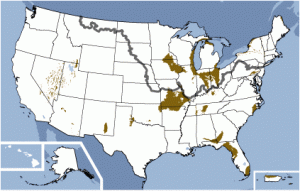
limit of Wisconsonian Ice Age  sheet glaciation with Carbononiferous rocks in brown
lakes are unlikely to occur naturally south of this boundary

There are about 8100 dam’s considered Major Dam’s across the US:
The National Inventory of Dams defines a major dam as being 50 feet (15 m) tall with a storage capacity of at least 5,000 acre feet (6,200,000 m3), or of any height with a storage capacity of 25,000 acre feet (31,000,000 m3)

Dam removal’s by year according to American Rivers of all sizes:

1999       20
2000       28
2001       23
2002       44
2003       34
2004       37
2005       34
2006       33
2007       54
2008       64
2009       50
2010       60
2011       50
2012       63
2013       51
2014       78
2015       62
2016       72
2017       86
2018       82

So some quick pro’s and cons:

What are Dam’s good for?
Flood Control, although it has to be managed right. When it isn’t managed right, you flood half of Nashville as happened a few years back. And we aren’t supposed to need flood control because it’s illegal to build in flood planes. we only need flood control because of how we screw up water movement in the first place usually. it’s often an excuse for the two things below.
Electricity Production
Creation of Recreational Lakes
Water Diversion for irrigation and to help cities grow that don’t have sufficient local groundwater

What Are Dam’s Bad for?
The Ecology.
The Temperature of the water and whatever it runs into after leaving the dam. They turn cold running rivers into hot water baths where increased surface area allows the sun to heat up and often evaporate water.
Migratory animals that used to use watercourses as migration corridors.
Andromedous fish that go to the sea from rivers, and return from the sea to spawn, like salmon.
Fish in general that need to not be arbitrarily separated from each other for genetic diversity.
Water Storage, since they can lead to a lot of evaporation on hot days, which can add up in places like Lake Mead.
Trapping Sediment.. they trap sediment that should be flushing down into the river below, and then onto shorelines to rebuild beaches as they roll with the tides and currents.
Throwing off the balance of the earth! I can’t make this up.. when you trap this much water at levels higher than sea level, you literally throw off the centrifugal force of the world.. like throwing your arms out when you spin around, you notice a little big of movement in or out changes a lot. It might be why the US Naval Observatory had to reset the Atomic clock by a blip recently.. the earth is literally spinning a little slower now.

Why remove dams?
If they fail, they can kill people who don’t expect a flood, and destroy a lot of property.
They destroy fish migrations so profoundly that they push animals to local extinction, and sometimes total extinction if a species is fairly localized, and then screw up everything else that expected them to be present, from predators like eagles and bears to bacteria and insects, who loose their support in the food web.
They heat up water so much it can screw up whatever they drain into. The Long Island sound is getting so warm comparatively that it’s getting dead zones, largely due to the change in water temperature due to dam’s on it’s tributaries, that collect sunlight and heat, throwing off centuries of temperature balance, and crating unwanted algea, red tide, and plankton blooms.
They collect so much silt they deprive lower rivers of sediment until they hit bedrock and become like sluices. And they don’t provide sediment needed for beach rebuilding.

So enough public service messages.. this blog is about hope, where is the turkey, where is the good news?

Well, I have been tracking this dam thing for a while, and it seems to keep getting bigger. It started back east, since you can’t mess too much with the Bureau of Reclamation, well, you couldn’t until a group of filmmakers decided to recently, but I’ll get to that.
The Army Corps of Engineers, it’s fair to say, is a little more thoughtful on these matters, and so are eastern environmentalists, and they can get the upper hand because they have smaller rivers and larger numbers.. water is more plentiful in the east, so the fight is often less contentious. Dam’s became a big deal about 15 years ago it feels like. States started to inventory them to make sure they were safe.. we had been building them for so long, especially in the heart of the American Industrial Revolution, New England and the north east, where men like Eli Whitney harnessed rivers for industry the way flour and saw mill owners had been for centuries. Mill ponds and dam’s are thought to be as much a part of life in the north east as Moxie Root Beer and local corn, but they are definitely a post Columbian development. In small numbers they weren’t necessarily the worst thing in the world. They ground our flour, sawed our timber, and gave us a place to swim on hot summer days. But then Eli invented his cotton gin, and we started to come up with hundreds of other things to make, and the North East with it’s rivers was the place, and then another North Easterner, Edison, started to electrify us, and it became pretty obvious that one of the easier ways to do this was to pour some cement and throw in a turbine. You didn’t have to do the work within mechanical distance. You could lay wired and do it where the people were, or where the raw materials were.. Dam’s proliferated all over the North East. But there was a cost, there always is. Salmon went the way of the Dodo bird.. there used to be Successful Salmon runs from the Canadian Border with Maine all the way to the Housitonic River near New York City it’s believed.At one point recently there was only one river with anything approaching a healthy salmon run south of the Canadian border, and from what I heard, it was the closest river to it.
We passed the Endangered Species Act (ESA) way back in 1973, but it was some 40 years after the last major tranche of north eastern Dam Building, back in the 30’s. rural electrification would bring Dam Building to places like the Tennessee Valley and Texas all the way into the 70’s, but there wasn’t much water left to dam in old New England, which tends to be the first for a lot of things in America, given that it’s got more post Colombian history than almost anywhere else, and is our most populated region.

Atlantic Salmon  not too charismatic, I mean, look at that awkward humble look, but compared to their buddies Shad and Alewife, and good old Eel, they are rock stars!

It took a long time for the ESA to get around to fish.  First off, they aren’t too charismatic.. every tried to talk to a salmon? I have.. they aren’t too riveting, see the humble look above, although they can be delicious. There were a lot of species in deep deep trouble, and Atlantic Salmon weren’t necessarily going to go extinct, since they have healthy runs all the way into Labrador, and in places like Iceland, Norway and Scotland, but we eventually got around to treating locally extinct as almost as important as extinct. And don’t forget that as part of a food web they affect other things. As we try to recover the North Atlantic Right Whale, it shares the sea with the Atlantic Salmon.. while it can be complex, it’s assumed that healthy runs of salmon are good for the Whales, since perhaps what the salmon eats gets munched up into fish doo that feeds the kinds of krill and plankton that the Whales eat.. while it can be more complex than this, as yes, animals do compete.. in this case it feels pretty safe to say that healthy salmon populations help make healthy whale populations.
Anyhow, the salmon became the rallying cry for starting to drop all these old industrial dams in all sorts of forgotten places on river after river, starting in Maine. While the salmon was the charismatic door opener, other species like the alewife and shad and even freshwater eels. think of them as the not so cool kids that get to finally go to cool parties because of their cool friend the Salmon, who literally get’s to knock down the door.
As we move down the coast, there is a state that people consider rural, but to visit it is to know that while it has many small towns, they weren’t usually farming towns.. Pennsylvania. Those small towns tended to be small industrial towns due to how many steep rivers there are in Pennsylvania. According to American Rivers, PA has led the dam removal list for 13 years!
In West Virginia and other parts of Appalachia, Dam Removal is tied up with Coal mining issues.. Dam failure is a big deal there ever since the deadly Buffalo Creek Dam Failure in ’72 and The Inez Coal Tailings Dam Failure more recently in 2000 in Kentucky screwed up hundreds of miles of stream and river.
Anyhow, why write about this now? Well, first off, I do want to promote this activity.. as much as I like the sound of water rushing over an old dam, they kind of represent a bad metaphor to me. Water is need, it’s the most important of elements on this earth to us, and damned rivers are like denied human need. They are the natural equivalent of corruption or repression.. they just bother me.. I like my wants and needs to be satisfied freely, not controlled by some engineer. it’s a funny way to think about it, but sadly it’s how I think about it, but back to some different Why’s.
While this is a local issue back east,  where devolution in government is a tradition in itself, it’s become a national issue out west, where like I said, it’s a lot more contentious, as water is a lot more scarce, and over-promised.
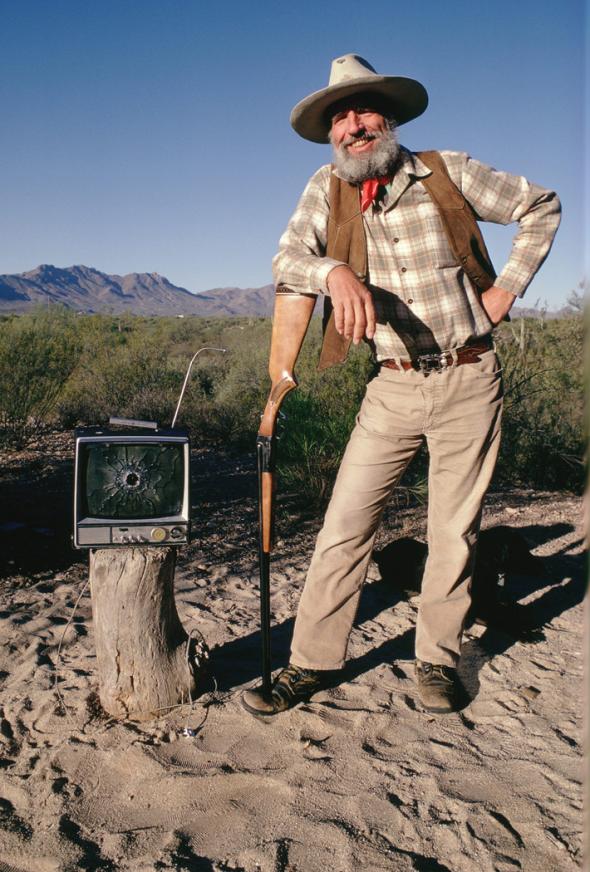
A few major things have been going on. After a lifetime of busy as a beaver activity by the Bureau of Reclamation, it’s finally starting to loose it’s iron grip over the west. Like a Dam falling apart, a trickle is a weakness that could very soon be a deluge. The trickle started years ago when a somewhat liberal Secretary of Interior by the name of Bruce Babbit decided to do something about how there was too little fresh sediment getting into the Grand Canyon due to dams upstream, most notably the Glenn Canyon Dam, and big artificial flood in 1996 to mimic spring floods that used to roll unbridled down the Colorado River, to rebuild gravel bars and deepen channels for the legendary rafting trips that follow in the course of John Wesley Powell. He literally opened the tap and in doing so loosened some of the iron clad doctrine of dam management as being wholly intentionally obtuse to environmental consequences. After that there was a long gap again, 15 years of so before a very public and successful series of dam removals in the North West. The first, in 2011, was a small tributary on the Colombia river, not too far from Portland and Hood River, called the Condit dam, seen above being released before it was completely deconstructed. The Bureau of Reclamation didn’t fight it that much because it didn’t have much to do with them. The Condit was a hydroelectric dam only, it didn’t have much use for shipping or agriculture. For those who saw this video however, this was a big dam deal. Why? Western environmentalists almost all have one thing in common. They almost all read a book called The Monkey Wrench Gang by an old part time National Park Service Ranger from Moab named Ed Abbey..

 it came out in the 70’s, and while I don’t advocate the activities fantasized about in the book (the first amendment guarantees your right to fantasize all you want!), the main premise of the book is about a group of 4 environmentalists in the Canyonlands of Utah who work to take down the Glenn Canyon Dam in Page, Arizona, that created the controversial Lake Powell and buried a whole world of red rock canyons. The Condit Dam being blown apart in HD color whet their appetite something fierce.
The Elwah River restoration was already in the works, and happened in the next two years, and it just fed the hunger.. it was a huuge success, opening a river that flows from the High Olympics of Washington State, removing two dams and restoring a watershed with a lot of research already into it that recovered so quickly that within a year scientists were proclaiming how stunned they were that it could change so quickly for the better.

Before even any of these dam’s came down, the mother of all dam removals so far was in the works, but they made a few tricky gambles that didn’t pay off. What I am talking about was the Klamath Basin Restoration Agreement. While all quite noble, and I’ve seen the Klamath, it’s beautiful, and it has a local Indian tribe that loves it and is willing to go to bat for it, but it was only going to cost about 500 million bucks to take down the dam’s, but they turned it into an extra 800 million dollar boondoggle, to make everyone happy at federal taxpayers expense, and the local congressman, a tea partier to be sure, decided to put the fix in until the agreement expired after 5 years. I want it to happen, badly, but I did dig into it a little bit, and I can’t blame ol’ congressman Craig Walden completely in these tight fiscal times. It turns out the Electric Company responsible is going to take down the dam’s anyways they recently admitted, so it’s kind of a win for all now.
But the real big news, and it’s not often that I cover something twice on this blog, as there are more stories than I can shake a stick at, but the big news came from a movie, a documentary to be sure, and I think this movie might be responsible for a big jump in numbers of dam removals in the next few years, if you remember the chart I put up way back when at the beginning of this here story from American Rivers. This movie was done by a bunch of enviro-sweet guys with the backing of none other than the master blacksmith himself, Yvon Chouinard..

Famous to most as the man who created the clothing line Patagonia, but famous to me and my buddies as the guy who started making America’s real rock climbing protection back in the 60’s with his rebel buddies at Camp 4. As much as I make fun of Pata-Gucci and it’s water repellent recycled plastic bottle broliciousness, I don’t know anyone who makes fun of the original gods of Camp 4. Chouinard made a ton of cash selling organic t’s and the original hardware, and he became a big environmentalist, and decided to bankroll the making of a documentary I already spoke about in my post on the arrival of documentaries as a real modern force in environmentalism. While it doesn’t quite have the global impact of Inconvenient Truth of Under the Dome, it’s the prettied documentary I have ever seen, and it stole the narrative of what this post was supposed to be so perfectly that I had to spend a year rewriting it ( I literally was going to the tell the same story, down to every dam he wrote about, and then one night I clicked watch on Netflix, on a cold night in Fairbanks, and there it was, pulled the rug right out from under me.) The film is called Damnation, and it might be the harbinger of a national movement to remove dam’s that don’t have a direct impact on global warming, since many dam’s cancel out their global warming benefits by being big heat sinks.

That end part get’s me.. pretty neat..great music. The dam they paint at the end there is the Matilija Dam near Santa Barbara Ca.. it’s not holding back a huge river, but it’s a useless dam to all but the local search and rescue team who use it for rappelling practice. it’s nothing compared to the big dam’s on the Colombia that the movie talks about, but now it symbolically huge. This movie started a big discussion, made it hip to be square enough to want to take down dams, and the public battle has now moved from the Klamath to a bigger public battle in Chouinard’s old back yard, the Hetch Hetchy Dam, one of the strangest of all, the water source for super liberal San Francisco, but in a National Park, Yosemite to be accurate, an anomaly if there ever was one. It’s getting big celeb attention now from the likes of Harrison Ford, and the lawsuits are drawing blood in state court. San Fran, always a hotbed of scientific creativity, is now researching aquifer storage as an alternative to piping their city water from a National Park about 200 miles away, through the San Joaquin Valley which obviously has it’s own water problems right now, and all the way to SF.
But the big question is what after Hetch Hetchy, which is a great cause and a fascinating media curiosity, but what will come next. Will the east just keep quietly getting rid of all the unnecessary dam’s till we are down to the 8100 or so we are actually using for electricity, which will help our streams, rivers and oceans immensely? I hope so, and maybe someday Atlantic salmon will be plentiful again like their pacific counterparts on the shores of the American portions of the Atlantic, but what happens out west is where the big fight will be. If you watch Damnation, it lays out all the Cadillac Desert conversation I am sparing you for the second time. But what if electricity and Salmon go head to head, global warming vs global species diversity.. what will happen, and where?
And not to limit this to the west.. there is a river in South Carolina I know about where the lack of sediment coming out of it is thought to be the reason why the fort that was the site of the attack by the 54th Massachusetts Infantry that was featured in the movie Glory, Fort Wagner, is now washed away and gone, it’s former site now 200 yards or more out to sea. While research shows it was gone by 1885 even, perhaps before that dam was finished or even conceived of, perhaps due to a local breakwater, the dam certainly isn’t helping matters on the South Carolina coast, and Morris Island keeps getting smaller. Trust me, I spend a day out there.. pretty place though.
But let’s stick to the good news.. the good news is that it’s happening. While I might mourn a few old mill dam’s that might get taken out and remove a little character from our land, nature is better for it, and so many of these things are anachronistic and even ugly. There are 70,000 dams we can remove before we rub up against global warming from what I can tell, and at about 60 per year it’s not going to be a major issue any time soon, although the Salmon advocates might make it one, which is to me a conversation worth having. For now what I want is wild running rivers.. I now realize I didn’t completely know what that was as a kid, since the biggest rivers near me spent a lot of their time in that 17% empressed lake zone, and not the 83% wild running zone. The local power company was happy to offer tours but I feel like no one was offering tours of the wild river when I was a kid, the one that rippled over rocks that you could hold onto and go for a ride from, slide down and be a fish in.. I had to figure that out for myself after I got sick of that bathtub feel swimming in the local reservoir, the stagnancy.. I think we all dream of an America that’s a bit less stagnant.
I dream of an America that takes down 80 or more dam’s next year.. can’t be too hard.. the tide has turned.. roll on mighty rivers, roll on..

Ed Abbey expressing his opinion