It’s the jungle.. There are some bad diseases about.. But in fact, the jungle ain’t the worst of it.. It’s the disturbed areas, where there is ranching and forest and food web fracturization that the bad shit really lives in…human contact is usually necessary for human diseases.. How do I know this.. because I am sitting in an emergency room right now, likely being diagnosed with leishmaniasis, in Medellin…it’s better than Chagas which was my first fear.. I don’t have swollen organs other than perhaps my colon, which in Latin American can come from any number of things, ask ol Montezuma.
So now writing from Cali, a few weeks later, I will fill in the distillation of my understanding of the disease threats in the Sierra Nevada de Santa Marta. this might be a bit horrifying, but there are problems everywhere.. this is not an impediment to a succesful climb, but it is interesting and perhaps helpful to know. As you have already figured out, in the immediate area, since mountains make their own weather, especially big ones like these, there are like 6 different biomes, from Humid Tropical (Wet Tropical would be the wettest, along the Pacific coast of Colombia, where they set world records for rainfall, but to the uninitiated Humid Tropical might as well be rainforest.. it is rainforest, it can just rain even more if you ever imagined it possible…) to arid to arctic. The variety of diseases possible seems fairly uniform, but I am no expert, but the things I know to exist are Chagas, possibly Malaria, and certainly contamination of water sources due to domestic animal and human waste. Chagas is present enough that studies have been done on the north side of the Sierra especially, charting infection by villages, and the numbers tend to be around 30%. I am not sure I can find the dang study again, but it was filled with graphics of the range.
The method of infection for most of the infections would be bug bites, or ingestion in the case of the gastrointestinal.
Here is a photo of someone after three days in the sierra without gumboots:
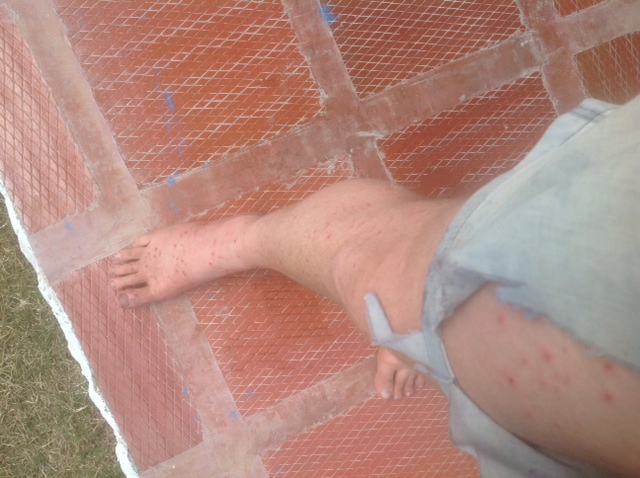
it might be hard to tell, but this persons legs are riddled with sand flea and mosquito bites. they spent 2 nights and three days up there.. they slept on the ground in a Kogi farm, instead of the recommended hammock, and due to the heat kept pulling out of their sleeping bag which was rated for two much heat.. most of these bites started to itch, indicative of Sand Fleas, and took about two weeks to heal once the poison was out of them (it is a pleasant sort of itch, the blood aside). A Cortisone shot was refused, but this likely would have accelerated healing. One of the bites got infected, and then blew up after another incursion into the sierra above Guatapuri, just due to the pounding on the feet somehow perhaps creating bruising where the infection could grow.
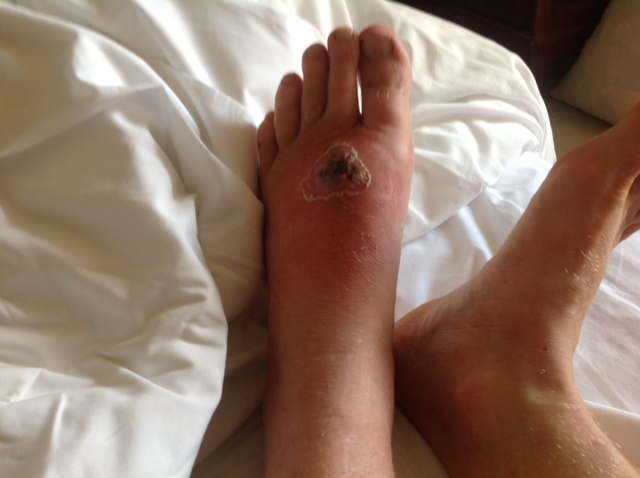
the bite in question became something called cellulosis I believe, it swelled up like a golf ball, then burst spontaneously while the individual was bed resting:
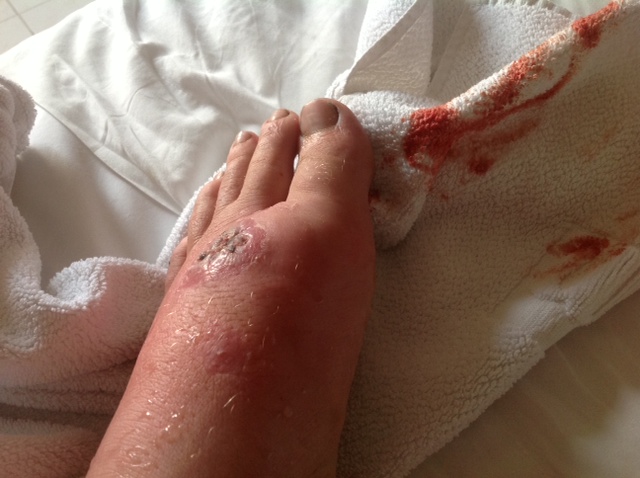
it was like a volcano of dark brown fluid, indicative of a blood infection. Eventually the scab was checked for something called Leismaniasis, a disease that enters through skin infection, but came up negative, but Staphylococus, also known as flesh eating disease, was present, and was eventually treated with doxycycline.
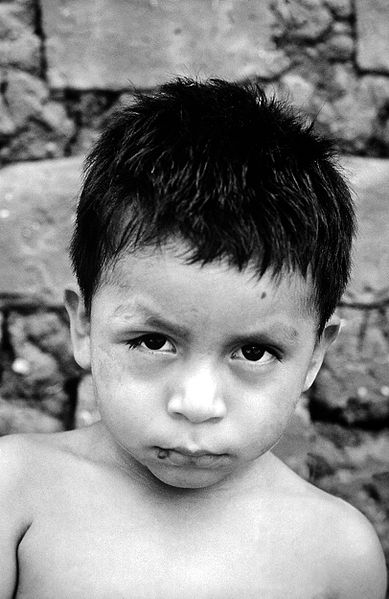
With more care this is all easily avoidable, but it points out the issues of especially sand fleas, kissing bugs and mosquitos, which are in many areas of the Sierra, from the beaches at sunset thru sunrise, to the newly cleared areas, to even Kogi and Arawaku homes. I never understood two things until now.. why South American natives often clear everything around heir homes down to dirt (I figured they just didn´t like putting effort in to landscaping, Mexican crews charge a lot to get here!) and why new Third World Homes are always made of Cement.. it turns out the thatch roofed homes we are so intrigued by end up being havens for disease carrying insect. Chagas in particular is carried by something called the Kissing Bug which bites people’s exposed faces at night. The classic photo of Chagas is this kid with a swollen lump over one eye.
Alright, I will now link to real info if you are still curious on the possibilities:
http://en.wikipedia.org/wiki/Chagas_disease
So there are multiple strains of Chagas, and more than one vector, basically, different bugs carry it in different places.. but it is generally the Kissing bug, the Pito they call it in colombia. It is nocturnal like I said. The disease comes from it defecating near the bite. Pretty stuff. Wikipedia obviously describes this better than me.
Alright, Leishmaniasis. I recently met a guy who had been in the army in Amazonas for three years, on this beautiful river, and he got it once.
http://en.wikipedia.org/wiki/Leishmaniasis
LEishmaniasis comes from the Sand Fly, which is one of the banes here, and I guess it lays its eggs in you, so if it has bitten you, sometimes you will see a little black bump in the middle of the scrape.
Can´t forget ol malaria.. he gets all the attention, incurable and all.
http://en.wikipedia.org/wiki/Malaria