Categories
Eastern North Carolina Primordial South Red Wolf Red Wolf Recovery SmokiesWolf Reintroduction Southern Wolf

Beasts of the Southern Wild: Recovery With The Last Remaining Southern Red Wolves

The South is no longer known for it’s savagery.. it’s a kind of gentlemanly thing now, modernized.. a bit red neck, a bit hillbilly, a bit yuppie, and a bit kind of ‘fat bald guy in a pick up with his Oakley’s on’ kind of ‘Atlanta NASCAR Military Suburban’, the kind of guy you might feel like you would agree with about nothing,

 but he’s got a sense of humor, and you deep down inside kind of appreciate he is your countryman.

this is St Louis! It’s what you expect from the true South, but they are mostly past it!

 ‘The New South’ they somewhat euphemistically and affectionately call it. I used to live in The New South, been all over it, walked a lot of it, trains, hitch hiked it, cruised some of it’s cities in a classic car, and I kind of love it.. the South don’t apologize, and it’s aspiration, the Old South’s aspiration at least, is to be itself.. its got a bad rap in the north for being backwards, but the South has faced a lot more of it’s problems than the rest of the world gives it credit for, despite it’s old cranky Uncle Alabama always embarrassing it, much of it functions pleasantly, and with a lot of culture that you dreamed would be there, still very much there..

But that wildness, the pre-cotton South, the pre-railroad South, the south that De Soto, Thomas Walker, Daniel Boone, Cabeza de Vaca, and La Salle knew,
http://www.enchantedlearning.com/history/us/enc/explorers.shtml
the Primordial South, is just hanging on in the recesses, and up in the Smokies, and along the Mississippi River between the levees in the Batture where it’s considered risky to farm, but it almost lost it’s crown, it’s crown species, that is.. the Southern Red Wolf…
http://en.wikipedia.org/wiki/Red_wolf
I remember when the talked about the failed Red Wolf reintroduction to Great Smokey Mountain National Park, but it had never ocurred to me to dig any deeper.. to me a Wolf was a Grey Wolf, the Wolf of Hansel and Gretel, and of the Northern Wilds, where, along with the jungle, our modern imaginations assume are the only places that wilderness still lives..
http://articles.latimes.com/1998/dec/13/news/mn-53449
http://redwolfssp.org/
The first time I thought of them as an adult was due to a book I was reading while hanging out in Charleston once, a book to give me some insight into the low country culture, one bad guy at a time. It was the memoirs of a local Game Warden named Ben Moise:

In his book, there was an aside about how he once spent a night on patrol for either illegal fishing or poaching, which one I forget, because you need a boat to hunt or fish in the Tidewater South, but in it he mentioned being moored up next to a barrier island that was part of a USFWS program or conservation area, maybe he was stranded by high tide which happened a few times in the book, and he talked about the pleasure of hearing a pack of wolves that had been placed on the island to breed, and to incidentally cull down the deer population, howl through the night, as he swatted flies and looked for his endlessly endearing quarry.. it was a passing reference, but it got me curious… Wolves in South Carolina.. what the heck are they doing ‘there’? I think of wolves and I think of Boreal Forests,Tundra, or the wild west…
Little did I know, that in the world before John Smith and Pocahontas, they were all over ‘there’.
As you might have read in the Wikipedia entry above, the wolves of the south were there well before either John Smith or Pocahontas’s relatives showed up, and appear to be a hybrid of Wolves and Coyotes..which wolf, the Mexican, the Grey, or maybe some other extinct predecessor species I am not sure yet, but I kind of love their existence! I dream of seeing them in some personal version of The Last of the Mohicans, since even though the book takes place in the areas of western New York, the movie was filmed in the Asheville area, and that area being substantially wilder than western New York these days (Adirondack’s aside!), I can’t help but have many of my east coast wilderness ideas occur there, in what must be the largest wilderness area in the south.. but not to ignore the wilds of eastern North Carolina (and South Carolina for that matter) where this story is about to go.
The Recovery Plan drafted by the US Department of Fish and Wildlife, the lead agency for endangered species, decided that this area, rather than the Atchafalaya where the wolves made their last stand prior to being captured, was the best spot to re-release them… one issue that drove them so far north was that Coyotes, which can breed with Red Wolves, had moved into the vacuum left by the absence of wolves and were populating those areas, making interbreeding inevitable..  and are the reason the population of 400 originally captured from the remaining wild population in the 70’s was reduced ( I was gonna use the word culled, but that means something pretty specific in Animal management!) down to 43 proven wolves, then 17 for true purebreds after even closer examination, and of them only 14 could breed… so the 200 something we have now are descended from only 14 wolves rounded up back then from the wilds of SE Texas and Southern Louisiana.
As has become the fetish of this blog, they actually keep a tally on the wild population.. the Wild Population you say?.. yes, the wild population… despite my lauding of the wilds of western North Carolina, and I will admit, eastern Tennessee, as much as I hate cutting Tennesseans any breaks, there is sufficient wild land in Eastern North Carolina, the lands behind the outer banks, the lands of pine tree logging and Camp Lejeune, and a smattering of red necks, former slaves, and maybe even a hippie or two, Pamlico Sound and Wilmington, the old estuarine haunts of Black Beard and the citizens of Beaufort, that they thought they might actually be able to release a wild population which now numbers about 130 individuals.. never heard of it? ..few have.. all the acrimony from Idaho and Wyoming ranchers (Montanan’s are taking it in much better stride) from the Yellowstone Reintroduction (successful Yellowstone Reintroduction I might add..) and even the controversy over the Smokies reintroduction have kind of overshadowed these humble beasts who are happily loping around a literal backwater you will have to look up on a map no doubt, Alligator National Wildlife Refuge and it’s 5 country environs… close to Raleigh and Virginia Beach I might add, two places you likely have heard of, and they have been there for years, since 1987 to be exact..

they keep tabs on the wild population and report quarterly:
http://www.fws.gov/redwolf/
https://www.fws.gov/redwolf/Images/Mortalitytable.pdf
if the above link doesn’t work, you can usually find that report linked on the right of the first one, click on the numbers, or here:
http://redwolves.com/wp/?page_id=197
and here:
http://www.fws.gov/redwolf/documents.html
Just about as many as they thought they could risk were put there to run wild while another two hundred or so breed in blissful captivity, in a bit of an east coast parallel to the California Condor story. They keep the Ben Moise’s of the world and their criminal counterparts busy, as every once in a while a cranky or adventuresome local takes a crack at one or two, someone runs into one with a car by accident or on purpose, but in general they are running around happily expanding their range, making one part of the south a little wilder and perhaps a little healthier.. I kind of think of them as an animal counterpart to the Blackwater Compound which is also nearby just north, wild, controversial, but keeping quiet for the meantime.. but perhaps hoping to get another crack at those delicious elk being reintroduced all over their former range again..

don’t let the innocent look fool you.. he thinks with his stomach…someday perhaps, when his numbers are high enough, maybe we can let him roam the Appalachians again, and any other wild spot we can find for him like the Atchafalaya or some of the large tracts of Paper company land in the south…. for now we know that they are being allowed to roam free in part, their numbers are steady even though there are some tough knocks in the risks taken to get there.. but their wisdom is growing, and that gives me hope..
here is the latest big article:
http://stories.weather.com/story/8795
there is trouble in Mudville, but the population as a whole seems safe…
Categories
Atlantic Right Whale Big Sur California Condor Hope Numbers Pinnicles NAtional PArk Population Recovery Red Wolf San Perdo Martir Vermillion Cliffs

California Condor: 400 and counting..

Never seen one, but I know how important they are. I think they are the biggest bird in North America, and what I guess I would describe as the Apex Scavenger of the American West. Debates continue as to how far East and North they might have ventured,but from Oregon to Texas and all along California and down into Baja and perhaps even Sonora and beyond they soared.
They are huge, 9 foot wingspan. I have seen an Andean Condor, the biggest bird in the world with up to 10.5 ft wingspan, and all I could think to compare it to was a C-5 transport plane as it flew towards me, impossibly large… They are basically huge buzzards, the things look like something out of Spielberg’s Dark Crystal, or like an animal caricature of the long lean faces of the old Indian groups from the same areas, like an old man from the Tarahumara in Mexico.
This tells the story better than I could. DDT was the problem, and they are susceptible to lead poisoning as well, which is a second major human cause of premature fatalities, since they often feast on carrion that has bullets or lead shotgun pellets embedded in it..They scooped up every remaining one in the wild they could about 25 years ago, the 20 or so remaining pairs, and started breeding. Their mating got all the attention of European Royalties for a while.
http://shadowofthecondor.com/facts.html
http://www.ventanaws.org/species_condors/
The Plan, with players like the USFWS, NPS; San Diego Zoo, Ventana Wildlife Society, and now the Mexican National Commission for Natural Protected Areas (CONANP) and SEMARNAT, the Mexican equivalent of an EPA, was to breed the remaining ones and try to increase numbers, then release them into the wild again as it became possible
with the degradation of the remaining DDT derivatives in the environment. The multi national multi agency effort up to five release sites:
Big Sur http://www.bigsurcalifornia.org/condors.html they never quite say where, but it looks like the northern areas near Monterrey. To be exact: http://www.parks.ca.gov/?page_id=578
http://gocalifornia.about.com/od/cabigsurmenu/a/condor-watch.htm
Pinnacles (never heard of it?..it’s a bit obscure as National Parks go, although there are like 380 of them. Inland from Salinas and Monterrey, east of the 101 on a dirt road last time I went there.)
http://www.nps.gov/pinn/naturescience/condors.htm
Sespe Condor Sanctuary in Los Padres National Forest, basically just north of Simi Valley, practically Angelinos, these scavengers:
https://plus.google.com/113976984920027860164/about?gl=mx&hl=en
The Vermillion Cliffsof Northern Arizona, north of the grand Canyon:
http://www.blm.gov/az/st/en/prog/recreation/watchable/condors.html
And now the highest area of the Baja Peninsula, the Mountains of San Pedro Martir, which rise to 11,000 ft and are well separated from many pressures.
http://www.inecc.gob.mx/menu-con-eco-ch/index.php?option=com_content&view=article&id=395:condor-parque&catid=37
They even have kindof a spotter site for fans:
http://www.condorspotter.com/
the effort is multinational and going places, soaring so to speak…
Like a lot of these Endangered species that number less than 1000 (Red Wolves, Atlantic Right Whales, The Vaquita), they seem to breed about once a year, so the number is a year to year thing. It’s like watching your favorite sports league at a glacial pace… but watch the progress we shall.. maybe we even pretend the things are pretty! With a little surgery, maybe we could get them work in the San Fernando Valley..

Categories
Uncategorized

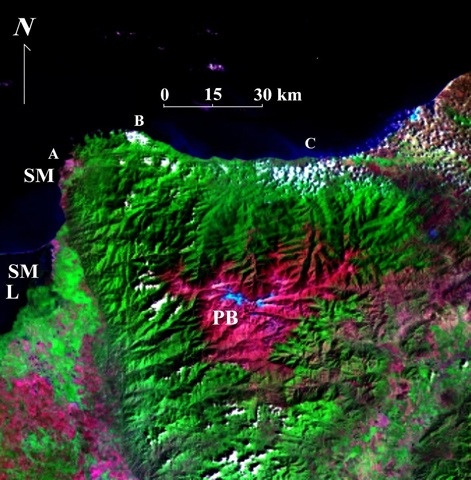
An infrared photo of the Sierra (I think.. something like that)

This displays reflectivity which shows you ground cover, from ocean to jungle to grass to rock to snow, moving from bottom to top.

20130114-122419.jpg

Categories
Uncategorized

A Mental Seige

For some reason I was headed to Colombia… don’t ask me why? Maybe my libido was leading me, maybe I didn’t want to commit too much to a distant land in what was already a half killed winter as I waited to return to Alaska where I have been somewhat haphazardly laying down roots. Maybe I was chasing some vision of contemporary history, wanted to see the search block give Pablo a Hitler stash, or see where Joe Arroyo sashayed the nights away and Shakira began her days, see the legendary pretty ladies and the price of 40 years of war, and just maybe see a glimpse of a nature I have never seen. Somehow this led to a continuation of a trip begun in San Francisco ended a year and a half ago at a hilltop in the Darien Gap, all of Mexico and Central America seen by bus, boat, and motorcycle, and the submitting to the taunt of a barrier I succumbed to in not crossing into Colombia. I can’t say I love Colombia, or Latin America for that matter, even though I will grudgingly admit I have learned to love Mexico, but in searching for a reason to come here, I stumbled upon something I found truly and not just relatively impressive: The Peaks of the Sierra Nevada De Santa Marta, at their highest 18,000 Feet (5700 M) high, and only miles from the Caribean Sea. The Highest point in Colombia, Pico Cristobol Colon, which edges out Simon Bolivar by a matter of Meters, I have not been able to confirm a single ascent of in years… Many Colombians don’t even realize it is their highest point, pointing instead to a 4000 m or so mountain somewhere near Bogota. Not many nations would leave their highest peak unassaulted for so long.. the why is an intriguing combination of war and some honest to goodness pre colombian native groups who haven’t changed significantly since first contact and act as protectors of the mountains.. it’s all just intriguing enough to make me blow off the beaches of Palomino and the Clubs of Medellin to have a look, to see what might be possible, to ponder if now is the time for a notion of nationhood to push out with the pride it’s usually associated with to somehow tame these mountains, turn them into a destination of sorts, and turn colombia for better or for worse into one more modern nation, or wether the notions of the past, either backwards or exotic and noble, shall keep this mountain unconquered… what follows is my mental siege.

Categories
Comprehensive Everglades Restoration Project Kissimmee River Restoration Project Picayune Strand South Florida Water Management District Southern Golden Gate Development US Army Corps of Engineers

Everglades Restoration Project Pt. 2: Change Around the Edges

The essential problem in the South Florida Water Management District, or less bureaucratically, the huge watershed that is South Florida, is that it used to be a huge shallow slick of fresh water that ran unabated for more than half the length of the Florida Peninsula, from the Kissimmee Lakes near Orlando, all the way to the sloughs and shallows in what is now Everglades National Park. The Everglades were, well, ever-glades, a glade that went on forever, 4,000 square miles.
Man’s ingenuity changed all that. After a flood caused by a hurricane in 1938 I believe, and the demands of road building, agriculture and population increase after Henry Flagler’s railroad started to bring Americans into the sub tropics, they set about controlling this water for farming, flood control, and accidentally by road building, in some profound ways. Canals were built for every reason imaginable, 1400 miles of them and their buddies, levees and water control devices, according to Wikipedia, and the ecosystem was brought to it’s knees, albeit in ways you had to pay attention to see, since it was hard to notice going by at 75 mph on Alligator Alley.

If you want to see how complex this can be, check out this tour of just one small part of the system that is relevant to the 3rd project I cover below, the water flows out of Lake Okechobee:
 tour of flows out of Lake Okechobee via canals
 Water supply to the area south of Tamiami Trail, essentially the National Park, fell to something like 1/10 it’s original amount, and rivers were straightened and diverted to the coasts. For some 70 years there were voices in the wilderness, the Endangered Species Act brought attention to the Florida Panther, but things got bad and stayed bad. The reef in what is now the Florida Keys National Marine Sanctuary and the segreses i the park started to deteriorate due to Nitrogen from every manner of sugar farming, cattle ranching, contaminated condo hot tub overflow, and orange grove, that created blooms of all sorts of stuff that shouldn’t be blocking the sunlight to the coral, so what little water did make it is almost making things worse. On a mega scale, the lack of fresh water entering the gulf Stream as it rounds south Florida on it’s way to England is now so weak the Stream has allegedly changed color.  But finally the South Florida Water Management District, the lead body for this area, The Army Corps of Engineers, and the State and Federal Elected Officials involved started to get their act together, and stuff is happening, or was funded and some of it still happening, even though Florida elected a tea Party Governor who stripped these budgets in 2011..
What, you say? Progress? Well, government being government, there was a lot of analysis, a lot of putting the whole picture together, then there was a long wait for money… and the project spans so many areas and congressional districts, I had always focused in my searches on the southern ends, the most famously impacted area, Everglades National Park, due to the partial impassibility of water over the Tamiami Trail, US 41, which is kind of the core problem of the everglades, along with the controversy over the sugar lands purchases that had been such an almost perfect then fall back into a kind of controversial ‘Sugar Daddy’ deal by ex Governor Charlie Crist, and it caused me to miss this pretty amazing project, change creeping in from the edges flowing from the north like the water:
http://www.sfwmd.gov/portal/page/portal/xweb%20protecting%20and%20restoring/kissimmee%20river
it was turned into a ditch, the C-38 canal, now it’s allowed to be a river again:
Images of Kissimmie River Restoration
somehow one picture alone doesn’t quite tell the tale, so I had to link to a bunch.. all the maps also don’t quite show what an aerial photo does of how it was a straight run, and now there are river bends and meanders again, and wetlands and groundwater replenishment.
Video tells the story best…

if you keep digging in, you start to realize the massive scale of this one bit of the everglades restoration project ( and the massive scale of the damage done by the canals all over Florida.), and the results of the rebound are quite stunning…fantastic in fact..

They have a ways to go, but they have restored about a quarter of the some 80 miles of former river that were channelized into canal.
satellite of completed areas of Kissimmie River Restoration zoom in a notch or two and it becomes more apparent, since the wider satellite images are older.
Go Army!
So this change from the edges notion lead me to another morsel, another precious piece of already federally funded progress:

http://www.floridaforestservice.com/state_forests/picayune_strand.html
digging into the story of Picayune Strand State Park, formerly The Golden Gate Estates, sold by the Gulf America Corporation
http://www.conservancy.org/page.aspx?pid=1061
http://en.wikipedia.org/wiki/Florida_land_scams
It’s everything you want from a South Florida story, no doubt the stuff of Carl Hiaasen or Tim Dorsey Novel.. but the work is getting done:
http://www.evergladesplan.org/docs/fs_picayune_nov_2012_508.pdf
it’s a bit complex to see what has actually been done, but it looks like at least a few of the roads and canals have been removed, and the project should be done by the summer of 2015
http://www.evergladesplan.org/pm/projects/project_docs/status/proj_30_current.pdf
and life is no doubt moving back in..
Up north a big project around the Indian River Lagoon, a long federally protected refuge estuary on the east coast of Florida north of Lake Okeechobee also has been moving forward. The issue there is that when the lake is too high water get’s pumped into the St. Lucie river via the C-44 canal and a few others, and it deluges the lagoon with dirty, sugar field fertilizer contaminated fresh water that used to (this will be a theme), flow naturally into the everglades. They decided to make a bunch of settling ponds and change the flows so instead of being pumped right down the canal, they settle out the contaminants and then flow down the river more naturally, further filtering and not crashing in late in the game via the canal like a packed on ramp to I-95 during the regular afternoon traffic jam.

The public on both coasts are clamoring for this project because it also affects the Caloosahatchie River and it’s estuary which get’s some of that untreated Okeechobee runoff in the same man controlled rushes which screws up fishing, clamming etc. with algae blooms and other changes to salinity and ecological balance.

In every one of these projects, all three above, there has been some pump or some group of guys pushing dirt and blowing diesel, when the goal is to restore something naturally.. well, it’s politics baby.. if you want green, I guess you gotto spread a little green, but I’m no engineer, maybe nature needs our help with big toys and bigger contracts.. it’s got me curious, but it’s progress…

But wait Grandpa Grumpy, you keep talking about the stuff on the edges, but what about the real problem, water not getting to the south of the Tamiami Trail, and all the run off from Sugar Production near Lake Okeechobee?
You caught that, did ya? smart group of li’l gators..
Alright kids, on to part 3..

Categories
Everglades Everglades Restoration Project Florida Florida Keys Kissimmie River Lake Okeechobee South Florida Water Management District Tamiami Trail US Army Corps of Engineers USFWS Enforcement

Everglades Restoration Project Pt. 1: Introduction

Anyone who has been to South Florida and knows anything about environmental science (or civilization for that matter) likely has one word that comes to mind to describe it:
F@#$%d

I spent enough time in Florida to need hope, since there is very little of it there. I also spent enough time there to never want to go back, but like en ex girlfriend with no soul, I still stalk her sometimes on the Internet, because there were occasional good times, improbably but somehow.

The magnitude of the problems facing the state were made apparent to me in once brief incident when a USFWS guy busted a friend I was snorkeling with for an undersized lobster (it was close, I must admit, a judgement call, and to make it funnier, this guy ran for Mayor of Key West a few years later.). There was something about the two FWS guys demeanor that told me that they felt pretty hopeless about their work here, like it wasn’t what they had gone to college for, like they were fighting the environmental Vietnam, and even though they could win it with the proper support, they were loosing it, and this was the equivalent of one more village they had to go into and torch, busting us for this lobster, when the big fish were hauling down the Ho Chi Minh trail unopposed, Sugar Companies, Condo Developers, Road Builders and Army Corps Ditch Diggers the NVA divisions of old to our little rabble of potential VC.. we tried to lighten the discussion by talking about water quality while they wrote up my buddies ticket, and on the subject of Nitrogen in the water, the guy, in that hopeless way that happened to all non-alcoholics stuck in the keys, he shrugged his shoulders and corrected us that there was too much nitrogen, not too little, which we were bantering about nervously since he had cut us a break a bit, and never even took his eyes off his pad, as if it saddened him, the Sargent Elias of his Platoon, affected…
After this I picked up a book on Manatees and water in the South Florida Water District, and like everything in the Sunshine State, it was tragically hilarious. This was in like 2009, the winter that had a gale storm every 3 days and Key West hit it’s coldest temperature ever, 38 degrees, which led to fish kills and dead manatees, numbering in the low single digit thousands in South Florida to begin with.
http://wlrn.org/post/red-tide-claims-170-manatees-south-florida-population-should-be-spared
http://grist.org/news/toxic-algae-is-wiping-out-florida-manatees/
 Stories abounded about invasives like Burmese Pythons in the Everglades,
http://en.wikipedia.org/wiki/Burmese_pythons_in_Florida
 arguments over Australian Pine in Key West,
http://saveourpines.com/
 and legends of dead coral all through Florida Keys National Marine Sanctuary
http://phys.org/news184044612.html
It seemed pretty hopeless back then to this uneducated observer, the torpor of Florida, the endless resentment the place seemed to breed to balance it’s inebriated and oblivious good times, it’s shark fishing for kicks and cigarette boat addictions unabated by the maturation the rest of America had gone through since the ’80s, poor planning choices and subtle but endless corruption, culture clashes and the endless idiocy of it’s destitute sun seekers, but slowly, and now quickly, things started to happen, and as I dig, things were happening all along.
On to Part 2..

Categories
2015 Boat Emissions Bunker Oil Carbon Savings Hope Panama Canal Panama Canal Expansion Short Cut

Panama Canal Expansion Project

Due to be done in a few years, and for a while ahead of schedule (no longer at last check), this promises to save a bunch of carbon, and the new gates are more efficient water-wise than the old ones, allowing for less impact on the ecosystem of the Canal Zone, well less than would have happened with the same gate system as the old gates (100 years and ticking!).
http://en.wikipedia.org/wiki/Panama_Canal_expansion_project
the one knock against this, unless you get anarchistic, is that it could have been done with a railroad system, but that might have been even more destructive, as panama would have had to build a huge port on it’s pacific side, plus a huge container yard, which might have been more of an eyesore and an environmental catastrophe than just this big construction project.

Expected Completion Date: December 2015
Monitor:
this first one is a bit engineering heavy.. they haven’t quite come up with a cool countdown clock yet..
https://www.pancanal.com/eng/expansion/rpts/informes-de-avance/index.html
https://www.pancanal.com/eng/index.html
https://www.pancanal.com/eng/photo/webcams-works.html?cam=Expansion
wow, this is a report about the impact in the US, and it implies that I might be simplifying things a bit, but ships go places other than the US, and I know there are already ships going around Tierra Del Fuego that now won’t have to, so I stick by my assertion that good will come from this.
http://www.future-science.com/doi/pdfplus/10.4155/cmt.12.65

I once drove the length of the Canal on the back of a friends moped (there is a cool train you can take too) and I saw one of the coolest things I have ever seen.. they had started digging the cut away from the existing canal to the new pacific locks, and a boat was going by that spot, and from my vantage point I could look past the boat to dry ground below it on the other side of the dike keeping the canal in place while the digging goes on.. still gives me the willies! it was a phenomenon that seemed impossible or at least physically improbable, like seeing a boat float past you from below through fresh air (which is likely possible from that hole).
I can smell the fresher air already, and what kid doesn’t think the Panama Canal is cool.. c’mon.. it’s like the Panda Bear of big industry!

Categories
Blog Environment Environmental Projects enviroprojects.blogger.com enviroprojects.blogger.mx Hope The Song Remains the Same

Introduction

The news about Global Warming is depressing, worse than people realize, and sadly true. I have a friend who is a Government glaciologist, and he once, after a beer or two, decided to tell me how much time was left for a few major ice caps we knew.. it’s a bit sad.. add to this the 150 years of environmental degradation from industrialization and population growth we are healing from, like a post party house cleanup, so I needed uppers, and I found a few good projects around the world to give me hope,which I sometimes check like expats check the sports scores back home… Like the cheesy line that Robert Plant somehow could pull off in introducing Stairway to Heaven on The Song Remains the Same: This is a Song of Hope…
http://www.youtube.com/watch?v=9Q7Vr3yQYWQ