Categories
Appalachian Mountains Conservation Eastern United States Elk Kentucky Missouri Pennsylvania Populations Renitroduction Rocky Mountain Elk Foudnation Smokey Mountain Virginia Wapiti Wisconsin wolf

The Return of the Elk to the East: Kentucky Most Prominently, But Now Little Pockets Everywhere

go to minute 2:45 if you want to get to the point…
I’m not usually an emotional guy, but somehow those 45 or so seconds of footage bring me close to tears. This entry might be the one that most affects me on a personal level, since it affects so fundamentally and dramatically a place I love so much and know so well, the Eastern United States, and the Appalachian Mountains.
When I saw the above video,while learning about a release of Elk in Missouri that were brought from this wildly successful Kentucky herd, first released in 1997, I felt like I was learning about a long lost uncle as an adult, as if something that had been missing from me, and from how I understood my world on some emotional level, was being returned, even though I had never known it was gone.
Not to play into the myth of a pristine pre-Colombian world, but I for years was left non-plussed by the legions of white tailed deer that populated my world, by the eastward moving Coyotes that were the only predators left, as they invaded previously unknown territories for them to pick off the edges of the weird kind of predator-less garden patch that was the East.
I grew up suspecting but never knowing that that Eastern ecosystem had indeed been a wilder and much more complex one, and watching this video, after an accidental run in with an article about the Missouri effort, was big for me.

I had always thought I knew a lot about New England ecology as a kid, and then that of the Appalachians as I got a bit older. I knew we had black bears and white tails, and not much else on the big animal level, maybe some cool weasels if you were lucky, and always talk of some phantom Mountain Lion roaming the land, but never like in the past.

Eastern Ecology is ruled by nostalgia, and by this persistent compromise with the growth of the population on the Eastern Sea Board, the awkwardly named Bo-Wash Corridor and other places like Virginia Beach, and with the coal mining industry which is the ever harped about lifeblood of the Central Appalachians, like a family in crisis with the neediest sibling screaming the loudest, the coal industry, a far cry from the humility of suffering and frontiersman-ship that were the touchstones of legends of the early European settlement in the days after Plymouth Rock. I would sometimes scratch my head trying to figure out why Davy Crockett or Daniel Boone might be so challenged by a simple whitetail. Now I know it wasn’t necessarily whitetails they were after. Now I know that Wolves once roamed freely, that the forest humus used to be thick and full, sheltered by old growth canopy stretching for leagues before earthworms, extirpated by the ice ago, were reintroduced to the east of North America by the ballast of the boats that settled Jamestown, the Susan Constant, Godspeed, and Discovery. Life on the east coast was indeed quite wild, and quite different from what we find today..
Trevor Jones – Elk Hunt – The Last of the… by 1236bigcat

An old friend of mine was a direct descendant of Daniel Boone, who hunted Elk when he came west though the Cumberland Gap, but as the map showed you, about 85 years after him and 125 years before my buddywas born, who still carries the orneriness of the original settlers, without the wilderness to bounce off of, they were no more Elk to be found in Ken-Tuck-ee.
Now that I know about the Elk, it somehow gives me a warm feeling because of how seriously some states and the Federal government are taking their reintroduction, somehow making an un-whole, or ecologically broken East Coast and Eastern US now more whole, like an environmental form of Truth and Reconciliation that occurred in places like South Sudan, the Balkans, South Africa, and East Timor. We are facing our mistakes and correcting them as a society.
I had never known that there were two sub species that didn’t make it past the initial wave of settlement that similarly drove out the Mohican’s, and so many other tribes in the Trail of Tears, and so many species that were lost or driven west by the incessant drive to domesticate these amazing fertile fields, possessing some of the thickest topsoil in the world, 80 meters in some areas near the Mississippi I was once told, that existed west of the Alleghenies. Alleghenies are thought to be the true indigenous name of the Appalachians, which was a bit of a map makers mistake as the Apalachicola of Florida boastfully but humorously claimed to Spanish explorers that they owned all the land and mountains of the east coast, a boast that would have made the Cherokee, Huron, Algonquin, and Mohawks to name a few more than a bit incensed to know about, if they hadn’t had a bit more to worry about at the time.
These were the territories of the Elk of what is now the United States:

http://www.plantanimalmineral.com/mammals/our-noblest-deer/4
And let’s not forget that Elk are park of a wider group of Wapiti that live in Asia as well:

One of the Sub Species brought to extinction was the Eastern Elk (except for a group of half breeds now know as Red Deer in New Zealand),
Wikipedia Entry on Eastern Elk
 supposedly the largest of them all, and the other the Merriam’s Elk of the Southwest
Wikipedia entry on Merriam Elk
What I had once heard rumors about, but never placed in a context, just figuring it was a fluke of some Gilded Age or Roaring 20’s Hunters, was the Pennsylvania Elk Herd.
http://paelk.com/
http://gothunts.com/elk-hunting-in-pa-new-state-record-non-typical-elk/
Benezette, PA on Google Maps
They were of course reintroduced as well, from one of the western breeds, but have been alive and well for close to 100 years in areas of Northwest, PA, which does bespeak why some areas of western PA east of Pittsburgh do seem truly wild, the folded mountains and gorges really resistant to the onslaught of domestication that takes people by surprise as they drive west on I-80 or the PA Turnpike.
But they remained alone on the east coast, this little pocket, a delight to hunters, perhaps a frustration to a few neighbors, and an unknown entity to countless Wolves who might have taken the effort to get to central PA from their nearest locations north of the St Lawrence had their little sniffers been able to pick up the scent. that is, until someone started some forward thinking in Kentucky. I don’t know whether it was the conservationists of old, political speak for hunters who are friends of environmentalism as long as they get to take a few, who did save Elk in all of North America from extinction in the late 1800s by their efforts to save the Yellowstone herd and other remnant pockets in the west, that had dwindled from millions of animals, to less than 40,000 I believe in all of the west by the turn of the century.
Unbenounced to me until recently, Michigan was a bit ahead of the gentlemen hunters in Pennsylvania, adding their own herd to the finget tip of the mitten in 1918. They reached 1500 individuals, but cut back to 800-900 for this 576 square mile area that has been designated as official elk habitat since 1984. They are staying where they are though, with no fantasies in the plan, currently, of allowing them to resettle all of wild north Michigan.
http://www.michigan.gov/dnr/0,4570,7-153-10363_10856_10893-28275–,00.html
http://www.michigan.gov/documents/dnr/ElkPlanFinal_382059_7.pdf
Pigeon River Country State Forest Area, heart of Michigan Elk Range
Now before I go into Kentucky, lemme give some more credit where credit is due to the great state of Arkansas, which did in fact enact a reintroduction in the early 1980’s around Buffalo River National River, a unit of the National Park Service, and the first of it’s kind subsequent to the modern environmental movement that began in the early 1970s with the publishing of Silent Spring, and was a place where Nixon and the Democratic Congress of the time found a lot of common ground as the public outcry grew for a number of environmental initiatives like the clean air act that launched the modern era.
http://www.centuryinter.net/nacent/ozark/elk.html
http://www.nps.gov/buff/naturescience/index.htm
they number some 400 today of the 100 or so released from the high plains.
But despite the two previous populations in Pennsylvania and Michigan, and the addition of and Arkansas some fourty years ago, none of them quite went as far as Kentucky decided to go, and another neat thing to realize, is that Kentucky did this in a complicated border region near the Cumberland Gap, where they adjoin Virginia, West Virginia, and Tennessee, and North Carolina is pretty close by as well… you might imagine that Elk don’t quite ask permission to cross state lines in these areas.. although they might be penned in by I-81 or the like, they have plenty of room to grow into all of the Southern Appalachians. Kentucky just has to shucks and apologize over to their 4 neighbors, most of whom are beginning to take it in stride.
From the first releases documented about some 16 years ago, 1997, occurring every few years until 2002, there is a healthy population of 10k and growing. I have no idea who first had the idea in earnest, but someone in the Kentucky Department of Fish and Wildlife, an important government agency in a place like Kentucky you might imagine, got in touch with a group of neat guys in Missoula, Montana called the Rocky Mountain Elk Foundation. These guys have their hands in every single dang thing that happens with Elk,  have raised not millions, but hundreds of millions of dollars in their time. Aside from the Federal and State Governments, they are the big players in this world, a bunch of Montana Conservationists, again read ‘hunters’, who had some cash in their pockets and seemed to get what was up, and had a way of connecting with the officials at these state agencies who might ignore their own biologists or the last 10 greenies left in a place like Kentucky or West Virginia, a breed just about as rare as Eastern Elk, who no matter how right they might be about healthy ecosystems, are likely to not have much of a voice in places like this.
http://www.rmefnky.org/kyelkherd.HTML
the video at top tells the true story, but here the Rocky Mountain Elk Foundation lays out the bare facts.
This video below shows the good ol’boy combo of hunting and environmentalism, driven by the hunting revenue, that is helping make this all happen. If you have a sharp eye, you will spot that a lot of the ‘Elk Parks’ that they are putting these reintroduced animals onto are the re-mediated removed mountaintops of the coal industry, and this might be the only silver lining of that horrible practice.

So as has become a trend I have realized in environmental issues, a trickle becomes a waterfall at some point without people realizing it.. Kentucky’s bold act got around, and other states slowly began to emulate.
When the National Park Service wanted to reintroduce Wolf to Great Smoky Mountain National Park, they kind of put the cart before the horse, and it ended in failure..
http://articles.latimes.com/1998/dec/13/news/mn-53449
One of the biggest reasons that the Wolf got out of there because there was nothing to eat. Wolf, like elk, have an uncanny habit of ignoring arbitrary human lines on a map. They wandered out of the park in search of food because there were no elk as there had been when the wolf roamed free. That effort in 1998 led to another one with elk in 2002 that might someday again pave the way for a more successful reintroduction of one of my favorite east coast predatory species to their old mountain home…
http://www.nps.gov/grsm/naturescience/elk.htm
http://www.nps.gov/grsm/naturescience/elk-progress-report-49.htm
you can see above that it is a small herd, about 140, all bottled up in one small area above Waynesville NC, and Maggie Valley, called the Cataloochie, up a dirt road called Cove Creek that still manages to attract a healthy amount of Subaru driving aficionados away from the parks main attractions along the Newfound Gap Road,  but give em time. In fact, as I update this post two years later, a herd of 20 is growing in the next valley by the Cherokee REservation.
Interactive Map of Great Smokey Mountain NP
Now to the effort that first caught my attention, part of this cascade, as other states catch on as well and decide this just is right to do:
http://www.outdoorhub.com/news/restored-kentucky-elk-populations-being-shared-with-other-states/
nope not talking about Virginia’s nascent effort in Buchanan County (pronounced Buck-a-nan, you Yankee.. yep, I’ve been there..), nor Wisconsin’s efforts to grow the 150 odd strong herd they reintroduced in 1995 after Elk were extirpated there in 1948 (Minnesota and Wisconsin aren’t really the East… in a funny way, their Sand County Almanac Environmental Values were never quite lost, so I don’t quite put them in the same sorry shape of the Southern Apps, or the Lower Midwest. the one that caught my eye was Missouri, since as the saying goes “as goes Missouri, so goes the nation.” might be very well a good thing in this case.

And…. they’re back:

I’ve heard rumors that Indiana is considering doing something in the vast National Forests it has down south, and even Suburban Illinois has a little population fenced in in a town called Elk Grove to remind us of what was, and what will be again… far be it for me to hope for an earthquake that accidentally knocks down the fence..
Let the bugling return!

Categories
Crime Dark Sky Dark Sky Society Explanation Full Cut Off Lighting Hawaii Legislation Light Pollution Lighting mating Mona Loa New Yorker Observatories Sea Turles Tucson

The Dark Sky Movement: Not all Polution is Matter, but it Still Matters!

http://earthscience.files.wordpress.com/2006/12/worldlightmap.jpg
In college I was once in a desert field ecology class (distribution requirements.. it was not my major.. now I kind of wish it was), and I found myself bumping through Tuscon with a van full of stinky but amiable Co-Ed’s late one night. Somehow it left an impression on me that Tuscon felt surprisingly small for the population I knew it to have, kind of, well, natural… and I remember someone mentioning or knowing there were some observatories up on Kit Carson Mountain, so I gazed up and had a look as we drove by on what must have been good ol’ I-10. I never knew much about astronomy, but my dad had been in the Navy, and knew how to navigate by the stars, had even studied it in college. He used to occasionally teach me a constellation or two. Given this small family preoccupation, I liked to pick out little details like knowing the observatory was there, and file them away.
Fast forward a few years, and I am a Municipal official of sorts (everyone makes mistakes in life!), and something crosses my desk about a new type of Light Fixture that the state government wants me to set up a demonstration project for. I have to find a place to put something like 7 so called “Full Cut Off Lighting Fixtures”. There was so much jargon in government that my brain took it in stride (it’s a street lamp!), since I was learning about everything from the constitutional law to street plows. I read the description that the state legislature had passed,  something kind of exotic and progressive called Dark Sky Legislation, to mitigate a so called Light Pollution Phenomenon (“What won’t they think of up in the capitol! Good for them, my brothers in utopic striving!” I thought to myself, in all earnestness.), and I think my brain was about to move on to other business as I moved further down the description, when I found the allegation that flooding street lamps have not only social consequences, but health consequences as well, and that people sleeping in rooms with too much light from street lamps can suffer from hormonal imbalances, mental health issues, and even circadian rhythms and menstrual cycle disturbances, and that it can be a contributing cause or the cause of their cancers and other infirmities directly or indirectly. Realizing that I work in politics, it might make sense that I fixed on one important thing: this might be something else to blame my girlfriend’s moodiness on when I am in the doghouse again.. hot dog!

Now since my girlfriend lived in another city, I did the right thing and told the state where to stick it, aka the main road from the more pastoral side of town, where I knew a few of the people to be the my boss’s supporters, one kind of cute as a matter of fact (like I said, my girlfriend lived in another city..), but also a place where it felt like rural blended into urban in a small town way, and where this allegedly nice lighting would shine down and bounce around instead of just flooding, highlighting at night a few of the nicer old wooden homes that created a small town feel despite the state highway plowed through there on what used to be an old wagon track. Done, onto next business, with me understanding that pretty soon anytime we had to put up a new street light or replace an old one, this law said it had to be ‘Full Cut Off‘. Send it by internal mail to public works… next order of business..
Back to Tuscon via a New Yorker Article I read a few years later while waiting for a check up in a doctors office. I never feel sophisticated enough for a New Yorker subscription, but whenever one was around in my eager ambitious youth, I would learn as much as I can about how the literati think, in case I might have a chance to impress one enough to get invited to their parties. As I sat there waiting for Dr. Feelgood, I stumbled upon this, and I don’t remember if I stole the magazine or sat there long enough to finish it (might have been all the light in my apartment screwing up my REM!), but finish it I did:
http://www.newyorker.com/reporting/2007/08/20/070820fa_fact_owen
Now I know his town wasn’t my own, since ours was founded in the dignified year of 1712, not some newfangled 1779 (dang interlopers), so I knew he wasn’t my neighbor, but his article addressed so many of my experiences, from the dark Arizona nights, that feeling of natural security I felt driving through Tuscon that I would never feel throttling down the interstate just in nearby Phoenix, to my sleepless nights in hotel rooms with floodlit parking lot’s outside, to New England Municipal lighting dilemmas, to that feeling that floodlit areas actually tend to be seedy and feel, well, dangerous, that this article was like a star lit pathway for my thoughts amid subconscious suspicions. And the realization that someone out there had an understanding of this, terminology, and an exotic sounding society of all things made me quite intrigued:
http://www.darkskysociety.org/
and the even more influential International Dark Sky Association
http://www.darksky.org/
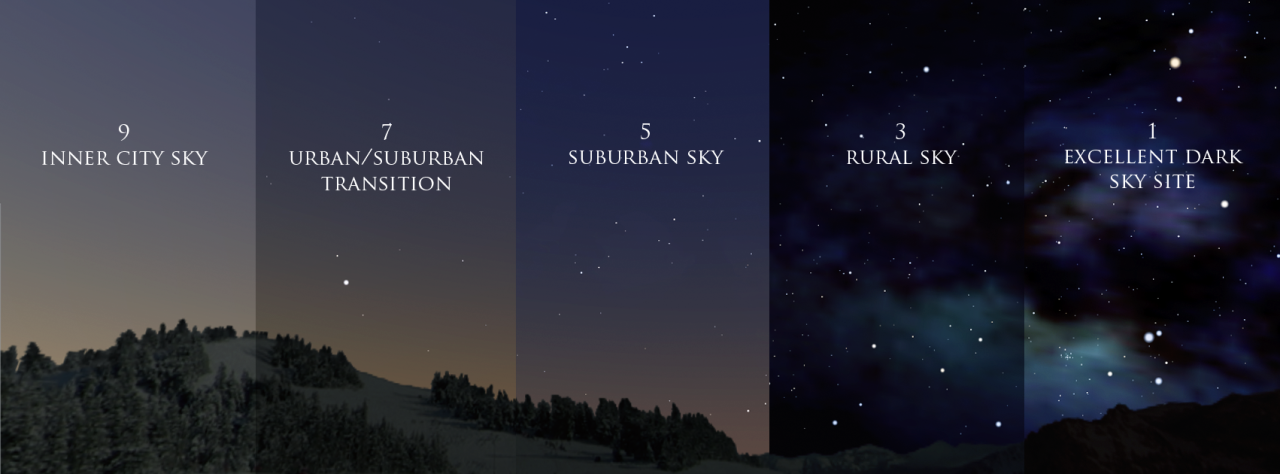
they even have a scale, the Bortle Scale:
http://en.wikipedia.org/wiki/Bortle_scale
http://www.skyandtelescope.com/resources/darksky/3304011.html

And here is a map that corresponds to the scale, similar to the satellite photo on top of the world, but color coded:
http://www.inquinamentoluminoso.it/download/mondo_ridotto0p25.gif

Bortle Scale Map of US

some of the ones in places you don’t expect, like north of the Falkland Islands, or in northern Russia, are National Gas Flares on oil rigs.. yup.. just being burned and wasted so they an get to the oil underneath it.. it’s a dirty little secret people don’t talk about because coal and oil are so much worse than natural gas.
My contribution to this fight was quite small, just an order to install those 7 odd lights in a row on the State highway, no biggie, but armed with this information, as I crawl a third world neighborhood or stand atop Mona Loa by it’s raft of observatories on an impromptu high altitude camping trip (right next to the highest observatory.. had a funny talk with a physicist out to get some air at 3am as I stomped my feet to stay warm in his pretty celestial parking lot, he taught me what the laser was for I kept seeing dart into the sky from his dome), noticing how subtle Kona and Hilo look from on high, since the island of Hawaii is quite commited-ly dark sky to aid the observatories, in addition to being well ahead in a few other national measurements of lifestyle and environmental care as a county. This article doesn’t just let me understand government or science, it helps me understand why I feel scared in certain places, disoriented, miserable, tired driving at night through urban areas, when the gross yellow halon glow of a cheap light makes me feel like I am about to stumble onto a group of Tijuana Thugs, or some weird playing of something from my Silence of the Lambs imagination.. here is some basis to it.. and it helps me also interpret that some places aren’t going to be bad.. they just look bad because of the crappy lighting and the disorienting effect of my not being able to see the sky. Sometimes I wake up in the morning to quite a nice place I might not have expected, since almost every town looks kind of crappy and intimidating when you arrive at night because of the inattention to these very details, and the norming factor of he lowest common denominator of street light, now a global phenomenon.
Thankfully, the solution to this is following behind the pollution, and it ain’t dilution. In places with progressive leadership, people are caching on, and I have noticed Full Cut Off lighting creeping in on highways and in towns from Europe to Ecuador to even the Baja Peninsula. In some places they are federal projects, where this kind of advanced concept is most likely to have registered first, but there are places where I don’t expect to see it and I do, small towns, remote places, and it’s quite inviting when I stumble off a bus or try to find a hotel late some night. It means to me someone is thinking, someone cares about my well being, they aren’t just mollifying the public with flood lighting to address a real or imagined crime problem that almost makes the situation feel worse.
And dare I get through a post without discussing real pollution, because lighting takes energy and energy often takes pollution. There was the argument that most Full Cut Off Fixtures are by nature more efficient, since they have mirrors and need less power to bounce down and around, but some years ago when a guy named Mark Begich was Mayor of Anchorage, Alaska, before he became the Senator from Alaska (Alaskans might tell you, perhaps accurately, that he sold out to the unions to get the job, and that if Uncle Ted had never been besmirched he wouldn’t even be there, but Alaska has more of a progressive soul than the old codger Sourdoughs want to admit! They are problem solvers. ) and when Begich became mayor, he did what the climatically challenged Alaskans do well.. he tried to innovate, and he started to find that although LED lights were starting to come on, no one had made them available for municipal lighting, and they solved two problems for him.. they made a lot of sense to the bottom line, since they use a lot less energy, especially when it is cold and those hot bulbs have to use a lot of energy just to burn, but also, he wanted to make Anchorage look a lot less ghetto for the long winter nights, almost 20 hours at their peak, that ‘ragers have to endure, and it’s not just people that you have to worry about: Moose and Brown Bears have ticked off kills within the city limits in my memory. But he is fighting a deeper endemic problem as well, the persistent urban problems in ‘Anchor Town’ associated with natives with emotional and substance abuse issues who drift into the city from there remote villages with now way of sustaining themselves, Tongan and Samoan gangs that took to dealing and tribalism to deal with displacement and breaks from fishing, and the long standing struggles of Anchorage with Prostitution since the pipeline days when cash was easy, where streetwalkers have became a norm to replace the pressure on the massage parlors of old that the city finally shut down, in places like Spenard and the ghettos of the East Side of town.
http://2.bp.blogspot.com/-0SURBcYJ_GY/UeG49iBnMHI/AAAAAAAABe0/Yf1JN9sh_RM/w1200-h630-p-nu/Alaskan+Street+Gangs.jpg
http://www.treehugger.com/interior-design/anchorage-alaska-to-install-16000-led-streetlights-will-save-360000-per-year.html
http://www.triplepundit.com/2009/02/alaskas-lighting-revolution-sustainability-is-more-than-kilowatt-hours/
The story I heard was that Begich actually had to work with this company Cree to get lamps that would work for the city, they actually were involved in pushing the design forward.
http://www.creeledrevolution.com/revolutionaries/city-anchorage
The white light they give off, while perhaps still bothersome in creating eternal daylight, was of a healthier, whiter glow, and didn’t give off that alarming amber glow, and started to make Anchorage feel cozy again, like it’s far flung cousins on the Alaska frontier, and to start changing it’s reputation from ‘Alaskas Bus Stop’, to a place to live in it’s own right. If there is no other more appropriate measurement, I can tell you that home values in Anchortown are up up up.

And let’s tie in some Disney-fied struggling sea creatures to wrap up as well… to end on an even higher note than the stars we are shooting for, the fuzzy good feeling we get by helping a pelagic in need.. so it turns out that Sea Turtles and their breeding are amongst the most affected by light pollution, a bit like the brown bag rule,… if they see it, they get disoriented, since their biological clock for laying eggs is set to the moon and tides, and they will crawl back out to ocean instead of laying on their chosen beach. More and more of the world’s shorelines are developed, and with people, rich and poor alike, comes alarmist, somewhat ineffective as we heave learned, stay away criminal lighting, if they can afford it, and it is considered one of the factors suppressing sea turtle numbers, along with plastic that turtles mistake for jellyfish, and poaching, and driftnets, and god knows what else (living to 120 ain’t so easy anymore!). So it has become a new concern, and a crusade in many a beach community (I have noticed that the surfier it is, the more progressive, but the limo liberals are chiming in as well, and its a good tune..) to try to make their beaches as dark as possible. Here’s a responsible little rule from a hip little beach community in South Carolina, which even restricts it’s self to mating season in case flood lighting the beach at other times of year is your thing:
http://follybeachnow.com/folly-beach-info/beach-information
Unlike Lebowki’s gold brickin’ ass, sea turtles are welcome in Folly Beach, and nothing says welcome to an amorous female sea turtle like low light and slapping sea waves… take note fellas..

http://www.youtube.com/watch?v=COiIC3A0ROM


Saving Turtles With Sea Turtle Lighting in Florida
http://seaturtlelighting.net/

Categories
Uncategorized

Burros and Horses: the Freightliners of the Sierra Nevada

Perhaps not in the Sierra, but by the time I left Colombia and Ecuador I had lost my fear of Burros, AKA Donkeys, and Horses. Not that I fear them, but it’s hard to imagine a climbing expedition supported by them. It seems so, well, old school, and now it fascinates me. The Sierra is loaded with them, as after your feet, they are the only other means of transportation I have seen there in common use. However their day to day use is likely governed by normal transport and harvests.

I had occasion to ride a few in some remote areas, and they are pretty tough, I must admit.. burros especially. I am larger than most people (don’t call me fat!), 90+ kg and I found burros to be resilient for the weight they were carrying. I don’t know much about how they would perform at altitude, above treeline, and what would happen if you were dependent on them and they didn’t make it,and you were stuck shuffling your gear, but I am not above considering them now. Horses are more fleet footed, but I also feel like they would be a little less dependably footed. In other words, for all their kind of stagger stepping, burros almost seem more dependable, the tortoise to the burro’s hare.. I would guess that burros and wranglers could be contracted to drop you off at the 5 blue lakes or any base camp you choose from perhaps Guatapuri, or from natives in any number of places, or even from mestizos in a place like Palomino. Average wages in this area are quite low, 10 or less dollars a day, so I bet they could be had for 50 bucks a wrangler and horse, if not cheaper, per day. How invited they or you would be would be another discussion, especially as you got further up, and the classic thing is for them to demand more money when you are almost there, so you would have to be firm, and have good relations. You also could experience them just saying they can’t go any further, or the pack animals having health issues. You could ride some and have others pack, or walk beside them, or some combination. My experience with the sierra at the end of the wet season was that the Camino Reals, the trails that go up the mountains that might be official old royal roads,  were horribly muddy, but that the locals still took their horses though them no problem, and their hoofs seemed to hold up fine. Many of the natives walked in the barefoot as well. Walking from Palomino to the climbable area would be a 4 day undertaking I am told, perhaps more for the unseasoned.. horses might take a huge dent out of that, although the time does allow for healthy acclimation. I would guess that either mestizos or Arawakus would be the most reliable wranglers, but choose wisely. I have done no inquiring of this, but it would be my guess that it could be arranged in a week or less, but you would want to form relationships with the wranglers and be on good terms with them first, and understand their methods of operating, the limitations of the animals, and have realistic expectations of each other, which would be formed by conversations with a lead guy you trust.

there is precedent for this, as the trek to Ciudad Perdido supposedly has some wranglers that hover and wait for gringos to hire them if they want to throw in the towel on what is supposed to be a tough walk. they could potentially be contracted, but they would only know a small corner of the Sierra you would be unlikely to go to, and finding a way to transport them around to your starting point would also be some work, but all possibilities.

Here is a post about using Burros in the Sierra to move school books into the remote areas:

http://biblioburro.blogspot.com/

Categories
Airbus 350 Boats Boeing Carbon Dioxide Carbon Fiber Cars CO2 Dreamliner 787 Eficiency Hope Carbon Savings LearJet 85 Lithium Battery Planes Progress Transportation Weight

Hope is in the Air: What Makes The Boeing Dreamliner Such a Big Step for the Environment

Check this out:
http://www.youtube.com/watch?v=2pw4OE7gM2M
The plane you see taking off is made with Carbon Fiber, from a kit based on the design of the Piper Cub, the famous bush plane, and perhaps smallest of what would be considered a traditional airplane. They usually weigh about 900 pounds. This one weights 300 less because of the difference in weight between carbon fiber and steel or aluminum. The plane landing likely is Carbon Fiber too. A friend of mine once took third place in this competition landing in about 130 feet with a plane, a Maule, that was handicapped for being slightly larger, but I can tell you that people were shocked when this thing took off in 17 feet in 2007, since even a normal cub souped up like a top fuel racer would still need 50 feet to take off.. not 17. In fact, the voice you hear muttering “Wow.. nice landing.. nice…” at the end is likely a buddy of mine, which I put together a few years ago. He was pretty astounded by what he saw there in 2007, as was the whole Alaska flying community. This carbon fiber thing was something big.
http://www.cubcrafters.com/carboncubex
Fast forward 6 years to 2013, and it’s been a tough few months for a low Carbon future in Aviation, specifically, for the Boeing Dreamliner, the biggest innovation in Commercial Aviation since the Concord, the airliner equivalent of that Cub, and the most fuel efficient Commercial Aircraft ever produced, 20% more efficient than any current competitors.

Why it’s been tough is the growing pains of new technology, specifically, a 40 pound battery that used to be an 80 pound battery, that Boeing didn’t want to compromise on when they decided to go all the way in making a big jump in technology:
Legends of Flight Pt. 1
You see, with about 25 planes produced and flying commercially, they had, well, a bad thing, two bad things by the standards of aviation, happen.. two different batteries caught on fire, one in Boston, the other in Japan. Made by a Japanese contractor, the batteries are Lithium Ion derivatives and although these are now the batteries in the Chevy Volt, the new Generation of Prius, the Tesla and even the Leaf and about any hybrid that might be trying seriously to compete, since Lithium’s are almost half the weight of the old best technology, the Lead Acid or Nickel Metal Hydride or some other heavy metal based battery, which are more damaging even at extraction from some Siberian mine. If you watched the above video, legends of flight, you realize now that for competitive and ecological reasons, Boeing tried to make as many jumps as possible in technology, not only in using Carbon Fiber to dramatically reduce the weight of the plane, but in other things like computerized flight controls, shadeless windows that dim electronically and also save a few pounds on the long haul from Tokyo to Timbuktu because you don’t have to haul around the plastic shades and make a place to slide it to and fro, many other ideas, and last but not least, these batteries, which were the first major Lithium aircraft batteries to be certified for commercial use to serve the plane when the engines are off and even out the power flow. What I mean by certification is that if you want to send any old contraption up in the sky, you can in the US just about, but you have to write the word EXPERIMENTAL on it, and the people whose lives you can potentially risk in it are limited to those you can convince without the exchange of specie.. if you are flying for money, the laws and regulations that the FAA use to regulate such practices require extensive testing for any part of a plane used in such a capacity, to make money carrying cargo or passengers or something similar, since you are an uneducated consumer by virtue of how complicated flight is, and somehow flying is considered a bit dangerous, since we all lost our wings when we got sent to this place. These batteries where quite tested, certified even, but didn’t stand up to real world use, although much worse things could have happened then a ground fire and and some in air smoke, but it did point out a problem in these particular Lithiums, which had to be redesigned by their Japanese Manufacturer, no doubt with a few Boeing Engineers breathing down their neck, to stay a bit cooler and to have thicker jackets between the cells, but the reason this happened in the first place was the aforementioned and displayed ambition, to make a plane radically more efficient and therefore less carbon emitting. They could have held back and rested on the Carbon Fiber improvement and still gone with a heavy metal battery, but they pushed the envelope, Right Stuff Style, because just shipping 40 extra pounds of battery, since an older chemistry would weigh about 80 pounds to perform the same work, from continent to continent over and over again, daily if not more, the way these aircraft are designed to do, would have a lifetime cost equivalent to quite a few SUV driving gas Bar B Q-ing Americans every year.
Unfortunately, it was a risk, the whole thing was a risk, and risks are risks because there is a chance of negative consequences. Boeing took on a lot, and it didn’t all come out perfectly, perhaps the price of what I am no doubt painting as a worthy ambition:
http://www.dailymail.co.uk/news/article-2258626/Boston-airport-explosion-Smoke-pictured-billowing-Boeing-Co-787-Dreamliner.html
http://www.youtube.com/watch?v=RK7M0FhyCAw
those with perspective on the airline industry and aviation know that although no accident is to be taken lightly, this is not a hard problem to solve, just like the wing attachment problems they solved with the Titanium brackets during development depicted in Legends of Flight. Once the plane is safely on the ground,
http://www.youtube.com/watch?v=a5QBuJla5do
 aviation goes from being the realm of hero’s like Jack Stryker )roger, Roger!), to the realm of Engineers and FAA inspectors.. just kind of a big lab problem at Kansas State.
http://www.cnn.com/2013/05/07/travel/dreamliner-fix-behind-the-scenes
http://www.youtube.com/watch?v=xaqQuBac2ag
What I am imprssed by here, what I consdider to be a small piece of Environmental and corporate courage, is that Boeing could have gone back to an older proven battery technology, just said to heck with lithium’s in aviation, and put the death knell into that idea for the public for years to come, but they stuck with it, held to their original vision with Lithium Bateries
http://www.youtube.com/watch?v=phKgfJlyfKo
Trying not to notice for a second that they to have the first flight in Etheopia (this blog isn’t about lingering notions of colonialism and racism!), the 50 already delivered planes are all up flying again with the ‘new’ new batteries in place.
Now let’s put aside for a second that an MIT Professor Ian Waitz who studies flight and the environment pretty much says we are F@#$ed no matter what because there are some 30K commercial airlines in operation all over the world, emitting maybe 1.5% of World Fossil Fuel Carbon Emission’s.
http://www.c2es.org/technology/factsheet/Aviation
What do MIT Science Professors and Deans of the School of Engineering know about, umm.. science..
Prof Ian Waitz lecture on Environmental Impacts of Aviation
His pessimistic, umm.. truthyness aside.. hope comes from small acts that become big trends, since no one seems to want to bring modern civilization to a screeching halt to keep carbon levels from hitting the anticipated catastrophic 500 ppm, and these acts lead to a better future we dream of.. no matter how drop in the bucket it may look now, so the 800 Dreamliner airplanes ordered that are 20% more efficient, now, let alone whatever innovations might occur in their lifetime and be implemented to make them even more efficient, are progress even though that may be 80% more carbon than we need still.
But Boeing isn’t alone in this business, they have one major competitor in the Jet Liner world, and they caught on quick, perhaps helped by Boeing’s 3 years of delay while they ironed out countless other issues before the battery. That competitor is Airbus, and even though the last aircraft they designed looks like the antithesis of efficiency, like a 70’s Cadillac to the Dreamliners Prius (the thing is massive, it is literally a double decker!), it was in fact the previous most efficient aircraft, the A-380, since it capitalized off ideas of maximizing passengers per flight with it’s design, since the greatest proportion of fuel used is at takeoff, if you put a lot of people in the air, the longer the flight, the relatively more efficient it eventually becomes.
http://www.airbus.com/innovation/eco-efficiency/
 http://en.wikipedia.org/wiki/Airbus_A380
But Airbus isn’t resting there… the French hate to be bested! Their next aircraft will be carbon fiber as well, and they already have 617 orders! Voilà!:
http://en.wikipedia.org/wiki/Airbus_A350_XWB
Deliveries to begin in 2014, if all goes well, and well, they don’t always, but we are going to keep on trying.
By the way, since I have a bit of American Pride in me, I do want to point out the original voice in the wilderness was, according the the Boeing Museum in Seattle, none other than Bill Lear and Lear Jet:
http://en.wikipedia.org/wiki/LearAvia_Lear_Fan
if you read the story, Lear was working on it before his sad demise to Leukemia, and tried to get his wife to finish it for him. It would have been the first production composite aircraft, some 30 years before the Dreamliner. She tried but it never quite got to production. It would have saved a hell of a lot of Carbon before many even knew that was necessary. This kind of cute story and precedent might be why one of the prototypes is so prominently displayed in the Boeing museum as they stake their future on the same gamble. and Lear’s company is making the same gamble again as well:
http://www.flyingmag.com/mid-size-jets/learjets-composite-airframe-bet
if you read that story, you will see that Beechcraft had a disastrous foray that might have been part of what scared people off for so long, but that’s history now.
http://www.youtube.com/watch?v=zKB9m_Z6XqA
http://www.youtube.com/watch?v=KKZ6UfJoEhM
most of us have likely never watched a private jet commercial, and some of us don’t want to, as Warren Buffet’s describing corporate jet’s as financially Indefensible also applies to their environmental impact, but we take progress and hope where we can get it, and since I couldn’t find any video of the Lear 85 taking off to make the snappy wrap up that Carbon Fiber efficiency is taking off, since the thing doesn’t seem to be done yet, I am stuck with these somewhat awkward videos. They will be the first production Carbon Fiber Corporate Jet that I have heard of, unless Honda get’s theirs out first.
http://www.cnbc.com/id/49269623
So to make a satisfying final jump to prove that carbon fiber is taking off, I will display a few random things from the ground, water and sky.. You see, carbon fiber, like almost any new Technology, is expensive, so at first it becomes a bit mock-able because it’s just in these flashy expensive realms of the rich, but this demand will lead to innovation, mass production and new efficiencies, as happened with the computer and the automobile, and over time, our transportation needs will be met by lighter and lighter and more efficient systems. Battery Technology will start to catch up as well, and eventually some of the transport modes that used to be driven by internal combustion will move to electric only, or who knows what…
feast your eyes:
https://hondajet.honda.com/news/Index.aspx
http://www.youtube.com/watch?v=18pvhne0C8E
http://www.gizmag.com/lamborghini-reveals-sesto-elemento-concept/16522/
http://www.ezequielfarca.com/enproducto.php?id=149
http://www.yuneec.com/
There is one Yuneek Flying in the US, out in Monterrey, California.
http://en.wikipedia.org/wiki/Yuneec_International_E430

http://www.thetruthaboutcars.com/2006/06/carbon-fiber-so-good-it-hurts/

The movement is coalescing:
http://www.aopa.org/News-and-Video/All-News/2013/May/9/Electric-airplanes-EAS-guides-the-way
Viva la Revolucion!