Categories
Americans Arizona Warming Call to Action Forest Fires Global Climate Change Global Warming Heros Hot Shots Symbol Yarnell 19

If Ever There Was An Enduring Symbol: Hope and the Yarnell 19 Hot Shots

I can feel your blank stare.. how, oh how, can you get hope from this, the deeply saddening deaths of these 19 swaggering young USFS Hot Shots who died in this wind shift near Yarnell AZ… where are you going to go with this Grumpy? Will it be right on any level?
I can’t guarantee it will be right.. nothing about this is right…I was a few hundred miles away when it happened, also sweltering in similar heat, and I resent the crap out of any good coming from bad, but in some funny way, that’s what this blog is about, so follow if you will, on a trip that might seem a bit Machiavellian, a bit opportunistic, but if you were these 20 guys, the 19 departed and the one spotter who survived, I think you would be looking for any opportunity possible to make a difference to keep this from happening again, or becoming commonplace..

I’ve hung with Hot Shots before..they are a fun swaggering sort.. cocky young dudes in nature, usually 20 somethings, working hard, experiencing its rewards and it’s solace, and trying to make a difference.. a lot of them tend to be veterans, looking for a bit of perspective in the great outdoors.. they get the same camaraderie, but their enemy is a physical force, somehow a relief you can’t reason with it, as a forest fire just requires hard work and a bit of luck, and although it can be sad, it isn’t sad the same way as a civil war or terrorism is sad.. it’s nature, not misdirected man. If you spend time in the great wild areas of American West, usually public lands, or in the occasional dry years in the Appalachians or any of the big National Forests of the east, or even in the desert that is the Yukon Basin of Alaska ( 8 inches a year of precipitation on average, and it burns like you wouldn’t believe most summers.. didn’t know that did ya..) you will run into these scruffy cats, sportin’ tan work pants, boots, official looking t shirts, usually a smile to offset the macho swagger, and it all tells you they must be a fun group to hang around a campfire with, especially if it gets out of control! They aren’t smoke jumpers, they are usually too new for that, but they won’t correct you if you make that mistake, but to a man, if they stick in the seasonal work long enough, they likely would make a smoke jumping instructor proud.. they are the Rangers to the smoke jumpers Special Forces, next in line, the shock troops, and there to help. They volunteer for reasons their own, and they serve their country, and to save lives, homes, and natural resources, like any other fireman, soldier, and emergency personnel you can think of..
So where am I going with this? This could be controversial, and it’s a long thread to make, a tenuous one, but it can be argued that the Yarnell 19 were victims of Climate Change, and the kinds of victims a society can’t ignore..
http://www.nydailynews.com/news/national/firefighter-built-protect-ariz-hotshots-crew-article-1.1389040
They were young, but they weren’t kids.. they took the job willingly, they were too old to be victims, innocent bystanders, in fact, I would wonder just by looking at them, and knowing this kind of person, if any of them would want to be characterized that way… they saw themselves the way a SEAL Team sees themselves, or an infantry squad, or a group of cops.. they were proud to do their job and accept the risks as part of the occupation, but might be willing to cry foul if the risks are exacerbated by negligence:
Lemme quote their boss a month before this incident, from a Christian Science Monitor Article about the 19  young men from Yarnell

“On average, wildfires burn twice as many acres each year as compared to 40 years ago. Last year, the fires were massive in size, coinciding with increased temperatures and early snow melt in the West,” US Forest Service Chief Tom Tidwell told the Senate Energy and Natural Resources Committee in testimony last month.

http://www.csmonitor.com/USA/2013/0706/Arizona-wildfire-Details-emerge-on-tragedy-that-killed-19-hotshots/(page)/2
The west has been burning more and more, and will continue to, in a vicious cycle that was first identified by climatologists and scientists in the 90s.. its a potent combination of warming temperatures, loss of biomass in some areas due to intensive uses like cattle ranging that make rains more intense but less consistent, a form of desertification, accompanied by fire suppression in other areas that make the forests more fuel laden, which leads to more intense fires that often overwhelm the fire resistance of the existing trees, and crowd out new growth. Those new trees are often destroyed, reducing their carbon trapping capacity while creating more undergrowth that is more fire prone in the spaces left by the dead trees.. There might be more factors, but you get the basic ecological ideas.. Global Warming plus 100 years of well intention-ed fire suppression, destruction of more resilient old growth stands, and ranching on public lands are leading to a dramatic and noticeable increase in fire frequency and intensity in the American west, and the sprawl of communities into these quite comfortable forest areas to live in has made more and more for the Forest Service to protect in terms of human homes and infrastructure.
http://www.washingtonpost.com/blogs/wonkblog/wp/2012/06/30/western-wildfires-are-getting-worse-why-is-that/
http://www.abc15.com/dpp/weather/weather_news/arizonas-climate-heating-up-faster-than-any-other-state
http://www.climatecentral.org/news/the-heat-is-on/
Tragedy places many above pointing fingers, it seems wrong, it seems like a violation of the sanctity of the tragedy, like arguing over a grave site, pettiness when nobility is called for, but If it is considered worthy to go after negligence in the Benghazi Embassy Attack, or in the Beirut Barracks and Embassy Bombings, or in Vietnam, Somalia, or a plane crash, or the Battle of The Alamo, then it is legitimate here, if nothing more than to understand, not to point fingers, but to find out why, because I am going to assert on the record that the record temperatures that played a part in this fire have an aspect of negligence to them, and almost all of us are guilty every time we burn fossil fuels, pour cement, or even breathe these days, but most of us are passively guilty, but our excuse of ignorance is fading.. but the actively guilty are those who are knowingly denying the human causes in Global Climate Change, lobbyists, corporations, and PR firms, and elected officials who fight these reforms as a huge crisis looms..
http://www.cato.org/publications/commentary/globalwarming-myth
http://environmentblog.ncpa.org/
Guess where I am going with this…
So where is the hope?
So obviously, as I step up my conspiratorial circumstance building and Militarize these guys for American deification, there is something about this incident that wasn’t regular, wasn’t just a fire.. every article about this incident seems to mention global warming as a potential factor, I have made the case that Arizona and the west are being dramatically impacted by the increase in Forest Fires for reasons that aren’t a mystery, and unlike Katrina where the mysteriousness of the intensification of storm got replaced as the story by human suffering, politics, accusations of incompetence and even racism, even though white people in Mississippi were just as ravaged as people who do to some degree bear the burdens of living under river level,  and again the story of Hurricane Sandy didn’t quite explain how much was devastated, and heck, New York ain’t entirely America by some peoples estimates, much the way Sept. 11 is in some ways still talked about a heck of a lot more in places other than the city where some 25 out of every 26 deaths occurred on that day,  and polar bears are kind of a Disney Fantasy to some, along with Eskimos and the residents of Vanuatu or Tuvalu.. c’mon.. your island can’t possibly be.. Sinking.. 
http://en.wikipedia.org/wiki/Climate_change_in_Tuvalu
Oh dear god it is..
You see where I am going with this now:
 Try to shoot holes in the reputation of the Yarnell 19. You can’t Swift Boat them, you can’t say they made a huge mistake.. the wind shifted 180 degrees during the highest temperatures ever recorded in the area, and they followed their procedures properly and still couldn’t survive.. they are Americans, they are sons of the heartland, they can’t be confused with Prius drivers from Marin County, lumped with the shrill liberal young who will learn someday.. they weren’t begging to be heard because they have a chip on their shoulder, the disregard able liberals that the Carl Roves of the world love to pigeonhole.. they were just dudes doing their job on a hard day, and they died doing it. I will give full allowances to the idea that forest fires have been happening since before we had any thoughts of global warming, and people died in them:
http://en.wikipedia.org/wiki/Mann_Gulch_fire
http://en.wikipedia.org/wiki/Rattlesnake_Fire
http://www.latimes.com/local/lanow/la-me-ln-griffith-fire-20130701,0,1341812.story
But any good detective would have to add to the math of the Yarnell Fire mans actions to warm the planet, whatever roles luck, chance, fate and skill might have played..
For years the paper has been filled with the trickle of faces from our wars in Iraq, Afghanistan, and wherever Al Queda appears (places you are less likely to hear directly about Americans loosing their lives in, but we are there, trust me..).. before that there was Vietnam and the Cold War in America’s recent memory… but until Yarnell, this new challenge to us, on the level of a War, perhaps eventually on the level of our greatest wars like WWII.
I don’t want to play a Carl Rove card, the way they twisted the Sept. 11 attack into the absurdly labeled ‘Afghanistan First Policy’ no matter how completely fairy tail the connections between Al Queda and Saddam Hussein’s Iraq might have been, or the way Goebbels and Himmler fabricated public justification for the invasion of Poland to begin in earnest that horrible world war
http://en.wikipedia.org/wiki/Operation_Himmler
I could go on and on with propaganda and calls to action.. Pearl Harbor, the USS Maine, the Gulf of Tomkin, Silent Spring.. but if ever there were a set of young men who undoubtedly symbolize what has been lost and what can be lost if we don’t take direct action on Climate Change, as they fulfill every positive stereotype that Americans hold dear, as arbitrary and clannish as that may be,  it is these 19 guys, and I hope they don’t mind, because I for one can’t seem to get them out of my head.. For once in a situation like this, perhaps we can honor the dead for something other than as symbols for hate, for this war of sorts has the blurriest battle lines one will ever see.. as intertwined as the molecules of the air..

Never forget?
Never forget.


Categories
Angola State Prison Arkansas Army Corps of Engineers Black Bear Blues Flood Control Greenway Hunting Land Between the Levees Levees Louisiana Mississippi river Mountain Lion Nature Corridor Pollution

The Great Mississippi River Greenway & Wildlife Corridor

I might be coining a term here: The Great Mississippi River Greenway and Wildlife Corridor

Click for Background Music

There are municipal greenways on the Mississippi, research shows a few, around St. Louis, Minneapolis, and even Memphis, good natured nature projects by civic groups and governments that try to make the riverfront a common area for recreation, tourism, and nature,
http://www.planningdesignstudio.com/portfolio/greenways-trails/mississippi-river-greenway
http://www.stltoday.com/lifestyles/health-med-fit/fitness/trail-of-the-week-new-segment-of-mississippi-river-greenway/article_1c402714-4d12-5709-8b3e-c334621133c7.html
and there is even a National Trail of sorts:
http://www.mississippirivertrail.org/map.html

but its a driving route that links all the good spots.
I am unable to find any evidence that anyone has thought of the whole river, ‘The Land Between the Levies’, as what it has very well become, which is a sort of massive greenway and wildlife and nature corridor through the heart of the United States, accidental at that.

The Army Corps of Engineers might cringe at the thought, since they have enough political pressures on them without having to worry about the environment more than they already voluntarily do, increasingly so as time has progressed and their mandate to control floods has been more and more successfully met.
This idea first occurred to me during a drive up The Mighty Mississippi about a year back. As I am sadly want to do, and you readers are the victims of it, I started researching the ecology around me as I came down the Natchez Trace Parkway, on nights in brick hotels and plywood motels, or even squirreled back in some odd spot to camp in the back of my car like an empty field near Oprah’s hometown, or a clear cut in what I think were called the Liberty Hills of the Highland Rim of NW Alabama, with a belly full of Bar B Q, and an imagination full of Rock and Roll and the Blues, in places like Tupelo and Jackson and Muscle Shoals.
While driving, I had spotted a snake on the parkway, a copperhead, and spun around just in time to watch a local run it over for good riddance, so wanted to know what was really around me, almost out of mourning and anger. I stumbled upon a pieces about how the last remaining Black Bears in Louisiana and Mississippi tended to be along the banks of the Mississippi between Baton Rouge and Vicksburg.
http://louisianablackbears.com/distribution-status-mississippi/default.aspx
http://www.covebear.com/BlackBearFactsAndResearch.htm
what I saw here were these concentrations along the river, since so many other parts of these states, if not heavily populated, are heavily hunted, and also given over to agriculture.
By this point I had crossed at Natchez, and gone in search of Angola State Prison, of Monster Ball, Rodeo, and Dead Man Walking fame, on a long days loop south from Natchez on the west side before I had to turn north and head for a wedding back in Yankee territory, which would allow me to follow the whole river until St Louis where I would turn off the blue highways and head east on Interstates. I ended up finding the Angola Prison Employees Ferry on a lark left turn off the Louisiana side two lane that runs right on top of the Levee, onto a dirt road, hoping to just find he river, and maybe a short cut to Angola.
I was genial refused access to the ferry (although told about a bridge about an hour south), as it runs right into the prison (you don´t want to go there, brotha!), but I had a chat with the big ol’ bull of a guard about whether he ever sees black bears around. I was a bit amused to hear him gripe about how the state of Louisiana was actually protectin´ them and trying to increase their numbers. The guy was a guard at one of the scariest prisons in the US, was the size of two of me, and I am not small, but he seemed truly intimidated by the idea of wild bears roaming the woods that stretched along this side off the bank for miles. He also seemed to see them as a bit of a pest. As we talked, I looked around me, and other than some visible buildings on the prison side across the way, the view from here on the bluff bank that was just a bit of a parking area with a guard post, was so satisfyingly primordial in all directions that I could not help but think I was seeing what De Soto might have seen, or Marquette and Joliet. It was starting to dawn on me that the land between the levees was all wild. It is left to grow, since it would help flood control, and not many farmers wanted to deal wit’ the high probability of crop loss from not only possible but probable flooding for anything short of algae. All the farm land was outside the levees, and people only built on the bigger bluffs in places like Nachez or Mempis or Vicksburgh or St. Louis. the further south you got, the less bluffs there were, and the wilder and wilder the land between the levees became, and likely wider as well, because the river drained more and more the more tributaries that entered, adding volume measured in tens of thousands of cubic feet per second:
http://waterdata.usgs.gov/MS/nwis/current?type=flow&group_key=county_cd&search_site_no_station_nm=
So the levees could either be even taller, or even further apart if the water was to be tamed.. I found them to be sometimes a mile or more from the river channel in places south of  Natchez, areas that felt and were wild and in some places impenetrable…
This picture, of the Illinois River, a tributary of the Mississippi and the namesake of that state, perfectly exemplifies the phenomenon I was seeing:
http://www.nature.org/ourinitiatives/regions/northamerica/unitedstates/illinois/index.htm
That strip of forest is between the levees, and undeveloped, and a corridor likely almost as long as that river, barring a few towns.. running all the way from St Louis to just about Chicago in this one instance, let alone the other rivers of the system, because the Levees aren´t just on the Mighty Miss herself, but on so many of her tributaries where they border farmland or populations, which is just about everywhere in The Great Midwest, perhaps the worlds greatest combination of climate and soil.
Take a look at this area north of Vicksburgh, Ms, for instance, incidentally, the area of the Famous Teddy Bear Naming Incident:
https://maps.google.com/maps?num=20&q=vicksburg+ms&ie=UTF-8&hq=&hnear=0x8628e027f6b111b9:0x77422a69074f7bc0,Vicksburg,+MS&ei=hcO0Uf25BY_-rAGspIGgBw&ved=0CPMBELYD
this whole area is wild because it´s where the Yazoo River meets the Mississippi. You are five minutes out of Vicksburg and you feel like you are 400 years back, not 100 years back like I feel in Vicksburg already!
And everywhere on the river, here seems to be one side or another where they is this almost begrudging gift to nature by the local farmers so that the river has some capacity to withstand the floods, which unannounced to me until now, since I am writing far far from the Mississippi, are occurring as I write, having hit it´s 4th largest crest in history in St. Louis just nine days ago. We´ll see if it registers on the kind of honorary official gauge down in Vicksburgh, which is just a few blocks for the Army Corps office for most of he Main Portion of the River south of the Ohio and Missouri inflows.
http://www.flickr.com/photos/melystu/5737712933/
to make this more stunning, you can see that we were setting records just two years ago in 2011, and not on the gage, low water level records last year… not to venture off into another discussion of world weather extremes which you are all likely quite familiar with.
So where am I going with this?
Click for Background Music Song 2
I am not defending the levees per se.. I know they have bad effects:
http://www.theatlantic.com/technology/archive/2011/05/what-weve-done-to-the-mississippi-river-an-explainer/239058/
but if you know about the flood of 1927, you know that people wanted to move into the area, and they didn’t want to die for the sake of picking cotton or living a life in what they had by then considered to be, for better or for worse, their homes.
http://disasteratbirdspoint.com/watch-the-video/
http://www.youtube.com/watch?v=ftaeaC3yZO8
http://en.wikipedia.org/wiki/Great_Mississippi_Flood_of_1927
Few people know that were it not for the Levees, and The Old River Control Structure, the river likely would have moved over to the Achefalaya and be draining out the Achefalaya Basin by now near Houma, especially given the last few huge floods, 100 miles from it´s current outflow into the gulf of Mexico near Venice, Louisiana, leaving both Baton rouge and New Orleans high and dry, more worried about what to do for water and money than floods.
You see it´s a classic story of people moving to a place that is wild, and taming it, and that is kind of what Environmentalists are against in principal, living in places that are inhospitable, that nature has another plan for, and bending them to your will at the detriment of the natural ecology, but it happened, and man did it happen under King Cotton and the creation of the Corn and Grain Belt! and maybe this is why so many people go the blues down there, because they were worked over hard as he nature there was, but there is a beauty in that resilience, and we now have communities one would consider old communities living there, 200 years old and counting in some cases, and thrivin’ cultures, and it would be termed Radical Environmentalism to just tear out the Levees, even if it would be the best for the plants and animals, but this is how things are, the Blues is about accepting, and the compromise is the levee system, and the upside is that it left this scrap of sorts, these river bottoms that are no doubt preserving the biodiversity of this once savage land that was only the home of human natives since the Clovis Man for 12,000-14,000 years, and then was explored by the Spanish, then the French, then the likes of Daniel Boone and later Jim Bowie and the like. it´s been in the last 200 years that man stopped moving for the River, and his effects are obvious from looking at satellite photos now. The Levees could be holding back some of he endless fertilizer and pollution that is part and parcel with intensive cotton farming and so many of the other crops that are the economy of this massive basin, which is creating a dead zone in the Gulf as we speak, oil spills just icing on this foul tasting cake..
http://switchboard.nrdc.org/blogs/aalexander/chicago_and_the_gulf_dead_zone.html
https://www.smm.org/deadzone/
  The Hope is that in these bottom lands, perhaps sediments are being stored and used to create life and forests and cypress swamps, instead of flooding out into the gulf and creating toxicity, perhaps the Mountain Lion will make his next breeding populations East of South Dakota, the Black Bear might be joined by the Grizzly Someday, the Elk, or maybe a few wolf will find a way past Minneapolis to trot down into the big bottom lands and wooded hills along the river in areas like Winona, MN, or follow it further south, into the River areas of Wisconsin, and if they can hop a lo of farm land, fat with Deer you might imagine, maybe all the way to the wilds near Muscatine or Cairo and Southern MO where the new Elk Population is waiting to be dinner!
Click for Background Music 3
If no one has put this idea together, I now offer it.. maybe its time to take the idea of a contiguous Mississippi River Greenway seriously, and not just the after-effect of other policies.
turns out it has been thought of..
Mississippi river corridor Study 1996
Read the Study
and perhaps I finally found an advocacy group for the whole river, not just one little area like this one in the Minneapolis area:
http://www.fmr.org/
These guys seem to be takin the macro approach:
http://1mississippi.org/mrn/
Ha.. there’s more than one!
http://www.msrivercollab.org/
http://elpc.org/category/natural-places/mississippi-river-protection
Further research shows that the land between the levees is known as Batture, much of it is privately owned, just usually kept fallow and wild, and here is a lot of case precedent to it:
http://www.tulane.edu/~mrbc/2001/MRB%20WEBPAGE/batture_case.htm
http://www.tigerdroppings.com/rant/display.aspx?p=42060837&pg=2
Places to Start… or maybe we just keep it informal the way it is, laid back Southern Style…
Maybe things are lookin’ up for the Old Black Water after all, and meanwhile, the critters in the land between the levies will keep on actin’ the way they have been since the days of the land of the lost.. one slither, shiver and growl at a time…
Click for Closing Credits Music

Categories
Appalachian Mountains Conservation Eastern United States Elk Kentucky Missouri Pennsylvania Populations Renitroduction Rocky Mountain Elk Foudnation Smokey Mountain Virginia Wapiti Wisconsin wolf

The Return of the Elk to the East: Kentucky Most Prominently, But Now Little Pockets Everywhere

go to minute 2:45 if you want to get to the point…
I’m not usually an emotional guy, but somehow those 45 or so seconds of footage bring me close to tears. This entry might be the one that most affects me on a personal level, since it affects so fundamentally and dramatically a place I love so much and know so well, the Eastern United States, and the Appalachian Mountains.
When I saw the above video,while learning about a release of Elk in Missouri that were brought from this wildly successful Kentucky herd, first released in 1997, I felt like I was learning about a long lost uncle as an adult, as if something that had been missing from me, and from how I understood my world on some emotional level, was being returned, even though I had never known it was gone.
Not to play into the myth of a pristine pre-Colombian world, but I for years was left non-plussed by the legions of white tailed deer that populated my world, by the eastward moving Coyotes that were the only predators left, as they invaded previously unknown territories for them to pick off the edges of the weird kind of predator-less garden patch that was the East.
I grew up suspecting but never knowing that that Eastern ecosystem had indeed been a wilder and much more complex one, and watching this video, after an accidental run in with an article about the Missouri effort, was big for me.

I had always thought I knew a lot about New England ecology as a kid, and then that of the Appalachians as I got a bit older. I knew we had black bears and white tails, and not much else on the big animal level, maybe some cool weasels if you were lucky, and always talk of some phantom Mountain Lion roaming the land, but never like in the past.

Eastern Ecology is ruled by nostalgia, and by this persistent compromise with the growth of the population on the Eastern Sea Board, the awkwardly named Bo-Wash Corridor and other places like Virginia Beach, and with the coal mining industry which is the ever harped about lifeblood of the Central Appalachians, like a family in crisis with the neediest sibling screaming the loudest, the coal industry, a far cry from the humility of suffering and frontiersman-ship that were the touchstones of legends of the early European settlement in the days after Plymouth Rock. I would sometimes scratch my head trying to figure out why Davy Crockett or Daniel Boone might be so challenged by a simple whitetail. Now I know it wasn’t necessarily whitetails they were after. Now I know that Wolves once roamed freely, that the forest humus used to be thick and full, sheltered by old growth canopy stretching for leagues before earthworms, extirpated by the ice ago, were reintroduced to the east of North America by the ballast of the boats that settled Jamestown, the Susan Constant, Godspeed, and Discovery. Life on the east coast was indeed quite wild, and quite different from what we find today..
Trevor Jones – Elk Hunt – The Last of the… by 1236bigcat

An old friend of mine was a direct descendant of Daniel Boone, who hunted Elk when he came west though the Cumberland Gap, but as the map showed you, about 85 years after him and 125 years before my buddywas born, who still carries the orneriness of the original settlers, without the wilderness to bounce off of, they were no more Elk to be found in Ken-Tuck-ee.
Now that I know about the Elk, it somehow gives me a warm feeling because of how seriously some states and the Federal government are taking their reintroduction, somehow making an un-whole, or ecologically broken East Coast and Eastern US now more whole, like an environmental form of Truth and Reconciliation that occurred in places like South Sudan, the Balkans, South Africa, and East Timor. We are facing our mistakes and correcting them as a society.
I had never known that there were two sub species that didn’t make it past the initial wave of settlement that similarly drove out the Mohican’s, and so many other tribes in the Trail of Tears, and so many species that were lost or driven west by the incessant drive to domesticate these amazing fertile fields, possessing some of the thickest topsoil in the world, 80 meters in some areas near the Mississippi I was once told, that existed west of the Alleghenies. Alleghenies are thought to be the true indigenous name of the Appalachians, which was a bit of a map makers mistake as the Apalachicola of Florida boastfully but humorously claimed to Spanish explorers that they owned all the land and mountains of the east coast, a boast that would have made the Cherokee, Huron, Algonquin, and Mohawks to name a few more than a bit incensed to know about, if they hadn’t had a bit more to worry about at the time.
These were the territories of the Elk of what is now the United States:

http://www.plantanimalmineral.com/mammals/our-noblest-deer/4
And let’s not forget that Elk are park of a wider group of Wapiti that live in Asia as well:

One of the Sub Species brought to extinction was the Eastern Elk (except for a group of half breeds now know as Red Deer in New Zealand),
Wikipedia Entry on Eastern Elk
 supposedly the largest of them all, and the other the Merriam’s Elk of the Southwest
Wikipedia entry on Merriam Elk
What I had once heard rumors about, but never placed in a context, just figuring it was a fluke of some Gilded Age or Roaring 20’s Hunters, was the Pennsylvania Elk Herd.
http://paelk.com/
http://gothunts.com/elk-hunting-in-pa-new-state-record-non-typical-elk/
Benezette, PA on Google Maps
They were of course reintroduced as well, from one of the western breeds, but have been alive and well for close to 100 years in areas of Northwest, PA, which does bespeak why some areas of western PA east of Pittsburgh do seem truly wild, the folded mountains and gorges really resistant to the onslaught of domestication that takes people by surprise as they drive west on I-80 or the PA Turnpike.
But they remained alone on the east coast, this little pocket, a delight to hunters, perhaps a frustration to a few neighbors, and an unknown entity to countless Wolves who might have taken the effort to get to central PA from their nearest locations north of the St Lawrence had their little sniffers been able to pick up the scent. that is, until someone started some forward thinking in Kentucky. I don’t know whether it was the conservationists of old, political speak for hunters who are friends of environmentalism as long as they get to take a few, who did save Elk in all of North America from extinction in the late 1800s by their efforts to save the Yellowstone herd and other remnant pockets in the west, that had dwindled from millions of animals, to less than 40,000 I believe in all of the west by the turn of the century.
Unbenounced to me until recently, Michigan was a bit ahead of the gentlemen hunters in Pennsylvania, adding their own herd to the finget tip of the mitten in 1918. They reached 1500 individuals, but cut back to 800-900 for this 576 square mile area that has been designated as official elk habitat since 1984. They are staying where they are though, with no fantasies in the plan, currently, of allowing them to resettle all of wild north Michigan.
http://www.michigan.gov/dnr/0,4570,7-153-10363_10856_10893-28275–,00.html
http://www.michigan.gov/documents/dnr/ElkPlanFinal_382059_7.pdf
Pigeon River Country State Forest Area, heart of Michigan Elk Range
Now before I go into Kentucky, lemme give some more credit where credit is due to the great state of Arkansas, which did in fact enact a reintroduction in the early 1980’s around Buffalo River National River, a unit of the National Park Service, and the first of it’s kind subsequent to the modern environmental movement that began in the early 1970s with the publishing of Silent Spring, and was a place where Nixon and the Democratic Congress of the time found a lot of common ground as the public outcry grew for a number of environmental initiatives like the clean air act that launched the modern era.
http://www.centuryinter.net/nacent/ozark/elk.html
http://www.nps.gov/buff/naturescience/index.htm
they number some 400 today of the 100 or so released from the high plains.
But despite the two previous populations in Pennsylvania and Michigan, and the addition of and Arkansas some fourty years ago, none of them quite went as far as Kentucky decided to go, and another neat thing to realize, is that Kentucky did this in a complicated border region near the Cumberland Gap, where they adjoin Virginia, West Virginia, and Tennessee, and North Carolina is pretty close by as well… you might imagine that Elk don’t quite ask permission to cross state lines in these areas.. although they might be penned in by I-81 or the like, they have plenty of room to grow into all of the Southern Appalachians. Kentucky just has to shucks and apologize over to their 4 neighbors, most of whom are beginning to take it in stride.
From the first releases documented about some 16 years ago, 1997, occurring every few years until 2002, there is a healthy population of 10k and growing. I have no idea who first had the idea in earnest, but someone in the Kentucky Department of Fish and Wildlife, an important government agency in a place like Kentucky you might imagine, got in touch with a group of neat guys in Missoula, Montana called the Rocky Mountain Elk Foundation. These guys have their hands in every single dang thing that happens with Elk,  have raised not millions, but hundreds of millions of dollars in their time. Aside from the Federal and State Governments, they are the big players in this world, a bunch of Montana Conservationists, again read ‘hunters’, who had some cash in their pockets and seemed to get what was up, and had a way of connecting with the officials at these state agencies who might ignore their own biologists or the last 10 greenies left in a place like Kentucky or West Virginia, a breed just about as rare as Eastern Elk, who no matter how right they might be about healthy ecosystems, are likely to not have much of a voice in places like this.
http://www.rmefnky.org/kyelkherd.HTML
the video at top tells the true story, but here the Rocky Mountain Elk Foundation lays out the bare facts.
This video below shows the good ol’boy combo of hunting and environmentalism, driven by the hunting revenue, that is helping make this all happen. If you have a sharp eye, you will spot that a lot of the ‘Elk Parks’ that they are putting these reintroduced animals onto are the re-mediated removed mountaintops of the coal industry, and this might be the only silver lining of that horrible practice.

So as has become a trend I have realized in environmental issues, a trickle becomes a waterfall at some point without people realizing it.. Kentucky’s bold act got around, and other states slowly began to emulate.
When the National Park Service wanted to reintroduce Wolf to Great Smoky Mountain National Park, they kind of put the cart before the horse, and it ended in failure..
http://articles.latimes.com/1998/dec/13/news/mn-53449
One of the biggest reasons that the Wolf got out of there because there was nothing to eat. Wolf, like elk, have an uncanny habit of ignoring arbitrary human lines on a map. They wandered out of the park in search of food because there were no elk as there had been when the wolf roamed free. That effort in 1998 led to another one with elk in 2002 that might someday again pave the way for a more successful reintroduction of one of my favorite east coast predatory species to their old mountain home…
http://www.nps.gov/grsm/naturescience/elk.htm
http://www.nps.gov/grsm/naturescience/elk-progress-report-49.htm
you can see above that it is a small herd, about 140, all bottled up in one small area above Waynesville NC, and Maggie Valley, called the Cataloochie, up a dirt road called Cove Creek that still manages to attract a healthy amount of Subaru driving aficionados away from the parks main attractions along the Newfound Gap Road,  but give em time. In fact, as I update this post two years later, a herd of 20 is growing in the next valley by the Cherokee REservation.
Interactive Map of Great Smokey Mountain NP
Now to the effort that first caught my attention, part of this cascade, as other states catch on as well and decide this just is right to do:
http://www.outdoorhub.com/news/restored-kentucky-elk-populations-being-shared-with-other-states/
nope not talking about Virginia’s nascent effort in Buchanan County (pronounced Buck-a-nan, you Yankee.. yep, I’ve been there..), nor Wisconsin’s efforts to grow the 150 odd strong herd they reintroduced in 1995 after Elk were extirpated there in 1948 (Minnesota and Wisconsin aren’t really the East… in a funny way, their Sand County Almanac Environmental Values were never quite lost, so I don’t quite put them in the same sorry shape of the Southern Apps, or the Lower Midwest. the one that caught my eye was Missouri, since as the saying goes “as goes Missouri, so goes the nation.” might be very well a good thing in this case.

And…. they’re back:

I’ve heard rumors that Indiana is considering doing something in the vast National Forests it has down south, and even Suburban Illinois has a little population fenced in in a town called Elk Grove to remind us of what was, and what will be again… far be it for me to hope for an earthquake that accidentally knocks down the fence..
Let the bugling return!

Categories
Crime Dark Sky Dark Sky Society Explanation Full Cut Off Lighting Hawaii Legislation Light Pollution Lighting mating Mona Loa New Yorker Observatories Sea Turles Tucson

The Dark Sky Movement: Not all Polution is Matter, but it Still Matters!

http://earthscience.files.wordpress.com/2006/12/worldlightmap.jpg
In college I was once in a desert field ecology class (distribution requirements.. it was not my major.. now I kind of wish it was), and I found myself bumping through Tuscon with a van full of stinky but amiable Co-Ed’s late one night. Somehow it left an impression on me that Tuscon felt surprisingly small for the population I knew it to have, kind of, well, natural… and I remember someone mentioning or knowing there were some observatories up on Kit Carson Mountain, so I gazed up and had a look as we drove by on what must have been good ol’ I-10. I never knew much about astronomy, but my dad had been in the Navy, and knew how to navigate by the stars, had even studied it in college. He used to occasionally teach me a constellation or two. Given this small family preoccupation, I liked to pick out little details like knowing the observatory was there, and file them away.
Fast forward a few years, and I am a Municipal official of sorts (everyone makes mistakes in life!), and something crosses my desk about a new type of Light Fixture that the state government wants me to set up a demonstration project for. I have to find a place to put something like 7 so called “Full Cut Off Lighting Fixtures”. There was so much jargon in government that my brain took it in stride (it’s a street lamp!), since I was learning about everything from the constitutional law to street plows. I read the description that the state legislature had passed,  something kind of exotic and progressive called Dark Sky Legislation, to mitigate a so called Light Pollution Phenomenon (“What won’t they think of up in the capitol! Good for them, my brothers in utopic striving!” I thought to myself, in all earnestness.), and I think my brain was about to move on to other business as I moved further down the description, when I found the allegation that flooding street lamps have not only social consequences, but health consequences as well, and that people sleeping in rooms with too much light from street lamps can suffer from hormonal imbalances, mental health issues, and even circadian rhythms and menstrual cycle disturbances, and that it can be a contributing cause or the cause of their cancers and other infirmities directly or indirectly. Realizing that I work in politics, it might make sense that I fixed on one important thing: this might be something else to blame my girlfriend’s moodiness on when I am in the doghouse again.. hot dog!

Now since my girlfriend lived in another city, I did the right thing and told the state where to stick it, aka the main road from the more pastoral side of town, where I knew a few of the people to be the my boss’s supporters, one kind of cute as a matter of fact (like I said, my girlfriend lived in another city..), but also a place where it felt like rural blended into urban in a small town way, and where this allegedly nice lighting would shine down and bounce around instead of just flooding, highlighting at night a few of the nicer old wooden homes that created a small town feel despite the state highway plowed through there on what used to be an old wagon track. Done, onto next business, with me understanding that pretty soon anytime we had to put up a new street light or replace an old one, this law said it had to be ‘Full Cut Off‘. Send it by internal mail to public works… next order of business..

Back to Tuscon via a New Yorker Article I read a few years later while waiting for a check up in a doctors office. I never feel sophisticated enough for a New Yorker subscription, but whenever one was around in my eager ambitious youth, I would learn as much as I can about how the literati think, in case I might have a chance to impress one enough to get invited to their parties. As I sat there waiting for Dr. Feelgood, I stumbled upon this, and I don’t remember if I stole the magazine or sat there long enough to finish it (might have been all the light in my apartment screwing up my REM!), but finish it I did:
http://www.newyorker.com/reporting/2007/08/20/070820fa_fact_owen
Now I know his town wasn’t my own, since ours was founded in the dignified year of 1712, not some newfangled 1779 (dang interlopers), so I knew he wasn’t my neighbor, but his article addressed so many of my experiences, from the dark Arizona nights, that feeling of natural security I felt driving through Tuscon that I would never feel throttling down the interstate just in nearby Phoenix, to my sleepless nights in hotel rooms with floodlit parking lot’s outside, to New England Municipal lighting dilemmas, to that feeling that floodlit areas actually tend to be seedy and feel, well, dangerous, that this article was like a star lit pathway for my thoughts amid subconscious suspicions. And the realization that someone out there had an understanding of this, terminology, and an exotic sounding society of all things made me quite intrigued:
http://www.darkskysociety.org/
and the even more influential International Dark Sky Association
http://www.darksky.org/
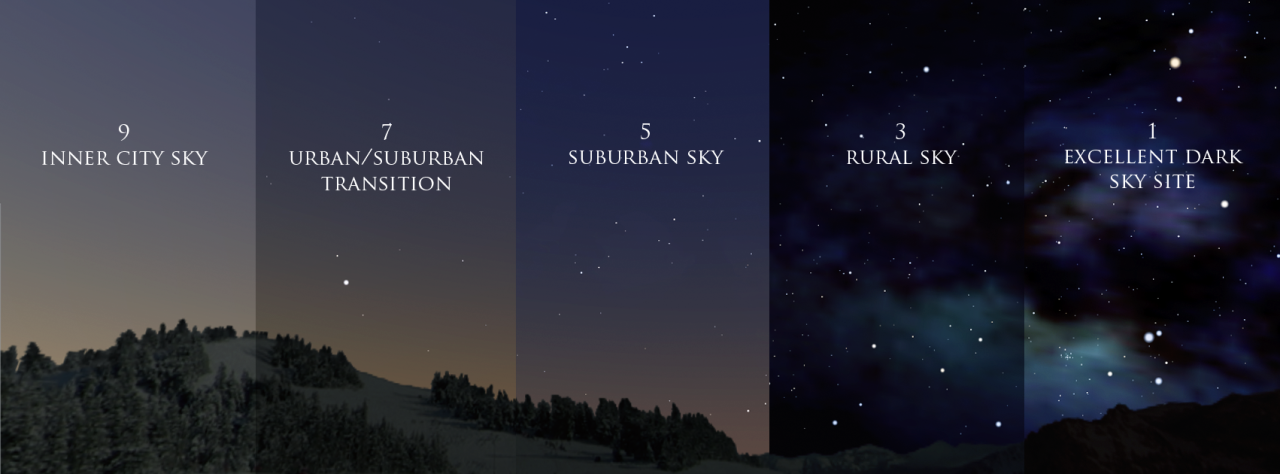
they even have a scale, the Bortle Scale:
http://en.wikipedia.org/wiki/Bortle_scale
http://www.skyandtelescope.com/resources/darksky/3304011.html

And here is a map that corresponds to the scale, similar to the satellite photo on top of the world, but color coded:
http://www.inquinamentoluminoso.it/download/mondo_ridotto0p25.gif

Bortle Scale Map of US

some of the ones in places you don’t expect, like north of the Falkland Islands, or in northern Russia, are National Gas Flares on oil rigs.. yup.. just being burned and wasted so they an get to the oil underneath it.. it’s a dirty little secret people don’t talk about because coal and oil are so much worse than natural gas.
My contribution to this fight was quite small, just an order to install those 7 odd lights in a row on the State highway, no biggie, but armed with this information, as I crawl a third world neighborhood or stand atop Mona Loa by it’s raft of observatories on an impromptu high altitude camping trip (right next to the highest observatory.. had a funny talk with a physicist out to get some air at 3am as I stomped my feet to stay warm in his pretty celestial parking lot, he taught me what the laser was for I kept seeing dart into the sky from his dome), noticing how subtle Kona and Hilo look from on high, since the island of Hawaii is quite commited-ly dark sky to aid the observatories, in addition to being well ahead in a few other national measurements of lifestyle and environmental care as a county. This article doesn’t just let me understand government or science, it helps me understand why I feel scared in certain places, disoriented, miserable, tired driving at night through urban areas, when the gross yellow halon glow of a cheap light makes me feel like I am about to stumble onto a group of Tijuana Thugs, or some weird playing of something from my Silence of the Lambs imagination.. here is some basis to it.. and it helps me also interpret that some places aren’t going to be bad.. they just look bad because of the crappy lighting and the disorienting effect of my not being able to see the sky. Sometimes I wake up in the morning to quite a nice place I might not have expected, since almost every town looks kind of crappy and intimidating when you arrive at night because of the inattention to these very details, and the norming factor of he lowest common denominator of street light, now a global phenomenon.
Thankfully, the solution to this is following behind the pollution, and it ain’t dilution. In places with progressive leadership, people are caching on, and I have noticed Full Cut Off lighting creeping in on highways and in towns from Europe to Ecuador to even the Baja Peninsula. In some places they are federal projects, where this kind of advanced concept is most likely to have registered first, but there are places where I don’t expect to see it and I do, small towns, remote places, and it’s quite inviting when I stumble off a bus or try to find a hotel late some night. It means to me someone is thinking, someone cares about my well being, they aren’t just mollifying the public with flood lighting to address a real or imagined crime problem that almost makes the situation feel worse.
And dare I get through a post without discussing real pollution, because lighting takes energy and energy often takes pollution. There was the argument that most Full Cut Off Fixtures are by nature more efficient, since they have mirrors and need less power to bounce down and around, but some years ago when a guy named Mark Begich was Mayor of Anchorage, Alaska, before he became the Senator from Alaska (Alaskans might tell you, perhaps accurately, that he sold out to the unions to get the job, and that if Uncle Ted had never been besmirched he wouldn’t even be there, but Alaska has more of a progressive soul than the old codger Sourdoughs want to admit! They are problem solvers. ) and when Begich became mayor, he did what the climatically challenged Alaskans do well.. he tried to innovate, and he started to find that although LED lights were starting to come on, no one had made them available for municipal lighting, and they solved two problems for him.. they made a lot of sense to the bottom line, since they use a lot less energy, especially when it is cold and those hot bulbs have to use a lot of energy just to burn, but also, he wanted to make Anchorage look a lot less ghetto for the long winter nights, almost 20 hours at their peak, that ‘ragers have to endure, and it’s not just people that you have to worry about: Moose and Brown Bears have ticked off kills within the city limits in my memory. But he is fighting a deeper endemic problem as well, the persistent urban problems in ‘Anchor Town’ associated with natives with emotional and substance abuse issues who drift into the city from there remote villages with now way of sustaining themselves, Tongan and Samoan gangs that took to dealing and tribalism to deal with displacement and breaks from fishing, and the long standing struggles of Anchorage with Prostitution since the pipeline days when cash was easy, where streetwalkers have became a norm to replace the pressure on the massage parlors of old that the city finally shut down, in places like Spenard and the ghettos of the East Side of town.
http://2.bp.blogspot.com/-0SURBcYJ_GY/UeG49iBnMHI/AAAAAAAABe0/Yf1JN9sh_RM/w1200-h630-p-nu/Alaskan+Street+Gangs.jpg
http://www.treehugger.com/interior-design/anchorage-alaska-to-install-16000-led-streetlights-will-save-360000-per-year.html
http://www.triplepundit.com/2009/02/alaskas-lighting-revolution-sustainability-is-more-than-kilowatt-hours/
The story I heard was that Begich actually had to work with this company Cree to get lamps that would work for the city, they actually were involved in pushing the design forward.
http://www.creeledrevolution.com/revolutionaries/city-anchorage
The white light they give off, while perhaps still bothersome in creating eternal daylight, was of a healthier, whiter glow, and didn’t give off that alarming amber glow, and started to make Anchorage feel cozy again, like it’s far flung cousins on the Alaska frontier, and to start changing it’s reputation from ‘Alaskas Bus Stop’, to a place to live in it’s own right. If there is no other more appropriate measurement, I can tell you that home values in Anchortown are up up up.

And let’s tie in some Disney-fied struggling sea creatures to wrap up as well… to end on an even higher note than the stars we are shooting for, the fuzzy good feeling we get by helping a pelagic in need.. so it turns out that Sea Turtles and their breeding are amongst the most affected by light pollution, a bit like the brown bag rule,… if they see it, they get disoriented, since their biological clock for laying eggs is set to the moon and tides, and they will crawl back out to ocean instead of laying on their chosen beach. More and more of the world’s shorelines are developed, and with people, rich and poor alike, comes alarmist, somewhat ineffective as we heave learned, stay away criminal lighting, if they can afford it, and it is considered one of the factors suppressing sea turtle numbers, along with plastic that turtles mistake for jellyfish, and poaching, and driftnets, and god knows what else (living to 120 ain’t so easy anymore!). So it has become a new concern, and a crusade in many a beach community (I have noticed that the surfier it is, the more progressive, but the limo liberals are chiming in as well, and its a good tune..) to try to make their beaches as dark as possible. Here’s a responsible little rule from a hip little beach community in South Carolina, which even restricts it’s self to mating season in case flood lighting the beach at other times of year is your thing:
http://follybeachnow.com/folly-beach-info/beach-information
Unlike Lebowki’s gold brickin’ ass, sea turtles are welcome in Folly Beach, and nothing says welcome to an amorous female sea turtle like low light and slapping sea waves… take note fellas..

http://www.youtube.com/watch?v=COiIC3A0ROM


Saving Turtles With Sea Turtle Lighting in Florida
http://seaturtlelighting.net/

Categories
Airbus 350 Boats Boeing Carbon Dioxide Carbon Fiber Cars CO2 Dreamliner 787 Eficiency Hope Carbon Savings LearJet 85 Lithium Battery Planes Progress Transportation Weight

Hope is in the Air: What Makes The Boeing Dreamliner Such a Big Step for the Environment

Check this out:
http://www.youtube.com/watch?v=2pw4OE7gM2M
The plane you see taking off is made with Carbon Fiber, from a kit based on the design of the Piper Cub, the famous bush plane, and perhaps smallest of what would be considered a traditional airplane. They usually weigh about 900 pounds. This one weights 300 less because of the difference in weight between carbon fiber and steel or aluminum. The plane landing likely is Carbon Fiber too. A friend of mine once took third place in this competition landing in about 130 feet with a plane, a Maule, that was handicapped for being slightly larger, but I can tell you that people were shocked when this thing took off in 17 feet in 2007, since even a normal cub souped up like a top fuel racer would still need 50 feet to take off.. not 17. In fact, the voice you hear muttering “Wow.. nice landing.. nice…” at the end is likely a buddy of mine, which I put together a few years ago. He was pretty astounded by what he saw there in 2007, as was the whole Alaska flying community. This carbon fiber thing was something big.
http://www.cubcrafters.com/carboncubex
Fast forward 6 years to 2013, and it’s been a tough few months for a low Carbon future in Aviation, specifically, for the Boeing Dreamliner, the biggest innovation in Commercial Aviation since the Concord, the airliner equivalent of that Cub, and the most fuel efficient Commercial Aircraft ever produced, 20% more efficient than any current competitors.

Why it’s been tough is the growing pains of new technology, specifically, a 40 pound battery that used to be an 80 pound battery, that Boeing didn’t want to compromise on when they decided to go all the way in making a big jump in technology:
Legends of Flight Pt. 1
You see, with about 25 planes produced and flying commercially, they had, well, a bad thing, two bad things by the standards of aviation, happen.. two different batteries caught on fire, one in Boston, the other in Japan. Made by a Japanese contractor, the batteries are Lithium Ion derivatives and although these are now the batteries in the Chevy Volt, the new Generation of Prius, the Tesla and even the Leaf and about any hybrid that might be trying seriously to compete, since Lithium’s are almost half the weight of the old best technology, the Lead Acid or Nickel Metal Hydride or some other heavy metal based battery, which are more damaging even at extraction from some Siberian mine. If you watched the above video, legends of flight, you realize now that for competitive and ecological reasons, Boeing tried to make as many jumps as possible in technology, not only in using Carbon Fiber to dramatically reduce the weight of the plane, but in other things like computerized flight controls, shadeless windows that dim electronically and also save a few pounds on the long haul from Tokyo to Timbuktu because you don’t have to haul around the plastic shades and make a place to slide it to and fro, many other ideas, and last but not least, these batteries, which were the first major Lithium aircraft batteries to be certified for commercial use to serve the plane when the engines are off and even out the power flow. What I mean by certification is that if you want to send any old contraption up in the sky, you can in the US just about, but you have to write the word EXPERIMENTAL on it, and the people whose lives you can potentially risk in it are limited to those you can convince without the exchange of specie.. if you are flying for money, the laws and regulations that the FAA use to regulate such practices require extensive testing for any part of a plane used in such a capacity, to make money carrying cargo or passengers or something similar, since you are an uneducated consumer by virtue of how complicated flight is, and somehow flying is considered a bit dangerous, since we all lost our wings when we got sent to this place. These batteries where quite tested, certified even, but didn’t stand up to real world use, although much worse things could have happened then a ground fire and and some in air smoke, but it did point out a problem in these particular Lithiums, which had to be redesigned by their Japanese Manufacturer, no doubt with a few Boeing Engineers breathing down their neck, to stay a bit cooler and to have thicker jackets between the cells, but the reason this happened in the first place was the aforementioned and displayed ambition, to make a plane radically more efficient and therefore less carbon emitting. They could have held back and rested on the Carbon Fiber improvement and still gone with a heavy metal battery, but they pushed the envelope, Right Stuff Style, because just shipping 40 extra pounds of battery, since an older chemistry would weigh about 80 pounds to perform the same work, from continent to continent over and over again, daily if not more, the way these aircraft are designed to do, would have a lifetime cost equivalent to quite a few SUV driving gas Bar B Q-ing Americans every year.
Unfortunately, it was a risk, the whole thing was a risk, and risks are risks because there is a chance of negative consequences. Boeing took on a lot, and it didn’t all come out perfectly, perhaps the price of what I am no doubt painting as a worthy ambition:
http://www.dailymail.co.uk/news/article-2258626/Boston-airport-explosion-Smoke-pictured-billowing-Boeing-Co-787-Dreamliner.html
http://www.youtube.com/watch?v=RK7M0FhyCAw
those with perspective on the airline industry and aviation know that although no accident is to be taken lightly, this is not a hard problem to solve, just like the wing attachment problems they solved with the Titanium brackets during development depicted in Legends of Flight. Once the plane is safely on the ground,
http://www.youtube.com/watch?v=a5QBuJla5do
 aviation goes from being the realm of hero’s like Jack Stryker )roger, Roger!), to the realm of Engineers and FAA inspectors.. just kind of a big lab problem at Kansas State.
http://www.cnn.com/2013/05/07/travel/dreamliner-fix-behind-the-scenes
http://www.youtube.com/watch?v=xaqQuBac2ag
What I am imprssed by here, what I consdider to be a small piece of Environmental and corporate courage, is that Boeing could have gone back to an older proven battery technology, just said to heck with lithium’s in aviation, and put the death knell into that idea for the public for years to come, but they stuck with it, held to their original vision with Lithium Bateries
http://www.youtube.com/watch?v=phKgfJlyfKo
Trying not to notice for a second that they to have the first flight in Etheopia (this blog isn’t about lingering notions of colonialism and racism!), the 50 already delivered planes are all up flying again with the ‘new’ new batteries in place.
Now let’s put aside for a second that an MIT Professor Ian Waitz who studies flight and the environment pretty much says we are F@#$ed no matter what because there are some 30K commercial airlines in operation all over the world, emitting maybe 1.5% of World Fossil Fuel Carbon Emission’s.
http://www.c2es.org/technology/factsheet/Aviation
What do MIT Science Professors and Deans of the School of Engineering know about, umm.. science..
Prof Ian Waitz lecture on Environmental Impacts of Aviation
His pessimistic, umm.. truthyness aside.. hope comes from small acts that become big trends, since no one seems to want to bring modern civilization to a screeching halt to keep carbon levels from hitting the anticipated catastrophic 500 ppm, and these acts lead to a better future we dream of.. no matter how drop in the bucket it may look now, so the 800 Dreamliner airplanes ordered that are 20% more efficient, now, let alone whatever innovations might occur in their lifetime and be implemented to make them even more efficient, are progress even though that may be 80% more carbon than we need still.
But Boeing isn’t alone in this business, they have one major competitor in the Jet Liner world, and they caught on quick, perhaps helped by Boeing’s 3 years of delay while they ironed out countless other issues before the battery. That competitor is Airbus, and even though the last aircraft they designed looks like the antithesis of efficiency, like a 70’s Cadillac to the Dreamliners Prius (the thing is massive, it is literally a double decker!), it was in fact the previous most efficient aircraft, the A-380, since it capitalized off ideas of maximizing passengers per flight with it’s design, since the greatest proportion of fuel used is at takeoff, if you put a lot of people in the air, the longer the flight, the relatively more efficient it eventually becomes.
http://www.airbus.com/innovation/eco-efficiency/
 http://en.wikipedia.org/wiki/Airbus_A380
But Airbus isn’t resting there… the French hate to be bested! Their next aircraft will be carbon fiber as well, and they already have 617 orders! Voilà!:
http://en.wikipedia.org/wiki/Airbus_A350_XWB
Deliveries to begin in 2014, if all goes well, and well, they don’t always, but we are going to keep on trying.
By the way, since I have a bit of American Pride in me, I do want to point out the original voice in the wilderness was, according the the Boeing Museum in Seattle, none other than Bill Lear and Lear Jet:
http://en.wikipedia.org/wiki/LearAvia_Lear_Fan
if you read the story, Lear was working on it before his sad demise to Leukemia, and tried to get his wife to finish it for him. It would have been the first production composite aircraft, some 30 years before the Dreamliner. She tried but it never quite got to production. It would have saved a hell of a lot of Carbon before many even knew that was necessary. This kind of cute story and precedent might be why one of the prototypes is so prominently displayed in the Boeing museum as they stake their future on the same gamble. and Lear’s company is making the same gamble again as well:
http://www.flyingmag.com/mid-size-jets/learjets-composite-airframe-bet
if you read that story, you will see that Beechcraft had a disastrous foray that might have been part of what scared people off for so long, but that’s history now.
http://www.youtube.com/watch?v=zKB9m_Z6XqA
http://www.youtube.com/watch?v=KKZ6UfJoEhM
most of us have likely never watched a private jet commercial, and some of us don’t want to, as Warren Buffet’s describing corporate jet’s as financially Indefensible also applies to their environmental impact, but we take progress and hope where we can get it, and since I couldn’t find any video of the Lear 85 taking off to make the snappy wrap up that Carbon Fiber efficiency is taking off, since the thing doesn’t seem to be done yet, I am stuck with these somewhat awkward videos. They will be the first production Carbon Fiber Corporate Jet that I have heard of, unless Honda get’s theirs out first.
http://www.cnbc.com/id/49269623
So to make a satisfying final jump to prove that carbon fiber is taking off, I will display a few random things from the ground, water and sky.. You see, carbon fiber, like almost any new Technology, is expensive, so at first it becomes a bit mock-able because it’s just in these flashy expensive realms of the rich, but this demand will lead to innovation, mass production and new efficiencies, as happened with the computer and the automobile, and over time, our transportation needs will be met by lighter and lighter and more efficient systems. Battery Technology will start to catch up as well, and eventually some of the transport modes that used to be driven by internal combustion will move to electric only, or who knows what…
feast your eyes:
https://hondajet.honda.com/news/Index.aspx
http://www.youtube.com/watch?v=18pvhne0C8E
http://www.gizmag.com/lamborghini-reveals-sesto-elemento-concept/16522/
http://www.ezequielfarca.com/enproducto.php?id=149
http://www.yuneec.com/
There is one Yuneek Flying in the US, out in Monterrey, California.
http://en.wikipedia.org/wiki/Yuneec_International_E430

http://www.thetruthaboutcars.com/2006/06/carbon-fiber-so-good-it-hurts/

The movement is coalescing:
http://www.aopa.org/News-and-Video/All-News/2013/May/9/Electric-airplanes-EAS-guides-the-way
Viva la Revolucion!

Categories
al Sadr Azzam Alwash Central Marsh Eden Euphraties Glory River Hammar Marsh Hawizeh Marsh Hope Iraq Iraqi Marshes Mesopotamian Marshes Nature Iraq Restoration Saddam Hussein South Park status Tigris

The Restoration of the Mesopotamian Marshes: Twice the size of the Everglades, but being in Iraq makes it..umm.. complicated..

Here’s something I never expected to see coming out of Iraq. It looks more like Moab, it just seems too normal, the anal tepid CNN anchor and all:
http://cnn.com/video/data/2.0/video/international/2013/04/03/inside-middle-east-iraq-babylon-e.cnn.html

I am better aware than most that the US went to War with Iraq the second time under some pretty attenuated public reasoning.. trust me… I might have heard some of the guys who trumped the whole thing up, in person and privately, in a different phase of my life, scheming about it, but that aside, and with all due respect to Sean Penn, Saddam was a pretty bad dude, and no friend to the environment…
We sometimes make a very Muslim mistake when we get frustrated with a political situation in our country, and we declare the enemy of our enemy to be our friend… and almost no one likes War, and well, if you are going to win a war, you need to so called ‘Win the Peace’, but no such luck in this case… However, Rummy, W and the boys, they did know a bit more than the average Tom, Dick, and Mustafah about Iraq, and even as they sharpened their knives and pens to `help Iraq rebuild it´s oil and national infrastructure’, in that order, they were aware of one or two little things that they didn´t necessarily think would sell as well as the ‘Goebbels perfect’ WMD fiasco. You see, in addition to Saddam´s mal-treatment of the Kurds, with Chemical Weapons at times, and the Shiites, and the Iranians.. and, well, the Kuwaitis…and any Environmentalist who remembers the burning wells after the Mother of All Battles, which burned 1.5 billion barrels, perhaps only 17 days use at current rates for the world, but straight into the atmosphere which caused perhaps a sharper than usual high in the saw tooth patterns of world atmospheric Carbon charts, should be as pissed as I was.. (that was pure Saddam), he had also destroyed one of the world’s distinct Ecosystems, the Mesopotamian Marshes.

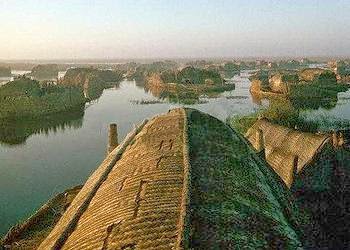
The Mesopotamian Marshes, kind of three distinct basins in south east Iraq, are a place where Iraqi`s used to go when they had trouble with the man… a kind of outlaws paradise, perhaps a Gangsters Paradise, Mess-o-potamia style…and the longer I live, the more I appreciate these little repositories of human wilderness, lawless perhaps, but often with a bit of their own honor. Friends I have familiar with the area from military deployments paint a picture in those early days after liberation of Family feuds settled with heavy machine guns over sleights as simple as Goat theft, endless Internally Displaced Peoples who were happy to support the famed anti American Shittie Cleric Muqtada al Sadr, still not 40 years old today, but the firebrand of Shiite dissatisfaction in the heights of the insurgency when the US was seeming very alone indeed.  Think of the people of the marshes as a Middle Eastern Cajun Clan, doin’ d’ere t’ing in an Arab Achefalaya. These marshes, which had a population of boat people to rival those of  Thailand or the Amazon, numbered at a half million before 1991… were a rich and ancient culture… it´s important to not forget that as Archaeologists find older and older advanced Cultures in places like the Coast of Peru, Hobbit Men in Flores, Indonesia, or older and older stuff in India, the first high civilization still appears to be the Babylonians, again, the Mesopotamians, and as the Cradle of Civilizations’ most geographically protected site, these swamps have to be interesting time capsules of time immemorial.

What the Neocons knew, cads though they no doubt were, but much of the world was unaware of, was that Saddam´s lust for power definitely overwhelmed his love of Anthropology and Archaeology, cute innocent smile though he might have had, and in order to route out his bandit problem, this particular Sherrif decided to do what he was good at by the late 90’s, big horrible acts of supression, and drain the marshes to dry out this problem… Even if he was destroying an ancient way of life and one of the worlds ecological treasures, with a host of endemic wildlife and countless other positive qualities, Saddam was sick of Shiite insurgents, allied with Iran, as Saddam was a Sunni by birth and when convenient to proclaim the faith. The Shiites were definitely not happy with him after his crushing of their insurrection after the Desert Storm, with the sad pulling up of Bush 41 in his commitment to aid insurrections against Saddam in the days, months and years after that war, and lawlessness challenging his authority from what was a bit like the American Swamp foxes lair, the American Revolutionary War Hero Francis Marion, Hollywood-ized ever so grossly deliciously, in the Mel Gibson ‘Rambo meets The Revolution’ action flic The Patriot, but a real person despite Mel larger than life depiction indeed, who operated out of the swampy pine forests between Charleston and Georgetown, South Carolina. If the Brits could have drained that swamp then, they just might have, but this time, as they came in and occupied this portion of Iraq in the wake of the Coalition of Freedom-ism´s 2003 invasion, they were the overseers, along with the Coalition Provisional Authority and a host of other Governmental Agencies, of the Marshland’s slow but steady re-hydration.
http://en.wikipedia.org/wiki/Mesopotamian_Marshes
http://www.globalsecurity.org/wmd/library/news/iraq/2005/05/iraq-050505-usia01.htm
But it wasn´t the British or the Americans or anyone else who got the ball rolling to refill the 90% of the Marshlands that had been drained by huge public works projects that Saddam commissioned, mostly in the form of three huge drainage ditches, one absurdly called the Mother of all Battles Ditch (didn’t they loose that fight?), with an additional absurd Loyalty to the Leader pipeline hauling water to Basrah, bypassing the marshes, that left these areas high and dry for 10 or more years prior to what I will call the re-invasion.
http://en.wikipedia.org/wiki/Draining_of_the_Mesopotamian_Marshes
http://en.wikipedia.org/wiki/File:Iraq_marshes_1994.jpg
 As the Second Coalition’s forces advanced in 2003, the Marsh Arabs celebrated what legitimately was a liberation for them not by toppling a statue, but by tearing out the dykes that held the flow from the slightly uphill Tigris, supposedlywitin hours of liberation, allowing it to begin washing downhill through the ancient marshes in an almost flat shallow flow reminiscent of the Everglades, into the Euphrates, with shovels and whatever they could get their hands on. Whatever feelings one might have about this or any war, it´s had not to find that act of defiance pretty profound. This was an act not much written about in all the confused coverage of those final days of the invasion, but maybe the singular most beautiful event I have heard of in the whole conflict. They were at work within hours of the Withdrawl of Iraqi troops.. it took about 70 years for a similar event to take place in the Florida Everglades last spring through the convolutions of our democracy.

By 2006, the marshes were considered to be 40% filled, but there were problems with the water, due to the salinity of the soil that had been left dry for those 12 years of intense draining, and impacted from draining projects going back to the 1950´s.
http://www.youtube.com/watch?v=G4lBT1YiEw8
Then came a drought that peaked in 2009, which did create some, umm.. shrinkage problems:
http://www.flickr.com/photos/mideaststrategy/5888843020/in/photostream
http://upload.wikimedia.org/wikipedia/commons/transcoded/4/47/Freshwater_Losses_In_The_Middle_East.ogg/Freshwater_Losses_In_The_Middle_East.ogg.360p.webm
The best explanation of the whole story I have found, heck, you could just skip reading me and watch this, was done by CBS’s 60 Minutes in 2011, also complete with an American journalist sitting uncomfortably homo-erotically close to the guy he has to interview over days in boats, but smartly done to explain the situation in general as of 2 years ago:
http://www.youtube.com/watch?v=WhQhtOgXBvo
another somewhat more sumptuous look from some English Documentary makers, also depicting Dr. Alwash.
http://www.youtube.com/watch?v=Ypyzr8-sUt0
So it appears that Dr. Azzam Alwash has become the point man for the battle for the Mesopotamian Marshes (which, by the way, means ‘between the rivers’):
http://www.rivernetwork.org/content/azzam-alwash
Just a few days ago he won what appears to be a prestigeous environmental prize caleld the Goldman Prize:
http://ecowatch.com/2013/iraq-waterkeeper-receives-goldman-environmental-prize/
Man, He’s got some cute daughters.
http://www.goldmanprize.org/
Even the New York Times found it newsworthy
http://www.nytimes.com/2013/04/18/world/middleeast/restoring-iraqs-garden-of-eden.html?pagewanted=all&_r=0
Dang it, I´ve been working on this blog post for a month, an they step on my toes just as I am going to publish!
When the war kicked off, and everyone tried to find a way to contribute no matter how strongly they might have disagreed with the War it´s self, the Italian Government took on the task of trying to restore the Iraqi environment, and the Marshlands become a major focus. Nature Iraq was started,
http://www.natureiraqfoundation.org/index.html
they actually got a new web page recently:
http://www.natureiraq.org/
slick!
kind of the Sierra Club of the newly, umm.. liberated nation, and under this umbrella the New Eden project was created:
http://www.iraqfoundation.org/edenagain/linksgovernment.html
and Water Keepers Iraq
http://www.natureiraqfoundation.org/waterkeepers-iraq.html
http://www.iraqwaterkeeper.org/index.html
They are spreading out and doing all the things you would want an organization in any peaceful country to do: safety training, rafting, water sampling, educational trips.. but this all leaves me a bit unsettled due to, well, a kind of Teutonic need for complete restoration. I want to see the number 100% next to the marshlands descriptions, and right now, I can’t seem to find anyone who posts the land area restored, and no one seems to be even dreaming about it anymore.
http://en.wikipedia.org/wiki/File:IraqMarshesAnnotated.jpg
The Hawizeh Marshes, the eastern ones along the Iranian Border, the ones that were the last man standing and the repository of the marshes genetic diversity after Saddam’s mad plumbing project look fine, healthy in satellite photos, and the ones to the west, the Hammal Marshes, seem to be bouncing back fine if only partially, but the central marshes happen to be where the oil exploration is, and they have, whether due to circumstances or intentions, filled up the least, no one seems to ahve ruptured the Glory River as Saddam named the massive mile wide drainage ditch that drained the Central Marsh, although it no doubt is holding onto a bit of genetic diversity, and now we have next problem on the list: Turkish Dams
http://www.treehugger.com/energy-policy/turkey-vows-to-build-controversial-dam-despite-iraqi-complaints-loss-of-european-support.html
There are flow gages along the river I am learning now from this USGS report,
http://pubs.usgs.gov/ds/540/pdf/ds540.pdf
and people have done the work to understand the basin and write about it in English:
http://www.fao.org/nr/water/aquastat/basins/euphrates-tigris/index.stm
unfortunately, the links for the three promising tables on this page all lead to the same chart that just shows how Iraq only controls 43% of the Territory of the Tigris-Euphrates River Basin, but 93% of Iraq´s area is drained by them, leaving Turkey and Syria to block the vital head water areas for their irrigation and Hydroelectric needs and wants, and nothing seems to let me get to the raw data that would tell me if the situation is improving day by day or not, although maybe I need to take some Arabic lessons first.
http://www.fao.org/nr/water/aquastat/basins/euphrates-tigris/figure03.pdf#fig3
But this entry is about hope, and maybe this is a lesson for me… Dr. Alwash seems to be smiling with the progress made, and he just retired from running Nature Iraq so he can go full time on the lecture circuit and leave the on the ground  (in the marsh!?) work to a new generation of nature technocrats, everyone claiming that in one way or another, the Marshes are about about 50% filled. So maybe this glass is half full, maybe despite the challenges of weather, dam building, tribal warfare, oil exploration, and whatever else might harm the marshes, getting to where they are at, after one of the most heinous acts of wanton environmental destruction in the world, four wars (Desert Storm, the 2003 Coalition Invasion, and the less known battle between Saddam and the Badr Brigades after Desert Storm, and the anti-coalition insurrection that many Shitties fought in these very marshes with the help of Al Queda and Iran until the final withdraw of the US in December of 2011 [I can’t help but notice that in typical CNN style, they are talking about themselves when the last American Vehicle momentously rolled out of Iraq.. yeesh!]) and millions of personal stories of loss, thirst, starvation, displacement, fratricide and violence, cultural upheaval, perceived invaders and economic woes, maybe this is hope incarnate, just perhaps not gift wrapped with a final report the way so many first world stories come. or Maybe it is yet to come, from some still being created Iraqi Department of Interior, some young person still in school today might talk of restored marsh otters and fish species 40 years from now like the man putting the nail in the box holding the holy grail in the last scenes of Indiana Jones, never quite totally realizing what it took to get there, but in a way they are glad he doesn’t…
and one more thing.. according to South Park, even Saddam made it to heaven:
http://www.southparkstudios.com/clips/152292/goodbye-forever-saddam

Categories
2017 Carbon Savings Caribbean Sea Oil Exploration Daniel Ortega Geothermal Power Green Energy Grid Hydroelectric Power Nicaragua Percentage of Renewable Energy Small Nation

The Mouse that’s Roaring Less and Less: Nicaragua Works for a Green Grid

This will seem funny for me to write about a country that as of now gets more than half of it’s energy from from Fossil Fuels ( CIA World Factbook Nicaragua Energy ).. but wait a second.. or a few years, and Iceland and New Zealand might have something to worry about.
I refer to the latter two because they are examples of countries that have put a concerted effort into having Carbon Free National Electrical Grids. From what I know, Iceland, with it’s famous Geothermal Plants creating about a quarter of it’s grid energy, and a good deal more of it’s bragging rights, not to mention one of the world’s coolest spas in The Blue Lagoon, the rest coming from hydroelectric dams. As far as I can tell, Iceland is alone in this distinction.

New Zealand, the kings of practicality, are at an impressive 70% carbon free for their grid, and the rest seems to come from a good deal of Natural Gas that they pump themselves.. the most green-washed of Petroleum products, though far from truly green, but it all makes for an impressive mix given that it has a population some 15 times little Iceland’s 300,000 people.. it{s a national goal to someday be carbon free from an electricity standpoint..
but Nicaragua, what the hell can I be talking about? Certainly one of the poorest countries on earth can’t be
riding up on these two international paragons of righteous unstinking defication!?
Nicaragua is a funny place.. it’s poor as hell is true.. one of the last countries in the world that people seem to make about 2 dollars a day in… it was stalled by war and a bet on communism after a Soviet sponsored but perhaps locally justified overthrow of the Somoza Family who ran the country like a hacienda for some 43 years. Then the Sandinista’s came and did a complete about face from it’s Banana Republic past, but this pissed off Ronald Reagan, and the Contras were formed, and poor Nicaragua, betting righteously on the loosing side in a Global Showdown, got it’s social justice but never quite it’s prosperity.. The Sandinista Leadership under Daniel Ortega, a smart but not necessarily perfect Guerrilla Leader turned President, cashed in towards the end when the writing was on the wall, his Soviet Patrons on the ropes, and his Greatest opposition, an outspoken Newspaper Editor, Violetta Chamorra, winning fair elections after some 10 years of Ortega’s somewhat genuine yet hamstrung leadership. She was, by the way, the first female freely Elected Head of State in the Western Hemisphere.
Anyhow, Ortega is plucky, not that bad, and well, he has the experience, which ain’t too easy to come by in such a small country, has the status to Pal around with the Castro’s and Chavez’s of the World in his old Olive Drab Uniform, and he does seem to see what’s going on even if he indulged in some designer glasses and might be looking the other way as Coke streams past his country… And in 2007 he got himself re-elected again after about 10 years of Chamorra’s party. What makes this important, is that unlike the other petty tyrants of the Bolivarian Movement, he doesn’t seem to want to ignore either global warming or the threat of having a Crude Oil dependent grid, especially when his country doesn’t produce any Oil. Even if he gets it cheap, he still has to pay for it, and he doesn’t know how much longer he can get it cheap. Need I remind anyone that Uncle Hugo just passed on? In addition, as if to remind him of the vulnerability, there was a famous CIA operation during the Cowboy days of the Anti Sandinista movement in the 80’s where some CIA agents laid mines in an important Nicaraguan Pacific port and tried to destroy their ability to import oil, and I believe, tried to mortar and destroy their Oil Storage in the port as well. In such a small country, they are just a few tanks away from the lights being out.
Now here’s where it gets interesting.. Nicaragua just won a dispute with Colombia over Control of Economic Rights of a vast part of the Caribbean sea off their Coast. Now Colombia under Santos is no blustery place… it’s beginning to heal from 50 years of Civil War under Santo’s kind of Clinton-esque humanity, but it’s one of the most Libertarian countries on Earth, and you can sure as hell believe they would have explored for oil had they won, but Ortega, he’s a funny cat, and he said no to oil exploration, for what seem to be environmental reasons..
Reuters:Ortega Says No To Oil Exploration
To be sure, eastern Nicaragua is an extension of Honduras’s Mosquito Coast.. it’s virtually uninhabited, almost everyone living between the lakes and the West Coast, over by the Volcanoes. Did somebody say Volcanoes… yep.. this is the part you have been waiting for.

Now realize that Nicaragua is one of the least electrified countries on earth.. it’s an NGO’s Dream of Neediness, but since they allegedly threw the cleptocrats out in 1979 (there might be a few in the new regime..), it’s a rare case of somewhat dignified forward thinking in the Tercero Mundo, even though the only place to even come close to being a modern city in the whole country is Managua, an ugly one at that.. It’s also important to remember that the whole country only uses less than a gigawatt.. heck, there are living room TV’s in America that might use more than a Gigawatt (especially if they are watching Back the Future! ), but in my humble need for hope, I am going to find it where I can, and little Nicaragua is starting to put some out.
Now this blog post all started with me having a juice in the bar of a pretty old hotel in Leon, Nicaragua, kind of Nicaragua’s Boston.. the Second City and revered university town, where even Ortega attended. Not much o a place mind you, and one of those places where when you meet an expat, you are so far out, you don’t pretend you don’t see each other so you they can maintain their only gringo in the world fantasy.. you talk to each other.. so I asked him what the hell he was dong here, and he said living large and working on the nearby Geothermal Plant. We talked a bit, but like many expats, he was living the nights as liquidly as he was sweating the days, and he blurred into a party with a few of his chosen female companions, but for a while I got an earnest recounting of what I believe was his Canadian Company’s assistance of Nicaragua in their quest for Energy Independence. And the research sustains it.. these are little projects, but big for Nicaragua… I have seen Geothermal Plants around the World, Iceland, New Zealand, Hawaii, and they tend to just be a pile of pipes coming out f the ground and an odd building or two, but they have a magical air, like something out of an old Japanese Sci Fi Movie, and as he described the plant a few miles east of Leon, I got that tingle like I had again discovered the birthplace of Godzilla!
Turns out they built two, and my guess is that he was working on San Jacinto.

http://www.greatenergychallengeblog.com/2012/06/07/nicaragua-looks-to-geothermal-for-energy-independence/
http://renewables.seenews.com/news/ram-power-puts-online-72-mw-geothermal-plant-in-nicaragua-325531
They seem to be expanding as they can, with a possible capacity of 90 Megawatts, which is like 10% of their grid output right now, with likely a few hundred more possible.. feeling a bit hot, Iceland?
Anyhow, they aren’t stopping there.. they are playing with Wind possibilities as well, a few farms that produce maybe 60mw, small installations by world standards, but big drops in this small pond…

my guess is that more are planned… and now to hand it to them, they have a bit of the Brazil thing gong.. it seems that in addition to the large amount of foreign oil they currently have to burn for the rest of the grid, I would guess from their buddies Venezuela or Ecuador, they are able to ween about 10% of it off by burning byproducts of Sugar Cane Production…
http://en.wikipedia.org/wiki/Electricity_sector_in_Nicaragua
and they aren’t stopping there, stepping now intentionally into the biomass world, not just for burning sugar byproduct:
http://www.nicaraguadispatch.com/news/2013/02/agricorp-signs-deal-for-biomass-plant/6830
My guess is that this will keep rolling along and they just might make the goal I recently discovered, for them to be 94% fossil fuel free by 2017
http://cleantechnica.com/2013/01/06/94-renewable-energy-by-2017-is-goal-for-nicaragua/
2017 is hardly an arbitrary number, like countries and treaties toss around for 2025, 2040, and 2050.. there must be projects in the works now to justify such a specific goal. Now if you look at the above link about 2017, there is something interesting if you scroll down a bit.. a list of about 45 countries that are largely fossil fuel free, which perhaps would have been good for me to find about an hour ago when  started writing, but if you examine it, it’s a bunch of countries like Colombia that are kind of accidentally clean because they are small and built a lot of Hydroelectric Capacity, which I will admit is my least favorite clean energy, although I am not going to claim much love for hydrogen or intentional biomass either if it creates more carbon that it displaces.
Realizing this makes me appreciate Nicaragua even more, because they are going about this is such a sophisticated way, not just ham fisting it like the massive Three Rivers Gorge in China… so I am proud to now call little Nicaragua the Mouse that is Roaring Less and Less, in reference to the Peter Sellers Film ( the famous creator of Dr. Strangelove and The Pink Panther Films amongst others), The Mouse that Roared, about a little country in Europe that somehow gets a nuclear bomb almost by accident after attempting to invade America and intentionally loose so as to benefit from something akin to a Marshall Plan:
http://www.youtube.com/watch?v=p7L7WLFBYR4
Nicaragua, for it’s part, selfishly motivated though it may be, is working to diffuse something akin to a doomsday device for the coming century.. Global Warming.

Categories
Army Corps of Engineers Cadillac Desert Chinatown Dams Drainage LA River Los Angeles Los Angeles River Mayor Villagarosa Plan Restoration Runoff Sewer

A Percolating Renassaince for The LA River

I don’t want to ruin the movie magic.. I don’t want to impose fact where fantasy should reign supreme, shatter the illusions that drive the American Fantasy Machine, but have you ever wondered what the heck this was?
http://www.youtube.com/watch?v=b08DChU5qsg
or hows’about this Greese reprise from the cult classic Repo Man:
http://www.youtube.com/watch?v=fN2AXsF-kwc
Oh wait, we got one more! God I miss the 70’s.. how’s this for a svelt action hero:
http://www.youtube.com/watch?v=vF-dgroq4TI
Go Cannon!
That was so random that it looks like the last time I played bumper cars at Lake Quassapaug as a kid…
So kidding aside, it’s the LA River, and what makes the LA River so vital in it’s current form is that, well, it’s kind of a natural disaster, and it has grit, and well, grit can be in short supply in Sunny La La land, but fantasy there is a business (and tongue in cheek, I will say fantasy is a business even more so up in the San Fernando Valley where the river originates, but I will leave that joke up to the adults to figure out!). So when you are too cheap to film on location like The French Connection, why not run people through the world’s biggest drainage ditch to supply a little cement bottled desperation to spice up the visual, even though Paris Hilton is tweezing her dog’s eyebrows a few blocks west.. it’s what’s called character in the land of Sun and Fun.
But I bet a few of you didn’t even ever figure that was a river, ever.. a few of you figured it was just some massive public works thing in the Home from Nowhere landscape of the American industrial nightmare, and I wouldn’t blame you, but a river it is.. and it used to, and upper parts of it still do, look like this:
LA River Kayakers
http://activerain.com/blogsview/3380586/kayak-down-the-los-angeles-river-
Does this photo seem like they have no association with the videos above?

I don’t blame you for thinking that.
You see, since sometime in the mid 2000’s people have started to take the LA river seriously again.. and not just location scouts and cinematographers who endlessly repackage the industrial areas south of downtown and the bridges over the river for car chase after action scene, since car chases in the river are now done!.. so last week! (alright, one more.. http://www.youtube.com/watch?v=5-PCs8V7nLg )
So since I wrote about the East River in my piece of Tidal Power, Hope Unda da East River!?, and nothing makes an Angelino insecure like a New Yorker (and vice-versa, but don’t worry fly over states, you don’t worry them at all, just keep investing in stocks and watching movies), I gotto balance the continent, and this is a worthy story. It’s going to be a bit like the Everglades pieces on a smaller scale, but the chicanery in LA tends to be much smoother and more under the radar. LA functions on a subtle form of indifference than Florida.. In California, the public good is the goal AND people get screwed, it’s not nearly so Latin… ask Jack Nickolson:
http://www.youtube.com/watch?v=3aifeXlnoqY
Believe it or not, Chinatown was about water, the LA River and a few other rivers as a matter of fact,
http://www.youtube.com/watch?v=ppGd-2nEOVQ&list=PLE3500CBEEC5651D0
but I’ll get into that in a bit.
My awareness of the LA River as, well, a river, began with my coming across this article a year or two ago, 2011, about the Winnipeg band Twin, and their attempt to Canoe the LA river as a break from Tour:
http://blogs.laweekly.com/informer/2011/04/what_happens_when_six_canadian.php
I feel like I read a version of it in an airplane magazine, and it got my wheels turning. If you didn’t read the whole thing patiently like required of all readers of this blog (Eat Your Meat!), the upshot is that they got arrested, but the fallout has been that this act of civil disobedience, intentional or not, started the wheels of progress turning on the LA river somehow a lot more than the token act by party hound LA Mayor Anthony Villagarosa in 2006 to begin exploring actions to improve the river, or, to be more honest, to turn it into a river again.  

http://www.lariver.org/download_publications.htm

While the plan may be a well written piece of Ecological and Urban Planning, but LA is cash strapped like everyone else these days, and the funds aren’t really there, dream though it may be, but it has been a theme of this blog I am starting to realize that little changes come first, the big changes later, like a locomotive building steam, or perhaps like floodwater coursing down a 50 foot deep channelized sluice that once was a natural watercourse.. things start with a trickle…
So this story comes tied into the three bogeymen of the environment of the American West (I’ll leave out the other three perhaps, the BLM, the DoE, and global warming for now..), the Bureau of Reclamation, the Army Corps of Engineers, and the LA Water and Power Company. Unlike in Chinatown, and the shenanigans of the California Water Wars in 1915 in the Owens Valley, or later in places like the Colorado River, Colombia River, just about every trickle of water in California as far north as the Klamath, and places like the Hetch Hetchy Dam and Mono Lake, the story of the LA river is a bit more straight forward *straight forward indeed, it’s runs like a bullet!); it was a river.. it flooded, and destroyed things that perhaps shouldn’t have been there in the first place, but were, and the solution became this huge gutter we have now. I would love to give you some stories of intrigue that acolytes of Marc Reisner’s groundbreaking book (since the west is a dry crust these days anyways!), Cadillac Desert would eat up, http://www.youtube.com/watch?v=8SPakQ7hH6I ouch!  watch with caution! but I ain’t nosey enough to imagine a conspiracy theory here. It was, well, again, straight forward.
The idea is that it doesn’t rain much in LA, about 15 inches a year before things started going wacko as we approach 400 ppm CO2, but when it comes, it often comes in torrents. The heavens literally open.. the ground is covered mostly in cement which can intensify rain through rapid heat release, what little ground there is is usually bone dry and doesn’t soak up the rain at first, and to jokingly quote Robert Deniro in Taxi Driver, a NY movie by the way, the rains come and wash all the scum off the streets.. and it has to go someplace in a hurry, scum and all… When there were just natives living there, the Tongva People, known to others as the Gabrielenos, they were used to it, lived on the high spots or the beaches and anticipated this, but then came the Missions, then the Hasciendas, then the Orange Groves with American Families like that of George Patton’s coming west for a new life after their loss in the American Civil War (yes, George Patton was an Angelino, should have been obvious due to his flair for the dramatic.. as an odd bookend, Admiral George Mullen, recent Chairman of the Joint Chiefs of Staff, also grew up in none other than Hollywood.), then movies and weather, sun and fun, caught the dreams of a restless nation and world, and within a century the LA basin and it’s environs had to support not the 100k or so people at it’s beginning, but 20 million odd persons now.

So those 20 million people didn’t want to have their homes washed out past Catalina Island once a year as was likely, so they did what Army Corps and Bureau of Rec do so well… they channelized, made it an express bus, and drained the water like any good mid century water engineer dreams of…pollution and all.. does this sound familiar from my Piece on DDT? That river got the same treatment, and dumps out a few miles over from the LA river.. It’s a weird thing, driving around LA.. there are hills for natural features, but nothing you would call a  river.. it’s as if the natural topography got washed away, you never use any ground features for navigation, just the freeways and major boulevards, and for all the desperation the place has for water, they began to look everywhere but right under their feet, as the estuaries and cienegas were dried up for land land land, and almost every inch of rain that fell was exiled to the Pacific instead of being allowed to replenish the local aquifer like happens in just about any place on earth we haven’t screwed up (It appears I was a little premature in this judgement, as they claim to capture 80% of the water in, well, man made dams for replenishment, which give LA 15% of it’s water  scroll down here to ‘DAMS and FLOOD Control’ near the Bottom. I do wonder if that was a post ‘filling in every natural water body in the basin’ figure to come up with 80% replenishment.).
It’s a funny thing to, because I often compare how water moves to how money or emotions move around a place, and California’s state budget is likely the wackiest and most obscenely funded, and if you get pissed at an Angelino, don’t expect much, because your anger flows right off them without soaking in like water flows down the LA River Channel, it’s water off a ducks back, if they didn’t choke to death on soap suds and motor oil, the LA thing is to simply not give a crap what you think.
After the Flood of 1938, which claimed 113 lives and did 40$ million worth of damage in the dollars of the time,

 we were already in the mood for big projects, with the infrastructural leap forward being performed to try to grind us out of the Great Depression,  the US for all intents and purposes a socialist nation at the time, and that flood was all ti took to get the attention of the swarm of ant like workers and agencies created to fix any problem they could find, and 3,000,000 barrels of concrete were laid by 10,000 hands, wait, 20,000 hands assuming they all had them all, 10,000 workers, to fix it up nice and good. Dam’s were built within the next few years. The Greatest Generation didn’t cut no Corners! You could land the space shuttle in that place…
The Core: Endeavor Lands in the LA River   wait.. they did! Didn’t know that Hillary Swank had her Pilots licence, did ya!? Actors are Awesome! Kind of Gives you an aerial view of the problem at about minute 5 doesn’t it… man, what excitement!
But like I said, slowly things are sinking in, and not just on the maybe 5 miles of the 48 mile course of the main branch that aren’t ‘channelized’, and since 2006 moves by the USDEP, Local government and now Local People are starting to happen. There were declarations about that time to declare the river navigable, and to start giving it status’ that just about any other river in the country has under the Clean Water Act.
If there is one thing I know about LA, nothing is hipper than activism.. ask Barbara Streisand or Warren Beatty.. it gets you laid! And activism in LA happens in groups, big showy pretentious groups, but in this case, woo hoo.. the big showy pretentious groups will be another good excuse to show off your buff, sports bras and even swim suits.. doing good one narcissistic hang at a time.. time to pull the Prius over and do some kayaking, because online and in the ‘river’ there is a proliferation of activity since Twin’s 2011 attempted float.
They have had an advocacy group since 1986, but now they seem to have like 4!
http://folar.org/
http://larivercorp.org/
http://www.laep.org/target/units/river/riverweb.html
but why hope now… well, since 2011 the traction seems to be happening.. online you got a documentary:
http://www.youtube.com/watch?v=zdWl35DIqHk
might have been older, but they finaly decided to post it…
then you got the Kayakers:
http://lariverexpeditions.com/page_about.php
http://www.theriverproject.org/projects/paddle-the-river
http://paddlethelariver.org/Paddle_the_LA_River/Home.html
http://www.kcet.org/socal/departures/lariver/confluence/river-notes/even-more-la-river-kayaking-expansion-news.html
Again, this is all in the last two years..
check out the bar on the right, where KCET, the local PBS affiliate has aggregated things about the river:
http://www.kcet.org/socal/departures/lariver/confluence/
and the Park plan from 2006 is starting to happen:
http://la.curbed.com/archives/2013/03/stretch_of_la_river_will_be_open_to_the_public_this_summer.php
Now Runners are in on the Game:
http://lariverfunrun.com/
Now people are noticing..
http://www.guardian.co.uk/world/2012/aug/27/los-angeles-river-storm-drains
http://online.wsj.com/article/SB10001424127887323530404578207642711599814.html
http://www.economist.com/node/21524902
But let me bring you to what to me is the most important link, but let me explain first: People who complain about the Military tend to not have met too many soldiers since the Army went volunteer. They are a pretty crafty and well intentioned group, and if you make it through this video, which rehashes a bit of what we have been discussing, while throwing in a few extra facts, there is a subtly seditious act at the end, again, from 2011. These Army Corps guys have been watching their buddies in the Everglades and elsewhere, they know what environmental restoration is, and they know they can accomplish both flood control and environmental restoration. They are the new breed, and it looks to me like they are asking for the cash to take on the task of creatively turning this sewer back into a river:
Army Corps of Engineers on LA River
Looks like the trickle is turning into a flood..
So maybe it’s time I go home, for my own good, like Jack Nicholson..no matter how pretty Faye Dunaway is. I think it’s gunna happen on it’s own… and I need my nose for other things…
http://www.youtube.com/watch?v=8G0BVEIjGyo&list=PLE3500CBEEC5651D0

Categories
Air Polution Alaska Cartagena Refinery Colombia Diesel Dinosaur Bones Progress Refining Stink Sulpher Ultra Low Sulfer Diesel United States

What’s That Stink?!: Low Sulfer Diesel.. One Small Step for Man..

Soundtrack: I always thought this song was called What´s That Stink, but it’s What´s at Stake, which is somehow even more appropriate for this post:
Mighty Mighty Bosstones: What´s at Stake
If I had a version of hell as a kid, it was being stuck in the back of the family Station Wagon, the seats all taken by others, trekking down an anonymous American Interstate, in the families 1980 Diesel Station Wagon. It was the Griswalds meet something out of the horror movie Hostel. The stench from the sulfur from both our car and the surrounding trucks made me want to pass out more than once, and perhaps once or twice I did, propped up between my dad´s musty suitcases and the back window, which I used to beg to have opened from 12 feet away to the front seat for air, just to have the stench kick in from the tailpipe, curling up in the icy slipstream of what was usually a New England winter, and make me realize the true devils bargain I had struck, and that we were striking with Diesel. We had a cat named Snowball that gave up the ghost on one of these trips. We assumed it was because my older sister, also once stuck in what we called the Waaay Back with me due maybe to a family friend along (she used to use her 2 years advantage in size in any way possible to avoid this fate), clogged off his little cat box breathing holes with the necessary down jacket some winter trip, but I´m now going to chalk it up to carbon dioxide poisoning in my past the environmental innocence of the 70´s´ new found awareness (this post ifs for you, Snowball!.. sniffle…). I didn´t think much about conservation at age 5, but I sure as hell knew something wasn’t right. This car, by the way, became a legendary turkey, is now on the list of ten worst cars of all times, the Oldsmobile, Buick, or GM station wagons from 1980. You see, Diesel is powerful, and needs a high compression ratio to burn (1 to 9 is typical for a gas engine, like ti was supposed to be, and for a Diesel, you start at 1 to 14 minimum, and go up from there to as high as maybe 1 to 24), especially with just a glow plug instead of a spark to make it commbust, and what GM did, since it takes about 2 years to cure the steel an engine block properly, or at least did in the technology of the day, is take a bunch of gas engines they had on hand, and just call them diesel after the country went mad for fuel efficiency in the wake of the Gas shortages during the OPEC crisis.. since they were short on appropriate ones and people were clamboring for diesel. The end result, to the endless snickers of the Click and Clack´s of the world, was that the crank shaft would literally blow off the bottom of the engine after a while…

10 worst cars of all time
There she is.. the Cutlass Cruiser.. our´s was light blue..
should have been a warning!
So diesel, you have smelled it for years unless you grew up like Romulus and Remus.. it is the power of world ground transportation, and much of our medium scale water transportation as well..

 it is less refined than gasoline (hey, it´s a workin’ man´s thing.. if you refine me, you take away the spunk I need to get things done! Keep your classical music, I loves my rock and roll!) so used to be cheaper, that stench that reminds you of nothing good, belching from a bus you are hustling past, emanating from an idling truck next to the park you are trying to chill in, roaring from the back of some ranchers truck who came into town to catch a Brooks and Dunn show.. it’s something about that combo of mechanical sound (is there something loose in there.. why does it have to make so much noise!?) and smell that the brain finds nothing good about that makes it a foul thing.. and if now is the age of petroleum, than when it comes to hard work, it is the age of Diesel, because it packs more heat and more dependability than any other fuel source at normal temperatures. I know because I personally tried to replace it. I worked on electrifying a boat once, giving it a system to support one of these nifty doo dads:
http://www.torqeedo.com/us/
I once asked a friend of mine at the time who was a salvage captain, and who had been kind of around helping me with my boat conversion, what he thought of what I was doing, and if he ever would think of changing his over. He often worked in bad storms and hurricanes, and his answer was no, because he said he could turn a garden hose onto his diesel and it would just keep whirring away, didn´t even need the electricity going once the glow plugs heated up.. it´s kind of a crushing blow to those of us who know that every ounce of carbon emitted right now is a step further down a long path to a bad place, but this is the logic of the immediate, so how can we find hope in this.. well, back to that stink… that stink is a lot of the things that are expensive to refine off, so, of course, they didn´t, but that stink didn´t do much for diesel power either.. some of the chemicals might have provided engine lubrication or burned to create a bit more unf, but what you really need out of it can still be there if you filter the other crap out that is part of the toxic soup that comes from the dark depths of the earth as crude oil. That stink is mostly Sulfur, and in this form even less somehow enticing than that wet fart smell you get in geothermal springs (c’mon, you know deep down inside you kind of sniff it and like it sometimes..) or after eating too many pickled eggs..
So it ain´t full stop, it ain´t world wide conversion to electric power (give it a bit more time) but the nations of the world are slowly starting to come around individually on what is known as Ultra Low Sulfur Diesel
http://en.wikipedia.org/wiki/Ultra-low-sulfur_diesel
You see, when the stench is raw, that’s 5000 ppm.. that’s the old stuff. when I cross into Mexico and an old School Bus from Plano Texas welcomes me by roaring into my face until the feeling I want to vomit reminds me my id is home, that is the hard stuff. the 5000 proof..it´s Tequila for trucks..
Rusty Cage by Johnny Cash, warning, scenes from No Country for Old Men
you are back in the 70´s, hells bells for progress, collateral’s be damned…
We seem to have shot right by Low Sulfur Diesel, which does not have any definition.
When you can´t smell the sulphur hardly at all, but you know it’s there just enough to remind you of the old days, you are down to 50ppm, Where Ultra Low seems to be defined, although it’s a nation by nation process. 50ppm is where the US now are, and even places like Thailand as as of 2012…in fact, Europe is down to like 15ppm or less.. that’s the true Ultra Low Sulfur Diesel.. it ain’t that howling moan and stench that makes you think the Gates of Mordor opened up, that stench of dinosaur bones and bleak despair that is something out of the tranche of finally honest 70´s movies, something by BBS productions, or the sad fantasy of machines ruling the world in Maximum Overdrive, it’s actually a bright new future where we might not realize we are harming the environment quite so odorously, or be reminded of it quite so intensely with every stifled breath, but it is better than nothing, because in fact, Sulfur is a bit like Methane, it traps a bit more of the old heat than a standard CO2 molecule does, so supposedly, while changing to sustainably derived electric propulsion is ideal, this is better than nothing. Alaska was slower to adapt than the rest of the US, I think about 2010.. I could smell the difference.. it was like having a nightmare return for the years between US adaptation and Alaskan..
Anyhow, so recently I was in a tropical country, and I was settling into the first city I would visit, and I saw a crew of expats doing what they do, getting drunk and making trouble.. they were the kind of guys I have become used to in places like this.. they are bored, and they bide their time carousing and drinking, but they tend to be a lot more thoughtful than first presentation would indicate.. they left home for a reason, perhaps the money, but there is usually a story there, and these guys didn’t disappoint.. I could tell they were leery of me, so I broke the ice a bit, and I could tell that leeriness was because they were doing something they thought I might not like if I were reflexive or simple.. as the night wore on, I did learn that they were in resource extraction, and that they were working on helping this country rebuild it’s refinery capacity.. since I had revealed a little knowledge, they let me know that while they were helping this country, which I will admit is Colombia, become independent for refining, as they are currently a net exporter of Oil, but have to import refined products, that the expansion in capacity they were working on in Cartagena, but also is being worked on at the other refinery in the boom town of Barrancabarmeja, is in fact going to be low sulfur… they said that the Colombians ¨dinked around for a year¨but the project is on the way, and the two year project is a year done, so look for fresher air in northern Colombia by sometime in 2014.
Now I can’t seem to snap my fingers and make diesel go away, but I breathe a bit easier when a bus goes by back in the good ol’ US of A or Europe, and I am looking forward to the day when Colombians don’t have to hold their breath as they scurry down the streets away from traffic.. they may still be getting poisoned.. we might still be short sighted-ly causing our doom, but it might be a little more hopeful to not have to know so obviously you are being poisoned, and maybe Colombia´s cities and towns will become a little less grey as a result…sometimes perspective is everything…
Off to burn more Dinosaur Bones… Yee Haa!
King of the Road

Categories
Amazonas Cattle Cattle Ranching Choco Coca Growing Colombia Deforestation Ecology Farc Forest Jungle Logging Mining Sierra Nevada de Santa Marta

The FARC as Forest Stewards

War is a funny thing.. loaded with unintended consequences… so what happens when the world´s longest war happens in one of the World´s most beautiful countries.. well, amongst other things, a lot of preserved wilderness.
Now this is a funny argument to make, might even be controversial, but hear me now and believe me later, the FARC have been good for the ecology of Colombia. Now before this sounds like an advocacy of the FARC, let me first say that I am not even going to pretend I advocate anything about them. I don´t tend to have much patience for cafe revolutionaries. I could compliment them.. they are tough, they can be effective, and they have held out for a long time, sadly with the aid of a lot of Cocaine Money, and even some help from old Uncle Hugo next door. I could even say that most of the FARC rank and file genuinely believe in what they are doing, I can´t take that away from them, there are a lot of kids living in the jungle with good intentions, but it has been a long 50 years, and even old advocates who saw just how oligarchic Colombia was now believe that it’s time to move on from this struggle. I will say in addition that things like the Valle De Cauca Assemblia Hostage Taking, and the accident though it might have been, up in Bojaya, Choco, with the Gas Cylinder Bomb, give me chills, it was brutal, but war is a funny thing, the world is a funny thing, and somehow, I am arguing, the FARC have been good for the forests.

Let me lay out my point.. when you drop through the rogues gallery of Colombia, there are a few big wheels that have been really wreaking havoc for years.. the FARC and ELN, the now demobilized M-19, the Narcos, the Paramilitaries, but wait, this ain´t no poli sci lesson, this is about ecology, and hope so where they heck am I going with this.. alright, lemme tell a side story for illustration.. I once met a British Army Jungle training specialist.. it was a particularly emotional time for him, because he was in the spot where he had first seen the hint of war at the age of 16 or 18 20 something years before.. he was in western Belize, where he had gone with his regiment to stop a Guatemalan attack on the country, which would have used the San Igancio-Belmopan-Belize City road as it’s axis of attack.. so sometime in the 70´s this guy was a scared kid straddling that road to the west of San Ignacio with his regiment, right where I happened to be staying when he wandered into this bar in San Ignacio a few years back looking for someone to share the story with. I was game, and after he relived it and got a few Belikins into him, I started to ask him about the Jungle, about the Nature you might figure I kind of dig.. so he listed off all the jungles he had seen, and it was a loooong list.. so I then asked him which country had the best, most pristine jungle, he had an answer… I believe he said Guinea-Bissau, in West Africa, although it could have been Guinea, but satellite shows Guinea-Bissau being a lot greener, but anyways, when I asked him why, he said it’s because the people there are afraid of the forest, so they leave well enough alone.

Well, if you are a Guerrilla Army that has given your country the grand distinction of “Kidnapping Capitol of the World”, like Colombia is often referred to, then you have created a good bit of Fear yourselves… and I don’t like making Lemon-Aid out of Lemons, but it{s hard not to see some here (actually, Colombians prefer Lime-Aid…). So Colombia is a beautiful country, Jaw Dropping at times in the drama of it{s mountain scenery and jungle expanses, but if you ticked down that list of powerful groups that like to throw their weight around, you would get to their Cattleman´s association quicker than you think. In fact, you would still be on your first two hands.. they have a lot of the Government by the Huevos, and in addition, have strong ties to both the oligarchy, who tended to be the landed gentry, and the old Paramilitaries that are proving to not be so old as land redistribution becomes a hot topic with the Peace Negotiations in Havana and a few months ago in Oslo (this post might actually be quite timely, the negotiations are going well, and this war could end soon…). The Paras are rearing their ugly heads in parts of the country where cattle ranches are being redistributed back to people forced into the cities.. you see, Colombia has a huge proportion of urbanization due to 50 years of trouble, 75%… you are hard pressed to find many third world countries higher that aren’t either in the desert or City States.
CIA World Factbook on Urbanization
again, good for the Environment, bad for the country perhaps, as a lot of a nation’s wisdom comes from those who live close to nature, and not many do in this country who aren’t either carrying a gun or growing something that the law man might not approve of. to round off the list, the Coffee and Coca growers, although the Coca growers and the FARC go hand in had quite often, are two more groups that do like to saw down some wood.. there is logging in Colombia, but nothing on a scale of destruction that makes it stand out.
So back to my main thesis, take a look at this Map:
Colombia Reports FARC Front Map
I bet you if you go anywhere there is a FARC front, you will find a solid forest canopy.. there might not be much bush meat left, but the trees will be growing… since trees = cover… the one exception is where Coca might be grown, which does like it’s share of sunlight, but Coca in the Carbon equation likely beats cattle, which the FARC, I will give on good authority, like to steel cows as well when all that fightin´works em up an appetite, people are even leery to graze near them.
It turns out I am not the only one to notice their occasional ecological bent:
Miami Herald Article on The FARC as Ecologists
and if you travel this country, from their greatest stronghold south of the Llanas in the northern Amazon along the side of the Sierra Occidental South of Villavicencia, to the savages of Choco, the rainiest place on earth where the Marines in Nuqui joke about the FARC front 2 km away and how no one has shot anyone else in years (If you want to know what a weird War this is, and why it has gone on for soooo long.. google the Human Right´s Laws of Colombia), the forest is pristine, and Embrerra Indians still live in their native ways, same in the Sierra Nevada de Santa Marta, where their old Front 19 of 800 people is down to perhaps a paltry 15, but the old fear dies hard, and people don’t mess with the woods there…
now before I sound too much like a cheerleader again, I will say their record ain’t perfect.. they blow up oil infrastructure that starts fires, they get involved in some destructive mining operations, and they get in fights with the natives over Coca growing and ecological issues in which case they sometimes kill them if they get too mouthy,
Blog Post by The Marjan Center for the Study of Conservation and Conflict
 but I will gander that the majority of their Areas of Operations outside the good Coca areas (which tend to be mid level mountain sides) are forests worthy of National Park status… something for the boys in Havana to consider, because trust me, the cattle ranchers, lumbermen, coffee men, and coca growers might be looking forward to peace as much as anyone.. so a funny thing to find hope in a war, but I am not quite advocating you grab your trekking shoes, even though they recently disavowed kidnapping.. stick to Peru! I don’t have any stats to back my assertions up, and if you have been reading, you know I love stats, but call it a hunch.
I will admit that I recently read a book on the Orchids of the Serranía de Baudó, just a tiny range by Colombian standards but essentially untouched perhaps due to the FARC, by a Plastic Surgeon from Medellin (trust me, he stays busy), who took it upon himself to explore this range for a week or two each year, over 20 years, until he had found close to 400 species in a small area alone, and I can imagine this is just the tip of the iceberg for what Colombian guide books continually proudly describe as the Megadiversity of their country. So fellas, lay down yer arms, but don’t let the bastards come in after ya!