Categories
Eastern United States Elk Hunting Kentucky lotttery Minnesota permits Possible Reintroduction Tennessee Wisconsin

Elk Populations of the East: Past, Present, and Future, as the Tide of Reintroduction Rolls On

One of the Most popular posts on this Blog has been my writing on The Return of the Elk to the East. It’s been so popular that I feel a follow up is called for.
I said about everything I knew at the time in that post, so I figured why not dig in some more and provide some more raw information for the autodidacts out there. As a service of information, I thought it might be fun to list where the elk are now as public herds (there are a lot of meat and trophy herds, which is great, but the public herds are more likely to be free roaming and an act of wide scale species restoration, although not to take it away from the Ted Turners of the world who are privately trying to bring about ecological restoration, but their neighbors might complain, and it’s harder to complain to city hall). I also searched news stories and the rumor mill as to where they might go as states and parks make active plans, and where they could go by my observations of places in the east that are wild enough. As I research, it turns out that it doesn’t take a huge area.. Virginia placed their herd on 3 square miles of recovered coal mine where most of them will stay if they manage for numbers, but many of the herds are much more woodland and widely ranging.
let’s start with where they started:
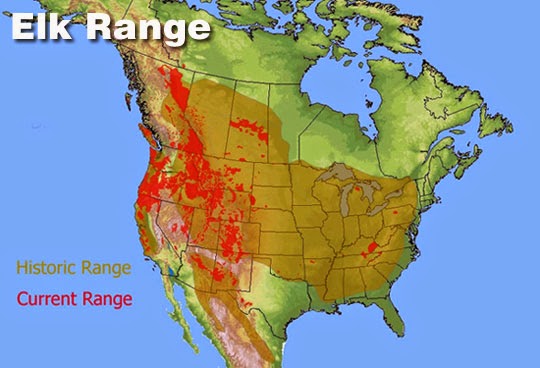
As many of you know, the Eastern Elk subspecies, Cervus canadensis canadensis, has been extinct since 1880, but bloodlines are ideally being brought east from the closest relatives in Alberta and the Rockies but some have come from as far as Arizona and Utah. They have been thriving and producing huge specimens.. the ones in Kentucky are considered to be some of the largest in the country, as the forage is so great compared to the west, they aren’t pressured out of rich bottom lands by Mountain Lions, Grizzlies and Wolf (yet, although maybe some black bear take an interest in the young) and the Eastern Elk subspecies was also known for being the largest of the species, perhaps due to the richness of the thick forage and the fruit bearing trees like the old American Chestnut.

There have been a few phases of the modern history of the Elk. They were extinct in the east by the Civil War is seems, and by the east I mean East of the Mississippi, although you could argue that the great planes separate the east from the west and therefore Iowa and it’s north to south rank of states, from Minnesota down to Louisiana, and even the next rank, Oklahoma up to North Dakota, are Eastern States.

The First phase of restoration came in the age of conservation brought on by Teddy Roosevelt and the realization that the great ages of logging and the beginning of the machine age had almost completely stripped America of it’s above ground natural resources by the beginning of the 20th century. Because of the destruction of wolves in Yellowstone National Park, there was a crisis of overabundance of Elk in the park which led to the exportation of Elk by train to about 11 eastern states,

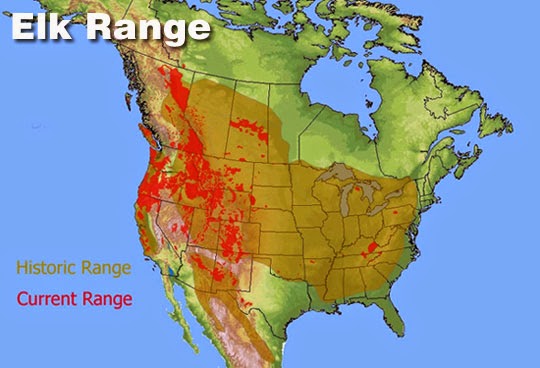
this map is about 5 years old and reflects reintroductions going back to the early 1900’s and is already outdated by great successes in the recent 2000’s

but they survived in only 2 to the present. In the rest they were hunted to extinction during the depression or in the 50’s for food or due to conflicts with agriculture, and little was known about what they needed in terms of habitat and territory. The dawn of the Environmental age in the 70’s and 80’s brought more sophisticated management to the two herds that did survive, Michigan and Pennsylvania, but it was the bold act dreamed up by some wildlife officials in Hazard County Kentucky (yes, the Hazard County immortalized by the Dukes of Hazard! ) that led to the major initiatives now in about 6 other states and hopefully will keep steamrolling into a full scale elk reintroduction to all the wilder recesses of the east. I was just told by one wildlife biologist that it’s the hot topic in the upper Midwest as budgets loosen with the end of the great recession. Hopefully we are entering The Golden Age of the Eastern Elk Restoration.

Where they exist now:


Number of Public Elk in the East as of March 2015 from internet sources:

Kentucky 14,000 + 40=14,040
Pennsylvania 900
Michigan 650
Arkansas 500
Tennessee 400
Wisconsin 235
North Carolina 140
Missouri 125
Minnesota 120
Virginia 90 +10=100
West Virginia 100 + 24=124
Illinois 23
South Carolina    1         
Total   17,293 or so totals for 2014 from public records I could find, and current efforts alone are expected to exceed 20,000 in the allocated areas. A far cry from the millions of yesteryear but a good start.


Herd Description by State
Arkansas
Arkansas has had one herd come and go since the extinction of the Eastern Elk, but efforts in the early 1980’s led to a second herd along the Buffalo River in the North West part of the state (flowing out of the Ozarks to the White river which connects with the Mississippi near Memphis), that has grown healthily from 112 individuals from Colorado and Nebraska  to the nearly 500 individuals running around this National Park Service protected river basin today. Arkansas Manages to keep increasing the population while allowing a hunt for about 30 individuals annually outside the National River area which is where the core of the population resides.
http://www.uaex.edu/publications/pdf/fsa-9099.pdf
http://www.nps.gov/buff/learn/nature/elk.htm

Illinois
This one will surprise you. There was a town called Elk Grove, that felt a bit dumb not having any elk, so they decided to remedy that, in 1925. If that’s not quite the story, here are the facts. There is a herd of elk, more a zoo display than a wild herd, in the suburbs of Chicago just north of the town of Elk Grove, just past O’Hare Airport, the Busse Woods, Officially the Ned Brown Forest Preserve. The Elk are on a pasture that allows for about one acre for animal, with some woods, for a usual rotating total of 20-30 animals. There is a guy who get’s paid to drop off and pick up individuals every so often to mix it up genetically with wild populations and farm populations. The Manager told me it’s an ideal mix of 70% field and 30% forest, and Cook County maintains the fenced in population by popular demand on this ring of parks that surround the city about 4 miles from it’s center, I believe as the execution of a plan by Frederic Law Olmsted. I have been to see them, and it’s definitely unique given that you can almost see Sears Tower over your shoulder. Despite Trophy buck in the south part of the state, this is the only Elk herd I know of in Illinois.
http://fpdcc.com/busse-woods/

Kentucky
The major Kentucky herd is the big eastern herd.. rumor has it there are 14,000, many more than the 10,000 officially stated, and they are spilling from SE Kentucky around Daniel Boone NF into Virginia, West Virginia, and Tennessee, forcing those states to take steps and legitimize their herds. The seed herd came from Kansas in 1997, then hundreds more from Utah with  goal of importing 200 per year for 9 years until they could reach 7,000 with domestic births, but they stopped after 6, having gathered others from New Mexico and even Nebraska. I have read that 1550 was the final number imported but I might be wrong. There is hunting now with ’bout 30,000 applicants for 1000 permits.. 1 to 30 are actually good odds given the other possibilities east of the Rockies.
http://fw.ky.gov/Hunt/Documents/1314ElkReport.pdf
Great Article on the Kentucky Elk effort in the late 90’s
There is a minor herd at the west end of Kentucky at the Land Between the Lakes National Recreation Area, that mix with Bison in a 700 acre enclosure within the park area. I have driven past it, and it’s a nice big field, and it’s neat to see perhaps the only area where Bison and Elk commingle publicly east of the Mississippi, but It wasn’t much more impressive to me than the Elk Pasture in Illinois until I learned from the article above that it was part of an experiment to see if the other subspecies of Elk from further west could survive brain worm. This was before the Fish and Game guys in Kentucky knew about the herds in Michigan and Pennsylvania, which experienced fatality rates of 2-3 percent due to the malady.  They should have read this blog post!
http://www.landbetweenthelakes.us/elk-bison-prairie-story/

Michigan
About 650 elk in North Central part of lower Michigan (the second knuckle of the middle finger of the mitton). Like in Pennsylvania, this herd has been around for a long time but suffered from ups and downs of neglect, but has been on the up as states became more ecologically minded since the 70’s.
http://www.michigan.gov/dnr/0,4570,7-153-10363_10856_10893-28275–,00.html
http://www.michigan.gov/documents/dnr/Elk_Management_Brochure_429864_7.pdf

Minnesota
This massive but agriculturally strong state has 2 small herds or under 100-120 individuals total that seem to be a blending of imports from the west in much the same way as Pennsylvania, around the times of the population explosions in Jackson Hole due to predator extinction that had Tetons and Yellowstone park managers shipping elk east on trains. There might be some Eastern Elk Blood left because those imports occurred in the teens before the last wild elk were shot elsewhere in the state in the 1930’s but I could be wrong.
The Grygla herd is close to the NW corner of the state, but the Kittson herd is literally on the Canadian Border and get’s some occasional blood from Canadian Elk drifting south. Compared to what is going on in Wisconsin, this herd seems over hunted and unappreciated, and it makes one wonder why not move it to someplace like Boundary Waters or at least dedicate more space to it. Without much research, it feels like it’s a bit mismanaged or neglected politically or otherwise.
http://www.dnr.state.mn.us/hunting/elk/index.html
http://blogs.twincities.com/outdoors/2013/01/10/1720/
But there is some greater hope for this in Minnesota coming from a unique direction. I am going to write below about a neat opportunity that is being generated by the Fon Du Lac band of the Chippewa Tribe and their resident Wildlife Biologist to create either one large or two more herd’s on lands they have ancestral hunting rights to that cover large parts of North East Minnesota.
As a neat foot note, there used to be Caribou even just 100 years ago in the Voyageurs National Park area and maybe other areas of Northern Minnesota, and attempts were considered to restore them in the 1980’s, but it was hard to put together the full coalition needed there in Northern Minnesota and White Tail Deer were present in such densities that the transfer of diseases like I believe Brainworm which are fatal to all cervids but deer made it difficult, and now it is felt that Global Warming would make a herd in this range of just 100 years ago un-viable, to use the lingo. there is evidence of Elk in the area perhaps 2000 years ago, but while a large wild area, it’s only due to global warming that perhaps ideal elk conditions will occur here in the near future, as they would more likely be to the south and west of this area under the normal climate and ecology patterns of the last few hundred years.

Missouri
“As goes Missouri, so goes the Nation” goes the saying. In 2010-2012 they imported 110 elk from Kentucky to South Central Missouri, an area around a place called the Peck Ranch, and as of the winter of 2014-15 they supposedly have about 125, and they expect the population to start to explode soon, with only an occasional mountain lion floating around to hunt them. Human hunts are being held off until the number fills out the territory.
http://mdc.mo.gov/node/10867
http://krcu.org/post/missouri-elk-herd-grows-no-hunting-yet

North Carolina

about 140 individuals as of 2012 centered around Cataloochie Valley on the North Carolina side of Great Smokey Mountain NP. 25 were introduced in 2001 and another 27 in 2002. The herd has split with a breeding pair having roamed one major valley west near the park entrance in Ocanalufte with it’s mowed areas serving as perfect Elk Habitat, and now supporting 20 or so of the 140 individuals.
It was felt that the Red Wolf reintroduction to the park in from 1991 to 1998 failed because there wasn’t sufficient game. The Elk don’t roam much beyond the Cataloochie but it’s hoped they will recolonize the whole park, and maybe someday there would be something to keep a wolf’s attention for more than a few months in the park.
http://www.nps.gov/grsm/learn/nature/elk-progress-report-49.htm

Oklahoma
Oklahoma has wild elk in 30 of it’s 77 Counties, and has since their reintroduction with just 6 elk in the early 1900s, 1906 I believe. They were only extinct in Oklahoma for 28 years, since they were extirpated in 1880. I would assume mostly to the west and in the Panhandle, and just had it’s first public statewide hunt in 2014. Populations are centered around the Wichita Mountains of South West Oklahoma where the 1906 releases occurred.
http://digital.library.okstate.edu/oas/oas_pdf/v43/p229_232.pdf
in 2014 the first hunt was approved with 60 takes allowed, but for the life of me I can’t find any published reports of the actual population in the state.
http://newsok.com/commission-approves-elk-hunting-season/article/3939464

Pennsylvania

There is a once small but growing herd, maybe the first reestablished herd in the east after eradication, which wasn’t seriously managed until the 70’s and 80’s and dipped to low double digits in the 30’s. As of January 2014, according to the sate web page, there were 900 elk in North Central PA and they were taking about 30 a year in a lottery that has 20,000 applicants
A Thorough History of the PA Elk herd

South Carolina
Sometime in October 2016 a Bull elk decided to kick off self introduction to South Carolina, by trotting south from either the Cherokee Reservation or Great Smokey Mountain National Park..
Let’s hope this even prompts South Carolina to cement it’s gains.. it’s a great and wild state and Elk would fit in quite well!
Agh, by January 2017 they brought it to Charles Towne Landing, a state park that is the Jamestown of South Carolina, the oldest settlement, just across from modern Charleston to be part of the Zoo there. Free the Elk! Bring in More!

Tennessee
I used to live in the Volunteer state, but I hadn’t caught wind of this until now. Although both of Kentucky’s her’s come within the width of a gnat’s ass of being in Tennessee, the one at Land Between the Lakes is confined, so it would hve taken an Elk Jail Break, but it turns out that Tennessee has done a full on wild herd on the Cumberland Plateau, which runs across Eastern Tennessee like a ribbon NE to SW, in addition to what might spill out of SE Kentucky on it’s own. So chalk one up for TN.
Between 2000 and 2008, 201 elk were released in Eastern T-N, 6 releases in four locations for a total of 201. I don’t see evidence of more releases despite a plan to import 400 total, which might mean it was a victim of the great recession that began later in 2008. but 201 is plenty.. The Elk came from Alberta, and Land Between the Lakes provided a few, which were also said to originally be from Alberta.
The Three release spots were Horsebone Ridge, nearby Montgomery Fork Creek, The Sundquist release site east of I-75 which also includes the Hatfield Knob Viewing Platform and Sanctuary , and Hickory Creek which runs right through the heart of Sundquist. and and they have been given what looks like 1000 or so square miles to play in which looks like it bumps up to the Kentucky border where there must be other herds in the Daniel Boone National Forest, all within an hour or two drive NW of Knoxville around the town of aptly named Huntsville.
http://www.tn.gov/twra/pdfs/elkzonemap.pdf
in 2014 TN gave out 6 permits, I think about the same amount they have been giving since 2009, and they estimate that the population has doubled to around 400 since the first releases in 2000. They estimate that this area alone, the only area that TN seems to be actively reinstating Elk on, could handle 2000 individuals. This is a neat celebratory video with a lot of detail from the 2009 first hunt:
http://www.tnelkhunt.org/tn-elk-program.html
http://www.tn.gov/twra/elkmain.html
If those Elk in North Carolina decide to do some mountain climbing through Smokey Mountain National Park, they would be added to the TN side as crossing the major ridge in the park also puts them across the state line. I don’t see any mention that this has happened yet, but it’s just a matter of time, and TN will join Wisconsin and Kentucky (and Minnesota although I don’t want to put them on a pedestal) with two populations.

Virginia
Virginia is a recent success story, but it turns out it has has a tiny herd for almost a century, a bit like illinois, for years, so two stories to tell. Someone beat me to telling the story in exceptional mapping detail on this page:
http://www.virginiaplaces.org/natural/elk.html
so I will just paraphrase with the major facts, but first the little oddity of the Bellwood Elk Herd.
http://www.aviation.dla.mil/userweb/pao/elk/elk.htm
http://www.aviation.dla.mil/userweb/pao/elk/WebBellwood%20Elk%202013.pdf
As you can see, especially if you click that brochure link, the Department of Defense’s Defense Logistical Agency bought a beautiful farm during World War II near Richmond, which is a big hub for military equipment storage, that already had a resident Elk population imported by Mr. James Bellwood, a wealthy naturalist who was the last private owner of Bellwood Estates. When it was sold it was insisted that the Army Department as it was then maintain the herd, which they still do on a 20 acre enclosure on the compound, although it appears they used to let the elk mow the lawns before it likely became a safety issue.
The DLA maintains the herd at 7-10, and as with the Cook County Herd in Illinois, excess are traded to other conservation herds.
But now onto the main event, which is the recent establishment of a herd in an area called South West Virginia, the pointy part that ends in the famed Cumberland Gap that was the easiest route through the Alleghenies, now more commonly know as the Appalachians. Virginia knew it’s hand was pressed by Kentucky, whose herd would keep growing into this exact area, and you can bet some progressive members of the state wildlife commission and likely some employees decided why not be proactive. A Plan was drawn up in 2010 to make it happen, and a budget was set of about a half million dollars over two years to import elk and prepare the territory.
http://www.dgif.virginia.gov/wildlife/elk/management-plan/elk-restoration-operational-plan.pdf
and they wrote out as many of their options as they could come up with in a detailed study:
http://www.dgif.virginia.gov/wildlife/elk/management-plan/elk-restoration-and-management-options-for-southwest-virginia.pdf
In may of 2012, 16 were radio collared and released in Buchanon county (pronounced Buck-A-Non down in those parts) which is the county that tops the little spur of SW Virginia the pokes up around the bottom ebb of West Virginia and has Kentucky on it’s west border. They established the herd on some old Coal Mining land, a big field of about 2000 acres that as seeded with forbes for restoration near War Fork that serves as a home territory the same way it is done In Pennsylvania with Winslow Hill and now Tennessee with Hatfield Knob. There are now 90 elk in the area, of I believe 70 brought in from Kentucky, the east’s Elk Breeder Reactor, in three deliveries over 2012 to 2014, the last totaling 45,  and they are hoping to get to about 400 before they start up hunting in earnest although it has begun, especially with farmers in nearby counties like Tazwell worried about their crops being expropriated to the Bugle Brigade. The Management ambitions were also downsized to that 400 from a bigger dream of 1000 or more with the protests of hunters in the more ag dominated Counties to the South East. Buchanon County, along with Dickson, Wise, and tiny Norton County, are part of the Cumberland Plateau, hilly and more suitable for woods than fields, that runs all the way down to Alabama and has been the site of the KY and TN major releases. the Area where there is resistance is part of the Ridge and Valley geographic area that runs all the way up to the Shenandoah and has about ten times the agriculture per similar sized county. The state hopes to contain the Elk to those Cumberland Plateau counties. The state appears also to be intent upon a once every two year helicopter study of where populations might have gone all along the Kentucky border areas of Virginia, as has been happening since just years after the Ky release in 97. In a way, the Buchanon County effort is just making it official.

West Virginia
I know the Appalachian Mountains very well, and can brag to have once walked their length, but when people makes jokes about them, I can think of a lot of impenetrable places in them, but the deepest and most impenetrable spots to me, as someone who knows them, is southern West Virginia and the adjacent areas of Kentucky. Nothing comes out but coal, timber, and chickens, and some good football players.. the people are loyal, despite some hardships, and stay put. it’s perfect elk country.
Now West Virginians are a cautious people, and although they started with plans at the same time as Virginia, they are moving at their own speed, but moving as we speak. Just days ago, in March of 2015 their legislature passed plans to make elk restoration happen, and RMEF just gave them the first of the grant money that will likely pave the way, 50,000 dollars.
There are already elk from Kentucky in West Virginia, so I am going to keep them in this column and estimate there are 100 already, and I look forward to that number growing. Now I have a reason to pop into southern West Virginia one of these days, which remains as exotic to me as Northern Burma or Bolivia even though I have been all around it.
Update January 2017: There are 24 Elk living in a pen-stock at Tomblin Wildlife Management area, known as the Big Ugly Wildlife Management Area (I’m not sure if this is true, it appears the area was renamed for the current governor.) which were recently brought in from Land Between the Lakes in Kentucky and are settling into their 3 acres before the gates come open on a paradise of acres and acres of southern West Virginia Elk Land. Two areas are selected to receive 75 elk each in an area near the heart of southwest West Virginia, the second not yet selected, but likely to be the Wyoming and Mingo County line areas near the VA/WVA/KY tri border. I would expect that these herds will eventually mingle with the Kentucky and Tennessee herds, although it could take a decade or two, and perhaps with the Smokey Mountain Herd, to make a Great Southern Appalachians Herd.

Wisconsin
The Badger State has had one small herd in it’s North Central Wilds since 1995 near a place called Clam Lake, closer To Duluth than any of the states major cities, when 25 Elk were imported from the old Michigan herd , due to an effort by students at U of W Stevens Point. They have grown to around 160 but the Wolves have circled, and the population has struggled to grow and remain genetically viable. As I write however, two groups of elk are being imported from Kentucky on orders from the top,  the Governor and Legislature and are either in roundup or quarantine or traveling as I sit, the first group of 75 to be released in an area near the Black River State Forest between Minneapolis and Milwaukee, not too far off of interstate 94 and a second in the next few years to join the Clam Lake herd and give it the boost it needs to spread out and grow despite the demands of being perhaps the only eastern herd to have it’s age old natural predator.
http://dnr.wi.gov/topic/wildlifehabitat/elk.html
It’s fair to say that Wisconsin is Jumping in in a big way like Kentucky did, and it’s great for the environment of their state. They don’t expect the two herds to touch, which they will manage at about 2000 individuals collectively, but it’s a serious effort to restore Elk, and it might dovetail with effort’s in Minnesota I am about to write about below near Duluth to create a multi state area as has begun to occur in the Cumberland gap area where Virginia, West Virginia, Tennesee and of course Kentucky are all tending herds, with North Carolina’s Smokey’s herd likely to someday expand and join.

Where they are talking about or planning on having them:

Maryland
In Annapolis and in the western part of the state, they talked about it but took a pass, for now:
http://rmefblog.blogspot.com/2013/07/maryland-passes-on-elk-reintroduction.html

Minnesota
It’s hot off the presses that the Fon Du Lac Indian Reservation near Duluth, not too far from Wisconsin, is considering a herd on tribal managed lands. They are one of 6 Chippewa reservations in Northern Minnesota, and are the one closest to Duluth.

 Now the Reservation in it’s self is not huge, maybe 80 square miles, and is spotted with tribal and non tribal land, although there are some small suitable spots on it’s west side, but the bigger story is that the Fon Du Lac have negotiated tribal hunting rights since they agreed to a small reservation in the 1854 that give them legal right and even authority to manage over some huuuge areas of North West Minnesota:

Their plan right now, and when I spoke with the tribal Wildlife Biologist Mike Schrage he was realistic that this was a 10 year process and that it would start with capacity studies and the regular steps that all other governmental agencies do in this modern age of more bureaucratic and precise but also undeniably more successful conservation. They have honed in on three areas of interest in the ceded territories, that don’t conflict with moose land, and work well with the heavy logging that occurs on state forest lands that allow for ample elk habitat, and this is one of many neat acts of Tribal conservation reintroduction I have noticed recently, starting with Buffalo on the Unitah and Ouray Ute Reservation in Utah, and then the Blackfoot Reservation, and Mike told me this wouldn’t be the first time for the Fon Du Lac’s who already have run a successful lake sturgeon reintroduction program on the major river running through the reservation, the St. Louis, which has been hailed as a major success, and they are working on wild rice as well I now see. Then remember that one of the Wisconsin restorations happened on former Ojibwa land and they might have had a hand in that, I am tempted to write about the parallel system of Tribal governments who can jump start ecosystem restoration without the inertia that the federal and many state governments have to overcome. 
These are the areas they are looking at, and although it’s a ways off, I bet you hear bugling within a few years as the tribe exercises their rights in a neat way to restore what they enjoyed in pre-Colombian times.

New York
In the late 1990’s there were a flurry of papers and articles on the idea of restoring Wolf to the Adirondacks, as well as Elk to there and the Catskills. There is now occasional voices advocating, but nothing official.

Wisconsin
Repeating from above, Wisconsin is going to open a second herd in the next few years in the middle of the state Near Black river State Forest, off of I-94, and they are hoping that the seed herd of 75 from Kentucky turns into 390 or so given the projected carrying capacity of the area.

The Missing States:
Maine ?
New Hampshire  ?
Vermont ?
Massachusetts ?
Rhode Island  ?
Connecticut (all of New England! Why wouldn’t elk cross the Hudson? were they extirpated by Native Americans prior to European settlement starting in 1620, or is there no archaeological record? )
New York
New Jersey
Delaware
Maryland
South Carolina
Georgia
Alabama
Mississippi
Louisiana (up north!?)
Iowa
Indiana
Ohio

Where they could go:

I’ve seen every state in the union, so I know some of the nooks and crannies.. by my estimation, here is where you could put em without too much rukus.

Southern Indiana
Southern Illinois
South East Ohio
The Adirondacks
The Pisgah
North Georgia
North West Alabama
The Ozarks
Isle Royale National Park
Wild areas of the Upper Peninsula of Michigan
Land Between the Lakes National Recreation Area
The Roan Highlands of North Carolina/ Tennessee
Grayson Highlands of Virginia
Green Mountain National Forest
White Mountains of New Hampshire
Northern Maine & Baxter State Park  The North Woods as it is described by some. is it too cold in New England or did they once roam here?
Western Maine
Arcadia National Park
Mississippi bottom lands from Louisiana, Mississippi, and Arkansas all the way back up to Minnesota, although they might not prefer this habitat
Voyagers National Park/Quetico/Superior NP (see discussion above under Minnesotta)
Delaware Water Gap NRA New Jersey
Categories
Barnes California Condor Copper Bullets Endangered Species Act Hunting California improvements Liberal and Conservative compromise poisoning

The Rise of the Copper Top: Copper Bullets are Making Life Cleaner for You and Longer for the California Condor

I’ve written a lot of posts by now. There have been a bunch of themes that have come out.. success is good, pollution bad, full ecosystems are good, and oil is bad, and one underneath has been that it’s a bummer if we have to regulate to fix a problem if the regulation doesn’t yield any other benefits to us. If we are walking off an ecological cliff, it’s nice to still do it with our constitutional dignity as any red blooded American will tell you. that leads us to the Red Blooded topic of this post:

No one will scream more about civil liberties than an American gun nut, and it’s a weird juxtaposition that some of the most active outdoors men are hunters, not hikers with Master’s degrees in Ecology and rugged good looks as the REI catalog might have you believe, and hunters are by nature gun nuts. About 6% of Americans hunt in any given year, and maybe 15% fish.. with likely a lot of overlap between the two. It’s become a sub theme of this blog to explore Red State and War Zone environmental successes, search where most environmental writers might not be comfortable searching, because as much as the global warming fight and many other eco fights are championed by the left, it’s when the right buys in that things tend to happen, money starts to flow, and the right tend to be really successful at things they set their mind to. I’m not a Randian, I just have never seen Al Sharpton create value, not that he is required to, but most solutions take resources even if simple prohibitions seem called for, since we have divided the modern world in terms of property, and the left, away from the major cities, usually doesn’t have a large portion of the resources.
If a Conservative act’s like an Environmentalist, it’s called being a Conservationist. This is a polite code word for Hunter in the ecological world. They tend to be driven by a desire to preserve habitat, which is awesome, but they often get a crazy gleam in their eyes talking about how nature needs man to balance it out scientifically with ‘takings’, which means shootin’ stuff.  In a lot of environmental fights it’s been the alliance of pristine environment seeking lefties and ‘nature filled with delicious and ample game’ righties that has made the difference for a greener planet. Half of many successful green movements wears camo is a funny way of saying it. But this story, the story I am about to tell about Copper Bullets, slices this Oreo a different direction. It’s back to the classic Blue vs. Red , Left. Vs. Right, regulation Vs. freedom narrative, but if you talk to those involved, the Conservationists are now thanking the Environmentalists for better Gun Control, but by gun control I mean better targeting.. what I mean by that will be explained a few paragraphs down, but here is a hint:

So remember the California Condor? One of my first Hope posts two years ago or so was about this humongous flying dinosaur.. and it’s sensitivity to DDT and Lead poisoning… let’s face it, like some of the guys who used to puke on me in College, the condor is pretty un-evolved. At one point in the late 80’s there were only 22 individuals of the species in existence!  It doesn’t have a lot of adaptations to some modern stresses since it’s about as old as they come, kind of like your grandparents and the flu. And with only about 425 of them alive (and increasing!) there isn’t a lot of room for the species to undergo natural selection if it is to survive on this planet. It suffices to say that if we want the Condor back in place as the top scavenger on the western part of this continent, we need to keep DDT out of it’s blood and Lead out of it’s stomach. Well.. the DDT thing.. big Success… Check!
However, the lead thing.. man.. that is a bit harder.. and here is why.. Condors are Scavengers.. they eat dead animals, and when you think about the reasons they die, people hunting and abandoning game with the bullet in it for them to scavenge is one of the largest. And when I say people hunting, to be clear, what I mean is people using guns to hunt mostly mammals, with a lead bullet, and then abandoning the portion of the meat that has lead contamination to the gut pile, the portion of the animal the bullet, bullets, or pellets passed through, tore up, and contaminated. It’s well known to most hunters that especially if you use a highly frangible ammunition, an ammo that breaks up on purpose, or lead shotgun pellets, or even solid lead bullets that don’t break up but leave a trail as they pass through tissue, that you don’t eat that part. If you do, studies show, in any part, you spike your Blood levels of Lead for a month or two, and it can lead to both short term and long term health consequences including neurological issues (remember the Lead Paint chip jokes when we were kids?). Maybe you know the old rumor about Rome falling because the people went nuts because they used lead in their newly invented Plumbing. The Latin word for soft metals is Plombo, the root of the word for Lead in many languages and it’s Atomic Symbol PB, so you can see the connection. So most hunters dispose of this part of the animal, and that often means dropping it where you dropped the animal, leaving it to nature to clean up. In come the scavengers.. crows, vultures.. they might get sick, they might even die.. but we don’t notice it as much because there aren’t only 425 of them under more surveillance than the Mob in the 80’s, over two countries and 5 wild release sites. If it’s a Condor that dies, the 35+ million dollar rescue effort that has been undertaken to save them kicks in to high gear and they get an autopsy, and unlike the nameless crows, vultures and coyotes that might stumble into a bush and die from lead poisoning, they produce autopsy results that might lead to lawsuits, laws, and regulations. Since the first release in 1991 in Big Sur, every condor in the world get’s watched like.. ummm.. a condor! From Baja Frontera (the north state of Baja Penninsula in Mexico [Mexico has 32 states.. cool huh!?] where a number of pairs were released into it’s highest mountains, the Sierra de San Pedro Martir ) to Central California to Northern Arizona and southern Utah, they are all watched attentively by government agencies, numbered, and accounted for whenever possible, even by casual observers on twitter .
So all that scrutiny I am talking about.. it leads to reports, Gubmn’t bein’ gubmnt’, and the autopsies I talked about.. have a look at the latest report, from October 2014 (that was 3 months ago I know.. yup.. they are late..) and once you have familiarized yourself with it, scroll down to page 9:
Condor Program Monthly Status Report 2014-10-31.pdf
what you might have noticed is that there were 10 deaths from lead in 2013, and easily as many suspected or pending for 2014.. that’s more than 2% a year of a population numbering in the low 400’s..
http://www.fws.gov/cno/es/calcondor/CondorCount.cfm
Now obviously the west is littered with old bullets, and it ain’t good for anyone.. it get’s into drinking water, washes into oceans, and into the muscle tissue of fish, or into wind driven dust, onto plants we eat, and into the blood stream of animals we eat, but the big issue here is specifically that they eat the contaminated Carrion, so even though those bullets lying in the dirt everywhere from last weekends shootathon in the desert aren’t a good thing, it’s the specific act’s of current hunters that cause these deaths.
Enter the American Entrepreneurial System stage right..
guns aren’t a new thing.. the Chinese invented gunpowder I am not sure how long ago, and continue to love it (ever been in China at New Years.. give up on sleep and just enjoy it!). At some point someone invented the gun:
http://en.wikipedia.org/wiki/Gun
there is is.. 10th century in China.. it made it to Europe by the 13th…
so lead became the de facto ammunition.. heavy.. easy to heat up and work with.. cheap and available.
http://en.wikipedia.org/wiki/Bullet
I’m not a metal or gun historian, but at some point people began to coat bullets with copper for a few different reasons: They don’t leave residue on your hands and on your rifle barrel, they don’t mushroom upon impact, which is banned under certain conventions, and they hold up well.
http://en.wikipedia.org/wiki/Full_metal_jacket_bullet
But for some reason, this company called Barnes Bullets, started in a guys basement during the great depression, started to make pure copper bullets in the 70’s with some success.
http://www.barnesbullets.com/resources/about-us/history/
http://www.americanrifleman.org/articles/2014/10/20/barnes-x-bullet-25-years-of-premium-performance/
That last article tells the story well. It was this guy, Randy Brooks, whom Barnes convinced to buy his company back from some people who were letting it languish:
From what I can tell, they were the first lead free manufacturers of Rifle Ammo, and it had nothing to do with saving Condors, since that is an idea that makes a red meat eatin’ hunter blush. They are made in Central Utah now, and were just bought up by Remington Firearms, also an Ammo manufacturer. 
I recently spoke to one of the factory representatives for Barnes, and he told me they make the with a press.. they cut grooves in copper round stock, and jam the tip into a bind which seals the bullet to a point and hides the seams, until it fired into something and splits up, leaving so much damage that hopefully the prey dies quickly and doesn’t run off on you, which both laws and the unwritten code of hunting requires you to stalk until it dies, which is a huge fear of many hunters, and a somewhat sad occurrence to witness.
http://www.barnesbullets.com/
I once spoke to an experienced hunter in a hunting store near the Book Cliffs of Utah. Myself and a motley group of friends were trying to shoot a Bison that one of our buddies had magically drawn a very rare ticket for, a golden ticket of sorts, and we were trying to learn as much as we could and buy the right kinds of bone saws and knives before we took off into the wilds, and this guy spotted me grabbing some copper bullets. I was grabbing them because I am a greenie, no doubt about it, but he just happened to be walking by, and was a local hunting guide, and just said something like ‘nice choice dude’. I started joking with him and asked why, which led to an hour long lesson for me and my buddies on a lot of things we needed to know. You see Hunting Bison was very new in this area, just a few years old, but he had done it, as people who had drawn the tag had hired him to ensure success. It was a serendipitous meeting, but he started off by explaining to me that he didn’t give a shit about the ecology and all that (This guy is a Conservationist, remember before?) but that the bullets were the most accurate he had ever used because the process of extruding copper into rods to be made into bullets traps a lot less air bubbles than Lead. He said that over a 600m shot, not uncommon in the open territory around us, those little air bubbles can have an effect on the external ballistics of the bullet, making it fly erratically in ways you might not notice at the usual 100 meters. He said as much as he hated what was happening in California and in DC to give Lead Bullets a bad name, these were batter for a number of reasons. They are also longer for the same weight, measured in ‘Grains’ by the gun community, since they are lighter, and that additional length for the same weight can also lead to a faster and truer flight.  Some other companies followed suit, two I have found, wait.. three, and started making them on lathes, an even more precise, for big game hunters for whom that one shot is worth every bit of 3 bucks a bullet if it means making a 20 thousand dollar rhino hunt successful.
http://monolithicmunitions.com/
http://www.gsgroup.co.za/04hp.html  These guys are in South Africa, where big game hunting is big money.
http://site.cuttingedgebullets.com/
But then the condor thing started to get real.. the precious few were dying again like before they gathered all the survivors up and bred them in safety, and California did what it does.. it started to make rules the make the world a bit more perfect in their eyes, and decided to ban Lead ammo in a 7 county area of Southern California in 2007:
https://nrm.dfg.ca.gov/FileHandler.ashx?DocumentID=82836&inline
 and passed a law to ban it in all of California for hunting, passed and signed by Jerry Brown in October of 2013, by 2019:
http://leginfo.legislature.ca.gov/faces/billVotesClient.xhtml
Utah and Arizona, the only other states where the Condor is hanging it’s hat right now (it obviously isn’t wearing it) created voluntary programs in the affected areas, the only politically expedient moves in these very conservative states, that seem to have some success:
http://wildlife.utah.gov/wildlife-news/1293-california-condors-get-help-from-hunters.html
Now there is a precedent for this kind of ban and move.. it started a long time ago with Waterfowl and Lead Shot.. every time a duck hunter fired a shotgun blast from a blind, he was tossing ounces of lead into the environment. The government and Conservationists and Environmentalists all got together and banned lead shot in waterfowl hunting, and steel shot replaced it, a but more expensive, a bit faster, but people adjusted and waterfowl numbers rebounded in surprising numbers. The birds that didn’t get blown out of the water were often bottom feeders like ducks, and they would ingest pellets that fell to the bottom of a pond, or river, or slough, when their cousin Donald got the 12 gauge dinner invitation, and die with it in their stomach from some combination of poisoning and starvation:
http://www.fws.gov/cno/news/2000/2000-177.htm
estimates are that the ban saves over 1 million ducks a year (imagine how many more if we restored the Grand Kankakee, but that’s another story). Now while I will bitch all day long about the California Plastic Bag ban and many moves towards Idiocracy, that steel shot ban in 1991 did not lead to an abrupt outbreak of tyranny in the US, and it was interestingly instituted under the watch of a Republican, none other than George Bush 41.
Barnes bullets have been trucking along for a long time before the ban and maybe they don’t even want the boost that will come with the ban in 2019 if it means a step towards tyranny. The NRA will no doubt fight this and other moves, but for better or for worse, the ban is leading to lot’s of ammo makers adapting Copper bullets, from Federal to Winchester, and government contracts for the military are moving that way as well. Barnes just received a major sniper bullet contract for instance. PMG and a few others are behind the game, but used to have contracts with Barnes I recently learned. 
All in all it’s just ounces of progress, when the Carbon war and other environmental fights are measured in Millions of Tons or thousands of acres.. etc. etc. but each tenth or so of an ounce might be one Condor saved, one crucial piece of genetic diversity, one more step towards restoration of food webs, which despite arguments to the contrary, tend to produce the widest variety and volume of overall game. Hope will turn into satisfaction when the 10 lead poisoned Condors a year turns to none, and they fill out their original territory, but the effort, improvements and a little bit of cool man pleasing technology are going precisely where they should, one round at a time.
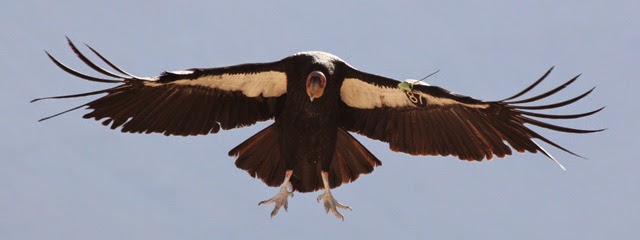
it’s hard to make these buggers look cute.. but they do look impressively huge and vulnerable!
http://www.huntingwithnonlead.org/videos2013.html


Categories
carbon reduction Carbon Savings co2 savings consumer revoution description energy savings era law LED math money savings movement requirement

The Rise of the Light Emiting Diode (LED)

They are cool.. literally.. you know them by name as well as by sight now.. they set the tone in swanky night spots and they let you know you are in a modern place, the adorn cars looking for street cred as well as those so helplessly geeky they only appeal to the efficiency obsessed. When you were a kid they blinked on your hi fi and on the bridge interments on the Millennium Falcon, and they seemed to last forever and glow on the other side of your TV room a bit evilly when you were trying to fall asleep. They made remote controls possible, saving that tired ass trip to the Zenith to change from the Yankees game to Maverick, and for some reason it took years to go from these simple uses to being basically everywhere, but now they almost are, at a time we need them most…

This is real simple math, even if you have been curled up with that remote control for the last 40 years and are a little groggy from when you nodded off when the Star Spangled Banner was ceding to the Test Pattern (remember when we had more channels than programming.. those were the days.). LED’s are 5 times more efficient than incandescent bulbs, and twice as efficient as Compact Florescent, the ol pigtails that were the last green wave. but to make it even better.. they last longer than both.. more than twice as long as the CFL, and as much as 25 (!) times as long as the Incandescent.
http://energy.gov/energysaver/articles/lighting-choices-save-you-money
 They can get hot, but not as hot as the Incandescent, which looses 90% of the power that goes through it to heat.. Once that was the big jump, from natural gas and fire.. in the times of Edison, when the first grid and streetlights were made in lower Manhattan, when the world ceased to be lit only by fire. That heat went somewhere, and it’s fair to say that for instance most of America needs heating sometimes.. but nowhere in America seems to need it all the time.. and think of the tropics.. it’s hot enough without that 100 year old technology blazing away when you have the soda coolers going too in the village general store. The heat is waste, and LED’s might not have it licked completely, sometimes a large part of the bulb is a heat dissipator, but we are now in generation 3 of common electric lighting technology (Sorry Halogen and Halide!) and the savings are starting to come in, as well as the non financial dividends.
There have been challenges. For one thing, these LED’s are so space age looking that the light was kind of unnatural. After either 5000 or 2 million years adapted to fire (depending upon who you talk to) we have a hard time giving up on something that is almost hard wired no matter how inefficient. It’s a question of what is called Light Temperature.. comparison to what I think the sun would produce as light quality at different temperatures. The Light of the sun gives us about 5000 kelvin, but that odd green light of old tubular fluorescent is 1500K, the kind you see burning in weird self help meetings in Fight Club. LED could be set at different temps and colors by the gap between the receptors I believe, perhaps oversimplifying, but it was a challenge nonetheless.

Somehow appreciating that, the hot shots at DOE made an X prize, the world’s new solution to intractable scientific problems. The Prize, 10 million smacks, would go to the company or organization that made the light that looked the most like, yup, an incandescent. We gave 10 Million Taxpayer dollars to the research entity who could best bend the future of lighting back to our past of fire..
http://www.lightingprize.org/
it may seem, well, a bit, a bit like a dim bulbed idea (couldn’t resist) but the DoE under the late days of the Bush administration and then Obama’s Nobel Prize winning professor turned Secretary Stephen Chu (luckily his boss got one soon after his appointment so it didn’t throw off cabinet meeting dynamics) there was a burning, not just light emitting, desire to get the country en mass to adopt this new technology, since a vast majority of our electric energy was and still is produced by Fossil Fuels with their attendant Climate Issues, and even so called clean sources like dam’s have issues, and since lighting accounts for some 20ish % of all US electric use across commercial and residential demand, and perhaps a bit lower in Industrial (and likely a greater proportion of world demand). If you can cut demand by 50% or 80%, you just chopped global warming emissions and a boat load of other issues by a sizable percentage, maybe 10% barring growth in demand if everyone switched over..
Unfortunately, there is this phenomenon.. when we save, we take a bit more. I have two good friends who work in big carbon saving industries, one is large scale solar installing, and one in Forestry, and they both seem to fly a heck of a lot more than anyone I know. We see our highest use as the base line, and we tend to use more when we save. I drive more now that I have a hybrid, because I feel a bit liberated by it, a bit less guilty. There have been similar effects in LED’s.. they are cool, not just physically, but cool looking. I will reference the Santa Monica Ferris Wheel. Since the pier was rebuilt and reopened as a fun park again after years of destruction and neglect familiar to Fletch fans, in 1995 it has been solar powered in some way or form, so it has a good legacy of eco-Karma, but when they rebuilt it in 2008, they, yup, added 160,000 LED’s. it’s pretty cool.. you an see it all the way down to Palos Verdes and up to the end of Malibu if there is no fog.

They are computer controlled and seem to never repeat the same patter twice. It somehow has come hand in hand with a new art style, which is heavy with LED’s. A few years back I was bumming around Dog Town and was invited to join a crew at the beach around the pie for a light festival.. almost every instalation had one thing in common.. LED’s.
http://glowsantamonica.org/
but keep going back with this.. Glow Santa Monica seemed to be to be an outgrowth of Burning Man, along with things like Coachella, and Burning Man’s using LED’s seemed to come from the rave scene using glow sticks and LED’s from Ibiza to South Beach, and this brings us all the way back to the joint ideas of electronics and mood lighting.. and all this seems like almost a dividend of the investment in more efficient energy.. so even if we are perhaps taking back a bit of the savings for fun, all work and no play can make jack a dull boy.
A latest outgrowth seems to be in Automobiles. When I was a kid, headlights, the eyes of the car, seemed kind of dull.. a bit impassively sinister as Steven King deduced.. in the 90’s halogens came out, and night driving started to seem like a Swedish safety innovation, coolly intense:

 but the eyes were beady, no matter how many plastic angles they put in there to change it up. the new trend, so expensive that is has been filtering down from the super car Audi’s of the world is to give these car’s LED eyebrows, and in some cases, LED headlights, as has been an innovation of the off road world and the aviation community:

But these are all on the fringes of the big usage.. the eggheads and the hippies in Californ-I-A don’t for a world change make, and ol Henry Chu knows that.. if the world is gonna really change back to the clean skies when ‘those were the days’, Archie Bunker himself needs to buy in and not see this as a socialist Obamaplot to change radio frequencies to make him infertile.. it needs to work for Joe Sixpack and Joe the Plumber, notoriously risk averse in the agriculture based societies of what are now known as “the red states” to contrast them from the allegedly more risk taking partying under the crystal glow city boys in those coastal areas with less to loose. 
Is that happening?
Well, a bit.. the logic seems to be appealing, and more importantly, the price is coming down. I did some field research in a little place called Home Depot in a city called Ft. Wayne Indiana.. fascinating place.. people actually shop there (I kid) and I had a conversation with the display manager while I picked up a grill/smoker that would single handedly double global warming’s impact ( I must deserve it somehow!). This was in the summer of 2014, and things were happening quick, and I had been watching it, because all summer I had been in one of Home Depot’s competitors almost weekly.. a place known as Loews, and I had seen the increasing number of options arrive, even in weeks. I asked him what was going on, and he said he wasn’t sure the price had bottomed out yet, but that there were so many new products coming out that he had to change the display almost every other week to accommodate the new variants in light temperature, intensity, and socket size. There was beginning to be competition even in obscure bulbs, like driveway lights and weird fittings that go under counters and porches.. some of the challenges remained.. bright ones were way expensive and the price went up directly relative to how many LED’s were in the bulb, unlike with CFL’s and incandescents where the bulb held it’s price and you just added a bit more or less filament or material to make it brighter or darker, yellower or whiter. But if you played with them, you found that something marked 40 w equivalent seemed to be as bright as a 100 watt bulb in the same place, and that it took experimentation to get it right, and that experimentation often lead to buying less expensive options that did work as well. And there were improvements in quality. A daylight bulb would flood a space with such a brilliant light that it felt like a museum space, and the walls would pop and the wood grain jump out at you.. it started to feel like a pleasure to do laundry (not that I do laundry.. I am never in any one place long enough to do more than just buy new clothes and burn the dirty ones in buckets of crude oil.. hey, I write about the environment, I earned it!). There are so many companies making LED’s now, from car accessories and airplane parts to city lighting as I discussed in my Dark Sky Movement Piece that the price has been coming down, but it’s fair to say that it can’t come down to where Incandescents are because there is so much more material there, it’s more complex, but I have seen them in end cap displays (it makes me cringe that I know commercial lingo…) well under 10 American dollars. And they might last 30 years. 
People just have to do the math, and many are doing it.. for one thing, they Gub’ment acted.. they banned incandescents a few years ago.. people hoarded them like they are hoardin’ 22 ammo today… although you can still find vintage bulbs, so they exist on the shelves if you look. I don’t like being told what to do any more than you do, but they acted, kind of. The administration trying to drive coal out of business (yes they are trying to do it, and it might be a good thing) seems to have made the price of electricity go up, as have high energy prices in general due to instability in places like the middle east and maybe some unseen hand of cartelling that even the best minds at the Wall Street Journal can’t seem to find. It has helped the math even as we do domesticate more and more of our energy demand with the huge fields opened in the first part of this decade in places like Utah and North Dakota. And even as it goes down, all seem to agree the weather is wackier and wackier, and that impression is filtering in. 
Now how long will it be before this all has to happen again? there are likely plenty of farmers who remember installing CFL’s in their barns ten years ago, and are wondering when the payback will come.. it took 90 years to get there, and here we are 20 years later doing at it again.. what if the next big thing comes in 10 years, or 5.. well… I can’t answer that.. better beats best.. but I think the whole lighting world is so focused on LED’s I am not sure what else is out there.. they are making things like the Phillips Hue, that can choose colors of an almost infinite variety and broadcast them from their bulbs.. I still don’t know how it works.. it’s like a bright color wheel. I wonder what will happen if new TV technologies come over to lighting, and things like the OLED, the organic LED that saves a few extra watts by using biological matter to create colors..

I hate to have to ask the farmer to change his lights again to this, but maybe this is where it’s going.. it’s flat, and it’s expensive, but if you find yourself in a Best Buy (winter is long where I live now.. I used to avoid all big boxes.. now it sounds like I live in them!) you know it looks really cool!
Wherever it goes, we know where it has gone, and it’s so much better that given the global crisis occurring (trying not to be a bummer.. keep watching the happy box!) it’s hard to not at least advocate that you switch as you go, as things burn out, replace them.. trying to be light about it, but there is a lot riding on it..
About 8 years ago I had the chance to go to two U2 shows.. U2 rerpresents this new kind of melding of art and consumerism.. let’s call it LED optimism.. we are just a few consumer choices away from Utopia it implies. I know they used to be punk and raw, back during the troubles and when Dublin was still poor and gritty, but Bono lives on Central Park West now, he’s got bills to pay.. the show was great, I can’t lie.. even if I don’t want them to have a place in my heart because I hear them blasting out of Lexus’s of people who then absent mindedly cut me off while checking their texts and stocks, they do, because their music is that good. I was entraced at the shows by these hanging strings of LED’s that they had turned into screens.. it was kind of amazing.. what also struck me was at some point during the show, Bono had everyone hold their phones up in the air to text and raise money for some such nonsense like ending world hunger (sheesh.. get to the hits if you have any!) and I was amazed.. when I was a kid, it would have been lighters. but here it was, yuppie power, and it was strangely beautiful.. I wrote in my 787 piece about how the Republican controlled US Congress has stymied every attempt to fight global warming that isn’t voluntary or consumer based, so again, this is where we are left.. indulge them but do it while making even more money.. U2 kind of represent this new LED future.. They do huge tours every few years, always epitomized to me by them stopping in Mexico City where they are revered, as kind of Men from the Future, bringing such an extravaganza of light and accessible emotion that you can’t help but be a little impressed.. 
Enjoy it.. remember it costs something, but it costs less in the long run..

Categories
Amur Leopard CNN DMZ Forum Future National Park Imjin River Korean DMZ Nature Sanctuary Spoonbill Tiger

A Sanctuary in the Last Crevice of the Cold War: The Natural Oasis of the Korean De-Militarized Zone

Prologue:
I am traveling in the northernmost reaches of South Korea, along the DMZ, and a friend has given me a kind of special task: To visit the area he worked in as a young Lieutenant after entering the army in 1964 for what would become a long and fruitful career. The area was given an American code name, Spoonbill, and the Internet has told me it isn’t too far east of the Visitors area of the DMZ. I find myself, after waking up in a Love Motel, which seem to exist almost everywhere in South Korea that you could possibly need a room at good rates, chatting with a group of South Korean soldiers manning a checkpoint on a bridge over the Imjin River at Jangpa-Ri…

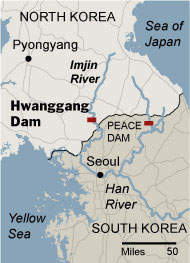
The Imjin is the major river that runs along the Western DMZ from up into North Korea at it’s headwaters. It divides the two countries for about a quarter of the border, and joins the mighty Han, the river of Seoul, downstream from Seoul to flush into the Yellow Sea near the now famous Inchon. The soldiers are a genial bunch, and the one who speaks English, a recruit Corporal or Sergeant ( I can’t totally tell their ranks), still in his required time but doing well, is quite smart. He had spent two years in college in the US before returning home for his military obligation, and his almost accent-less English is fluid and disarming. They are all modern children of Korea, grew up with conveniences and a good education, movies, music, phones and books, but they are soldiers, and you can tell they can be tough underneath by the standards of modern teens. It becomes clear that my little quest might end here. The bridge, where my friend has described his base being about a half mile across, is what is called the Civilian Line of Control, and without a permit, not hard to obtain, or without being a farmer working in there, I can’t go any further… they couldn’t be nicer in explaining this, and submit to me asking questions about the area and telling me stories.. it’s morning on guard duty, and there don’t appear to be any North Korean hordes coming anytime in the next half hour. it’s not on the daily bulletin anyhow… our conversation is broken by bouts of patriotic music, and a group of former comrades in arms who come up to say hi to their old unit, now just an hour away from their cushy modern life in Seoul. it’s fun, and I can see they care about their work and each other. As I speak with them, watching the bridge, and the river, and the wild bluffs on the other side, I see waterfowl and wonder about clams on the bottom of the river. it looks like the Hudson in late fall, or a smaller river, the Housatonic, or any number of Appalachian Rivers, and it feels strangely peaceful despite the North Korean presence hanging 3 or 4 kilometers north of us like a Damocles Sword.
They talk of their role as a speed bump to these hoards, humorously, proudly, and nervously. Their forward Platoon gets locked in for a month at a time, and is a success if it slows the DPRK advance by something like 5 minutes. The rest of the company guards this bridge and patrols the area with the meticulousness of newly minted men, and their stories are interesting, but it remarks to me what they find remarkable.. not much happens, but there was a time when some guys from their company, including one of the guys who just showed up to visit, captured a North Korean defector and got two weeks leave… but another story struck me even deeper, showing how basic training does not make a country boy, cannot compensate for life in the wild, interaction with true nature. They talk of the rumors of Tigers in the DMZ jokingly, but they tell me a story that they find dramatic: On guard, they are watching the actual DMZ, the open territory between the posts, and a civilian enters. They watch him with interest.. this could be a portent of any number  of things, and anything happening at all in that zone is a big deal.. the North Korean man has a rifle, but he isn’t there to hunt people. They watch with almost horror through sophisticated night vision equipment as the man stalks a deer, takes it, and drags it back to the North Korean line.. he then appears to gut it, and begin selling the meat to the guards on that side.
By Korean standards, this area is a wilderness, and to these products of urban south Korea, where even a farm town has high rises and a modern town center, this is behavior that does not exist in their modern lives. Hunting no longer really happens in South Korea.
I head east from here a few villages for another night, and am pleased to find my friend had patrolled through the area I end up in as well, as well as had spent time in the village above the bridge where I stopped for lunch and paused for photos, so that I am exploring his experience. I climb up on a ridge that feels like a managed forest, but with trenches in place an strung with communications wire almost everywhere I look. I peek north from high points near a cemetery, into and across the DMZ to forested ridges beyond, and ponder how wild it might be in the places I can’t visit. I resolve to at least take the DMZ tour, see what I can learn. I hitch hike and take buses back to Munsan and arrange for the next day.

Most people would think I was joking if I said we had something to thank North Korea for. It’s a lonely position to be in to say anything good about the world’s last Stalinist dictatorship, which continues to outlive almost the word it’s self, since Albania, whose dictatorship crumbled back in 2005, was the other last place where communism and the bizarre led to some externally sad but internally horrifying situations like this.. North Korea is now ‘Sine Pare’, without equal. I guess we just got a taste of the collapse of dictatorship in the Ukraine, in the hard fought spring of 2014, but while it was weird, the guy had one heck of a house, no-one would call it Stalinist, which is a term really reserved for oppressively dictatorial, cult of personality based and genocidal left wing regimes… but here it is, 2014, and the wall came down in 1989, and by 1990, many of the other Stalinist odd balls like Romania and, well, Albania, (it’s kind of a short list, Belorus is a dictatorship, but the guy plays hockey, it’s kind of just a local arrangement, and Cuba certainly ain’t all right, but it’s not really Stalinist either, and Yugoslavia was liberal despite the reign of Tito, and even China loosened up from Stalinism after the death of Mao), had given up and gone democratic as quick as you could get there in high tops and a track suit. North Korea is in a unique position, It’s quite…. ‘Ronrey’…

Now as I needed to when I wrote about the FARC preserving jungle in Colombia, I need to say that this isn’t an endorsement of the Government of the Peoples Democratic Republic of Korea. In fact, if it was up to them, this 2.5 mile (4km) wide strip of hope wouldn’t exist at all, they would steam roll down to Pusan and spread their hungry success to all their allegedly misguided southern countrymen, but due to their intransigence, and their danger, when the UN set up the armistice after the end of the Korean War, it created a strip of land across the Korean Peninsula, a line now famously known as the Demilitarized Zone, the DMZ, and that is the subject of today’s post. But while your intelligent mind jumps ahead to what I might be talking about in an Environmental Blog, I have to say that as with my Colombia post, going to the country takes away any of the detached humor and admiration I had for the villains of the place. As with the FARC, the North Koreans are some misguided and dangerous people, and as much as it’s fun to parody that as the South Park Guys did in Team America above, the consequences of the DPRK’s actions are quite horrible, and I would gladly loose this strip of nature to end the human suffering up there (prison camps for 3 generations, starvation, brainwashing, impressment.. the list is long), but for now it exists, and the consensus is to wait it out, because the consequences to the South and possibly to the world with North Korea’s acquisition of Nuclear Weapons, outweigh the benefits of liberating the 23 or so million people living under such oppression. Half of Seoul, 20 millions strong, might die before such a feat could be accomplished, and the war in Iraq has given the world a bitter taste for the notion of regime change. Better to let the grass grow in the DMZ is the thought, than to wake up this sleeping Bear. But the closer you get to North Korea, the less it becomes a parlor joke, and the more it becomes a really sad place where people starve and suffer, but let’s get back to hope, and the Parlor Jokes since that’s a pretty morbid subject, and became more morbid the more I learned.

Now imagine Korea if you will. These are an industrious people. They have been living on this peninsula for thousands of years developing a distinct culture and even cuisine and language from either of their bigger neighbors, China and Japan, despite subjugation by I believe Japan for a good 40 years at the beginning of the last century, and some domination by China I suspect. they are like Asian Arcadians, or Kurds, between a rock and a hard place. They formed alone, on this rugged 100 and something mile wide peninsula, that feels like Western Pennsylvania or West Virginia. The mountains aren’t too high, the highest peak in the country being a 9000 ft volcano, I believe with a lake, on the Chinese border, but near the DMZ, which runs near the highest mountains in the south it’s still about 6000 to the summit of most. But they seem to go straight up and straight down wherever you look. They actually cover most of the country except for some alluvial planes on the West side of both the north and south nations, where both their capitols lie. Before I visited Korea, the word ‘Rugged’ felt like a descriptive Cliche. Now that I have been there, I can’t think of a better word. And it’s people, the older the more so, have this rugged resilience.. the are the kind of people who smile when they fall down.. laugh when they make a mistake, and keep at it. it’s a tough, pretty little place. But population growth, war, and poverty took their toll. Dominated by Japan as a Colony for so long, mistreated, and then, just 5 years after liberation, launched into a great civil war which ranged almost the entire land, from the Pusan Perimeter in the very south to the Yalu River in the north. A more wide ranging civil war could hardly occur, as if the American Civil War were to Range from Miami to the St Lawrence, leaving only Maine and the Florida Keys untouched. And while every social class has it’s consequence on the Environment, that of the poor tends to be the most immediate and visible.. they gobble up everything useful within a days walk for firewood, growing, and other immediate needs. I know someone who described South Korea for me in 1964, when he fought there with the lid on the war, but the pot still occasionally boiling over. He said the ridge lines were denuded and not much nature was left, between the war and peoples appetites. to visit the South now, some 50 years later, is to see much progress in this respect. While it’s not natural progression, they planted tree’s along all the ridge lines, and guard their forests as national assets, many as parks, some as strategic resources, others as strategic hiding points (lined with pre-dug and radio wired trenches I will add, since almost every time I went into the woods I felt like I bumped into a prepared infantry position of some sort, inevitably oriented towards the north), but the point remains, while almost every flat spot in the nation is either inhabited or farmed, just about every hill has a tree growing on it in South Korea in the Teens of the 21’s Century. And they are even wise about urban growth.. almost every town, no matter how small, has a high rise to preserve the farm land. They work hard to survive.
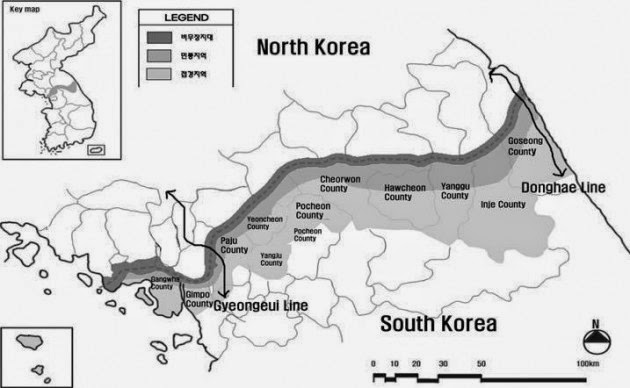
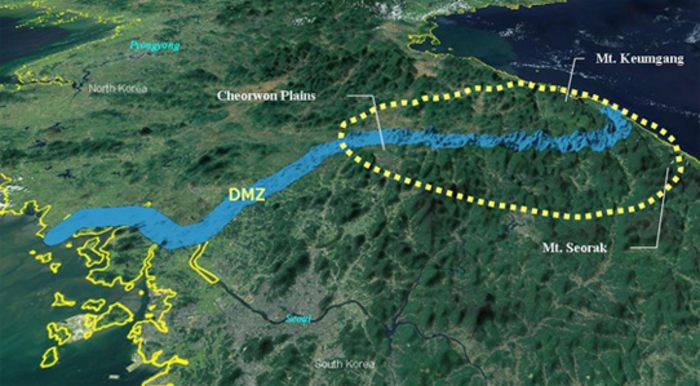
Now not having seen the north (other than from Binoculars on my DMZ tour, and in literature and film), I can only go with what I hear and can see from satellite photos, but the jist is that outside of some major National Parks that the DPRK displays with pride to anyone who will come visit and listen to their loony justifications, the state of their nature is that which you would expect from a very poor country. They farm any good land they can, they eat any animal not tied down, and they are so short of petroleum products, that like Haiti or Zimbabwe, their forests exist but are hard hit and nothing close to complete food webs. So this brings us back to the DMZ and my Thesis.. there is one place that man can only walk but not linger in the whole country, with 3 notable exceptions, and that is the DMZ. And while the DMZ was designated in negotiations to be 4km wide, and 250 km or 160 miles long, running east to west about half way down the peninsula, (roughly where the front line settled in the last two years of the very hot war after the Chinese entered and chased the UN back south from the Yalu), it is in effect wider, since the South has instituted something called the Civilian Line of Control, which tends to sit about 3 mile south of the center line, and the north no doubt has some similar arrangement to, ahem, maintain security, and not as you might assume, prevent people from flooding south in untold numbers so they can get a decent plate of Bulgogi for the first time in their lives (instead, they head to the Chinese border for that, where they then travel all the way to Thailand in many cases, seeking asylum in the Korean embassy there). So we are left with a 6 mile or so wide strip of land more or less across the whole peninsula, which does contain some military installations, more than a few mine fields, some guard posts, and even some now famous tunnels, but on the whole, it’s left to it’s own devices naturally, and has been since about 1953, 61 years and counting.
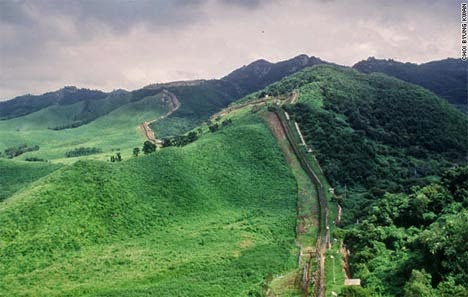
Now it’s not managed as a park, for obvious reasons. It can be assumed that the soldiers, North, South, American, thousands of them concentrated here you must realize, clear their fields of fire, and they patrol pretty constantly. There is a fence from what I know that runs the length of the actual middle line, but despite all that, there is a green strip visible on satellite running from the Han River to the Sea Of Japan coast over the mountains to the east.
This is not to say i’ts perfect. There was a tradition of burning the land near Seoul on the DMZ by the north to make it easier to see people coming, but hopefully this practice is dying. but burning natural lands is still mare natural than settling it thickly.

If you take the DMZ tours that are pretty constantly peddled to foreign travelers in the hotels and traditional hostels of Seoul, you will go to the same 4 or 5 places, the Peace Village, the Peace Park, The Peace Industrial Park with the Toothy Smile of George W Bush hanging over it, complete with a train station waiting for the day North Korea decides to give up and send commuters to Seoul, the Invasion tunnels so shockingly but determinedly dug by the ADPRK, the hilltop observation post looking off to the north, and maybe Panmunjom it’s self (you gotto book early for this one!) but if you have time to think about what you are seeing, and aren’t overwhelmed by the recent human history around you, you start to notice that it’s a pretty chill place. It feels like you are off in the forest from the moment the soldiers step on to calmly, officiously, but not intimidatingly check your name and welcome you over the Civilian Line of Control and into the DMZ on the bridge next to the peace park. Once through, it’s like the land of the lost, like a forgotten part of perhaps West Virginia or Eastern Kentucky, with some well maintained roads and a few soldiers hanging about, jogging or playing volleyball even. it’s a temperate deciduous forest, and it doesn’t necessarily impress from what I saw with the size of it’s trees, the grandeur of old growth, but it’s nonetheless established and growing nicely, uniformly with the exception of some scattered fields. I can now imagine this growing all the way to the Sea of Japan, and what we have then is a greenway to begin with. Imagine if there was a 6 mile strip of land from Maine to Puget Sound along the US Canada border, or the Scottish-English Border along Hadrians Wall, and that is what we would be talking about. The border running along the Han River, with it’s highway to Seoul from up north, might be a bit like where the border runs along Puget Sound or the Great Lakes, and while it doesn’t preserve forest, it does preserve the river, which seemed to have no economic activity at that point.. I start to imagine the clam beds present now, right under the noses of the endless guard towers unpleasantly sandwiched between the river and the highway (they have to be dreaming that Kia or Hyundai starts making an electric car!).

If you begin to look at the numbers, it’s startling.. there is a huge abundance of biodiversity cited by many sources.. it seems like almost every manner of flora and fauna that could or should be growing along that strip from even the days before the industrialization of Korea (supposedly commencing with the Japanese Takeover in 1905) is present. Many of them are for obvious reasons endangered or threatened due to the growth of populations and the various economic activities on both sides of the DMZ.
It’s a fascination of many a person, and often times a used and abused symbol by organizations such as the World Wildlife Fund, to fetishize, kind of Disney market, the apex animals and predators. This has more than gone on in the fascination with this particular unintentional Preserve. It appears there is one guy who is obsessed with proving that there are Tigers in the ‘Z’ along with the countless species of tree, shrub, fungi, bird, rodent and apparently even The Asiatic Black Bear (for whom it would almost take an army for him to avoid being served up for his bile to cure some Rich Chinese Businessman’s Gout) and an almost extinct goat species, The Long Tailed Goral, for whom the DMZ is home to 100 of it’s perhaps 1000 or so surviving numbers. it’s almost like a seed depository of the whole Korean Peninsula, the fauna and flora are so complete except for perhaps a handful of apex predators, like the Tiger, Amur Leopard, the Wolf, and Brown Bear. It’s almost a distraction from what is there to call it incomplete, but perhaps it is, the way Yellowstone was before the Wolf came back. Since no one quite does sensationalism and awkwardly misses the point quite like CNN, I will allow them to demonstrate what I am talking about:
http://www.cnn.com/2010/TECH/science/05/09/tiger.tracking.dmz/
Here’s the hitch… since it isn’t a national park, it’s a highly fortified borderland, the idea of reintroducing tigers doesn’t quite makes sense, because it’s tricky enough for American and Korean Soldiers to patrol worried about stepping on a mine or getting shot, let alone worrying about becoming a Tiger Meal..
But there is a persistently optimistic group that sees a day when the razor wire disappears, and the land can become a park, a friendly vestige of past insanity, with a happy ending… The DMZ Forum:  http://www.dmzforum.org/
This a group dedicated to the nature of the DMZ and it’s preservation. The older generation of Koreans are joiners… they like walking clubs and eating clubs and clubs of all kinds, and this is right up their alley. no one bowls alone in Korea.
It somehow strikes me as distinctly South Korean, heck, Korean period, to have such optimism that despite almost 70 years of separation, the end to all this fratricidal madness will be over soon, so we should energetically plan for it.. they have this persistence.. and the South Korean Government, which has been over this problem for a long time, but still has to deal with it daily while they create a modern society and a manufacturing if not cultural powerhouse, and act soon to be two time host of the Olympic Games (not too far from the beautiful mountains that are the east and wildest end of the DMZ!), likely supports this activity as they maintain this kind of open arms policy for the north, like leaving a bedroom open and a bed made for a runaway child…
http://www.dmzforum.org/aboutus/ref_eco.php
Anyhow, until that runaway child sees the light and returns home, or recruits it’s brother to the south into it’s Utopian Worker’s Paradise, we have this situation, and this time capsule of sorts to an even older Korea, an almost pre human habitation Korea as time allows the strip to mature.. and with these eager hands ready to make the most of it, to treasure this ecological treasure no matter what happens, it is a treasure to all, and a fortunate accident indeed, perhaps the only way one could save such a swath from such determined hands as a united Korea would industriously be… the spirits work in strange and mysterious ways, don’t they? and they seem to be at work here…

Categories
787 Dreamliner aviation and global warming Carbon Carbon Fiber details environement experience flight Global Warming toilet windows

A Trip on a Dreamliner: The Tesla of the Skies, or is it the Chevy Volt?

I am writing from the economy plus section of a 787-8 Dreamliner (free upgrade because I begged for a window seat), someplace just east of Japan, and this is the second post I have written about it. Something about being on it has inspired me to revisit it, and there are things to be inspired by.

I have been traveling for months, looking for good stories, and most of the stories I have found are more loaded with Fear than Hope. I am seeing a lot of Environmental Alamo’s in the Third World, but coming back to the first world, you see that something is happening.. that people are getting the picture, and that action is being taken so our worst fears are not realized environmentally, in part because unlike in the tropics, the volatility of the weather is serving as a huge wake up call to anyone who isn’t trying to ignore things. In the tropics, as with a lot of places, the weather is either creating more intense storms, or longer periods of dry clear weather from what I am reading and seeing, and this is something that people can shrug off aside from the storms, but the temperates are not so lucky. I skipped a winter in the northeast United States that was like a winter I did experience in Florida a few years back, the winter of 2009-’10 where every few days a new storm whipped by, the jet stream acted erratic, and record cold temperatures were set. In Alaska and the west, things were warm and dry, and although not as numbing to the soul, everyone could tell something was wrong.

So here is how the debate on global warming has gone: sometime in the mid 1970’s, a college Professor named Wallace Broeker was working at the Lamont-Doherty Earth Observatory along the Hudson River just north of New York City, which is part of Colombia University, and he wrote this paper:

http://blogs.ei.columbia.edu/files/2009/10/broeckerglobalwarming75.pdf

It was published a few weeks before I was even born, so hard to call it a new discovery. So after that, College professors started talking about this, but they were too late for the big environmental emphasis on air pollution in the Nixon Administration days. In fact, I’ll be danged, this was published a year to the day after he resigned, knew I knew that date, and the country was focused on government reform. So anyhow, who hears about this but just bunch of other college professors, and they start telling their students, like Al Gore’s professor at Harvard, Roger Revile, who got him thinking about these things, perhaps even before Broeker wrote his paper. I learned about it sometime in the late 1990’s from a professor nicknamed ‘Babs’, who was one of the cooler people I ever met in my life, not only because she passed me when I likely was undeserving, but because she was pretty chill, and allowed me to see the connection between our lifestyle, my tailpipe, the power plant downtown, and weather. Perhaps it was in an earlier class with an also pretty cool guy named Val that I made the connection, in meteorology, since I had to take three science classes to get out of college, and this accounts for two of them, but I remember it really clicking with Babs’ Energy Systems in a Modern World, which I took because it was close in character to my Social Science emphasis. So sometime around this time the Oil Industry started to take the threat of these Liberals seriously screwing up their profits like Nader did to Detroit and Rachel Carson did to Big Ag (thank you for smoking, by the way…), so they started to counter the argument before most had even thought about or contemplated it, perhaps sometime in the 1990’s, and you had the likes of Rush maybe taking a bit of baksheesh to still birth this idea to the American People, that anything we could do could destroy the inexhaustible layer of air I am now cruising on which is actually only like 20 miles thick (I’m 5-6 miles up, and above here the air is too thin to really sustain both the flight and combustion necessary to fly this thing.. smaller jets can go to 10 miles without too much strain, and some rocket planes might even hit 16 miles)… and all the sudden the American people were hearing about it, even if just from Rush and Fox lambasting the idea that anything the American people do that benefits their corporate overlords can possibly be wrong. Of course then Al Gore jumped into the fray in 2006 with the release of “An Inconvenient Truth” and all the sudden you had a name on the other side, a big name other than Conservative pundits, and the debate heated up. Soon after the weather started to get more and more inconveniently wacky, and even oil companies started to admit that Global Warming was Inconveniently happening, along with more than 70% of the American people, and things started to happen finally, but what?
That is what is germane to my current chariot, because there seemed to be a general agreement among the powers that be in the US that we would feel no pain to fix this problem. The last holdouts, the Koch Brothers (who have made billions on a family Oil Services Company and their guys in the US Congress, and in the Libertarian and Tea Party Movements (philosophically I might even like these guys, but I can give you first hand proof the Koch brothers are manipulating these groups for their own ends.) held out strongly against any pain being felt to reduce global warming, any national legislative plan to match the problem, so we were left with three options: Executive Rules changes, mostly Presidential Executive Orders ( Higher national fuel efficiency standards, changes to EPA standards), voluntary changes in the spirit of good will (I’m going to buy a Tesla because I want to be good to the environment, and have a car that goes 0-60 in 4.5, and because I can afford it incentives or not), and perhaps more efficient business practice (if UPS uses less gas by making more efficient routes and never making turns across traffic, they save more money on fuel), and incentivizing the so called free market to make number 2 more attractive (republicans will live with this if it benefits corporations they represent, and unlike at the federla level, states that lean liberal do set high gas taxes), like subsidizing or tax breaking low carbon changes on both the individual level (hybrid and electric car subsidies, home efficiency improvement tax credits) and corporate level ( tax breaks and subsidies to build wind farms, or ethanol plants). What is funny is that traditionally republican states have been gobbling up most of the latter, so what I am arriving at as a conclusion is that the consensus is that a few hipsters can ride the bus, or pedal to work out of perceived obligation, but the country is betting on improvements in technology to change what is argued to be an unchangeable lifestyle, e.g. I will keep driving, so an electric car will make that less destructive, so I will buy my way past global warming..
Will it work?I find myself now wondering if the Dreamliner is like the Romans figuring out that lead was in their plumbing a bit too late, or me obsessing about the arrangement of these carbon fiber chairs is a bit like the same process on the Lido deck of the now famous Titanic (although I cut a pretty good looking Leonardo DiCaprio look alike if I do say so myself!) as she slowly sinks away.. you start to wonder how much of what we offer as a modern, now increasingly economically united world, can survive more and more volatility through bad weather tugging at the margins of our overly tuned economies and ways of life… but the promise of all this is a promise of a better life.. we traded and continue to trade atmospheric carbon for all these promises like mobility, and fresh food anywhere, and entertainment and warmth.. I can go from Japan to Seattle in 8 hours, not the 17 days it would have taken in the days of freighter travel, and ask for forgiveness, but here I sit on the Dreamliner, and it is materially better, but only 20% so ( in essence, it uses 20% less fuel to do the same job as it’s aluminum counterparts, which in this case is to haul me and my pile of books, computers, and tropical and winter clothes home.
I do not know the meta analysis of it’s carbon lifespan to include production, which is a question for Boeing, but I would guess that they worked hard to minimize production waste and impacts, but I would have to guess that the production life of a plane is far outweighed by it’s performance over a 30 year lifespan, the energy used in which might be 30 times the energy to make the plane.. I’m flying to Seattle, maybe I pop out and ask them!), so I am still some 80% crapping out a shit ton of carbon to cross the Pacific, to indulge in the luxury of home after, I did in fact try taking a freighter the other way.

So here is the deal, airplane flight is by nature, since sometime in the 80’s or 90’s, undignified.. it sucks.. it has sucked since the days of Frank Abagnale (on a DiCaprio and Sinatra theme!) and my dad bringing home gifts from the bar of the 747 ended with the growth of demand sometime 30 years ago. Waned away to all sorts of manipulation and second dealing (sure you bought a ticket, but that bag is too heavy!), and the lowest common denominator like Southwest actually feeling like a relief since you can at least be confident that their sardonic sense of humor is what you paid for, and they aren’t jerking you around for once with fluff in place of substance.. but here I sit on this plane that is only 20% better, but it feels materially better, like 50% nicer.. how so? OK, well, I like real facts after I postulate for a bit, it’s what I like to deliver so here goes, and these are first hand observations, occurring as I type:
The world looks prettier out of these huge windows (remember the plane is carbon fiber, so not only is it lighter than previously used aircraft aluminum, but it’s stronger, so the windows are bigger, like twice the size in area, and to save weight, there is no shade to jar you awake, there is just this dimmer switch that works some magic on tinting the windows through some physics and chemistry mojo that I can’t figure out other than to say it works.. there are 5 settings and when it is dark, I can only see lights outside, not the items attached to them, and even then just barely.) Why does the world look prettier? I am just coming from a Buddhist area of the world, so my best non scientific answer is Karma.. it’s better for the planet, so somehow you brain picks out trees and plants and the beauty of lights instead of just how many goddamn houses are down there and what a mess it is.. it was also a pretty sunset.

I have never in my life seen wildlife outside of a plane window in a modern airport, but I saw a crow pass by.. in the US, crows are not necessarily a vaunted bird, but they like them in Japan, and it was somehow beautiful to see him glide by, in a place I never expected. It might be because I think the plane has an electric motor to back it out of the gate, and it wasn’t making any noise, so the crow, or perhaps raven, felt comfy to pass by.. that electric motor not only saves carbon, it saves infrastructure and noise in a place you would never expect to care because it is so abandoned, a modern airport tarmac.. these are places that we turn into environmental sanitized zones, since they are devoid of plants that could get sucked into the engines or need watering, and just big sheets of cement or asfult soaking up heat and releasing it too fast, and otherwise just producing intense runoff from the intense rains it also produces as a heat island.. it was somehow a reminder of the forgotten tarmac to see that bird go by, perhaps a reward for the plane being just that much greener.
The headroom is huge, the plane is bigger, or feels bigger inside, even the door felt like a grand entrance. It could just be better design, the windows and other things conveying the effect of grandeur.

The stewardess handed me a non-bleached napkin. Maybe it’s just a bit of Japanese craft, but it’s god environmental practice as well. I guess now I realize I have had those brown paper bag looking napkins too, the heavy stiff ones, maybe on a southwest flight, and in some way they were saving money and chemicals, but this feels intentional.. it feels right… well, 50% righter.. the warm towel also didn’t come wrapped in plastic, and wasn’t disposable.
The plane feels like it does sit relatively higher up. I had to come from another terminal, and drove right by my plane, or what I guessed was my plane, and proved to be, since it had 787 emblazoned on the side. It seemed huge. Not like the A-380 or 747 seems huge.. when you look at the windows, it looks small, almost like a toy, but it seems so tall up on it’s landing gear it looks like a cartoon plane. The Logic isn’t so you don’t have to troop down steep gangways anymore, although that was nice.. all that pounding of aluminum plates you usually hear was absent, but the real reason has to do with engine efficiency… the engine has to be physically bigger to be more fuel efficient, so that means jacking up the wing. This one seems to start right where my feet are, and I know that the one issue they had with the first production 787’s was stress at that attachment, so there must be a lot going on right underneath the floorboards there. The reasoning has to do with a ratio inside the engine, the ratio of the size of the air intake, the opening in front, to the areas where combustion occurs if I have it right. The more air you can jam in, the less fuel you have to use, so it makes the plane look like a gooney bird , with these huge bags under it’s wings.. it’s the only visual flaw on what otherwise looks like a find play-mobile plane, but there is one other odd detail:
The wings are wider than the fuselage is long… instead of a gooney bird, this thing is an albatross (which is specifically a nickname for an awkward looking albatross, so not far off), and Boeing doesn’t mind that comparison because it is actually one of the themes of that documentary I linked to in my first blog post. If you actually watched it, then a lot of this is repetition, but they were inspired by the endurance of albatrosses, since the 787 is a long haul jet, made for the big intercontinental flights, and what do albatrosses do but fly out to sea for months on end.. the wings come to a point gradually, are extremely flexible, and like I said, they are collectively longer than the length of the tube I am not sitting in if you include the maybe 5 meters of fuselage fuselage in between them (the wings by themselves without the fuselage would be just a bit shorter, maybe 2 meters shorter, but the wingspan of the plane overall is longer than it is wide, does that make sense?), but that’s a big deal, and seems illogical in some ways compared to the aggressive jets that characterize the genre of machine, like the fighter or the sleek Learjet. However, when you think about it, jets have big engines and small wings for not only maneuverability, but because if you have all that thrust, you can stay flying on less wing, since wings can contribute to drag.. the idea here here was to minimize the thrust needed to both take off (the plane is lighter because of the carbon fiber and a lot of smaller innovations, like fly by wire. There are no physical connections between the flaps and the pilots controls.. it’s like a big wifi node is flying the plane.. with a little electric engine turning what needs to be turned. Now, more than ever, I make sure I am on airplane mode!) and cruise (bigger air intake, more efficient engines, bigger wings).
So I just spoke to a stewardess as the LED’s dimmed by touch screen control to make us nod off more naturally, and she tossed me a few more interesting tid bits. When we took off, the plane was rattling a lot, all the light plastic that the luggage compartments and what not are made of, but as soon as the wheels lifted, it was quiet, and she seconded that, and added some more that filtered into my new-found knowledge of titivation of the last 4 years. Since the wings have such a pronounced V shape when in flight, the tips are above my head considerably as I sit here right at the back end of the wing root, (the morning after I wrote this, as we approached Seattle, I noticed that the wings were not only above my head, but even with, if not above the height of the aircraft. I had a connecting flight 3 hours later and the wings were half as bent high on a 737. The plane is remarkably smooth in flight laterally.. it ‘yaws’ less in the parlance, since there is a kind of pressure to keep it straight due to some aerodynamics I kind of understand but would have a hard time explaining, but you might intuit, from the v shape, so she said landings are so soft that unlike on just about every commercial plane where the stewardesses are taught to lift off of their seats just prior to landing to avoid repetitive stress injuries coming from their lower backs being scrunched all the time from the impact of landing, they literally do a little lift with their arms off the seat, which I have seen and chalked up to dainty stewardesses having a quite womanly struggle with flatulence at an inconvenient time. She said this aircraft lands so softly it isn’t necessary. I noticed also a little extra flight control surface, about two feet wide, between the ailerons and flaps, that seemed to be computer controlled, always moving up from the plane of the wing to varying degrees at all times, kind of jumping every few seconds, which seemed to be a stabilizer adjusting to immediate conditions.
Since I yawed into bathroom humor, the toilet on at least this flight had Japanese features like an internal bidet and bum dryer… that’s class!

The stewardess also said that it is quieter both at take off and landing, and that is a big deal in places like San Jose where millions of dollars are spent in noise abatement to maintain home values and quality of life (not sure in which order.. it is Silicon Valley!). Now that she mentioned it, it jibes. You could have had a normal conversation all through the take off we had (my seatmate, an old Japanese guy, admitted he didn’t speak a lick of English, and I know about 6 Japanese words, so it wasn’t an issue).
She also mentioned that because of the higher cabin pressure there are occasional issues with condensation coming down from the overhead compartments (better than a suitcase I guess!) but that it isn’t that often, but on a cuter note, something so Japanese flight attendant, she said that due to the higher pressure, there is less need for skin moisturizer, which many of the women who both work on the plane and fly appreciate, and maybe me too. Sometimes my nose itches like I was on a Mexican lucky bender all night with the old Robert Downey Jr…. when I get near customs, I feel funny itching my nose like I must be a mule stealing from the boss, but won’t be a problem on this flight.. the air doesn’t feel fresh like the west coast of Ireland, but for an intercontinental flight, if feels pretty nice.

I asked her if she showed up in destinations feeling less tired, but it might have sounded like a come on, so she didn’t quite answer, but I am going to guess yes. We were standing in front of a crew bunk bed area I have never seen on any other plane before, and maybe it seemed like an invite to the mile high club, if she wasn’t too tired, but she later did come and tell me that all the stewardesses felt better when they got to their destination, less tired, than on any equivalent aircraft.
So it’s approaching 3am at my destination, and I kind of want to walk around the plane still, so what is the upshot of all this? Well, first some good news.. this is the way things are going to be… this progress will hold it appears. They got over 600 orders for this plane, especially since oil and aviation fuel prices were out of control when it was introduced. The can deliver over a hundred a year I believe. Airbus followed suit.. it’s A350 might even be better than this although they gambled on a big Caddy, the A380, over the Prius of the Dreamliner, so the spoils belong to Boeing for a little while for taking the risk, but them catching up is good for the planet, so it’s a win win I hope.. I once read that commercial aircraft makers don’t even make a profit on the planes.. it’s all in the parts and maintenance later, so this is like a gimmie anyhow.. although from this altitude I am praying against planned obsolescence! And now Lear is working on the first carbon fiber corporate jet, which Mr. Lear dreamed of before he died in the 70’s, but the way advanced dream of the time, not so much a dream as we were already using it for things like Intercontinental Ballistic Missiles at the time, but it died with him, and the end of the oil and gas boom days in Texas that seemed to so fuel that company, and a little company out of Yakima called Cub Crafters is making the first carbon fiber bush planes, and its creeping into gliders and ultralights, and will work it’s way up.. as of yet, I have not herd of carbon fiber in commuter jets, but maybe I need to look at the makers like Bombardier, Embrear, Cessna and Saab. Looks like Mitsubishi tried and gave up:
http://en.wikipedia.org/wiki/Mitsubishi_Regional_Jet
But like I said, it’s 20% better, and it’s going to take 30 years for this conversion to take place, and Global Warming and Climate Change is making it’s presence know now, and every bit we pump in is overwhelming us, since the planet can no longer absorb it at the rates it was able to until more recently. So what do we do with that.. well, this is step one.. they built a plane that looks like a normal commercial plane, no Popular Mechanics stuff, and it was 20% better… battery technology will kick in and start to change small aircraft in the next 5 years in ways that will be impressive. If this is the Volt, that upcoming aircraft will be the Tesla. To that victor might belong the true spoils, the Elon Musk Prize for inter-leg sackularity.
But the reality is that there are 30,000 planes flying around the world in the commercial arena alone, let alone private jets and prop planes.. this does start to seem like a drop in the bucket to an industry whose share of Global Carbon production is in the mid single digits, 1/20 of all anthroprogenic (caused by man) Carbon Dioxide and associated warming gasses releases, although it does come in intense spurts for the individual who does fly, with maybe a quarter ton for every hour flown, when the average american, the highest per capita carbon producer ( of the big nations, and not people living in remote places like the Faulklands.. wait, I stand corrected.. Australia passed the US in 2009! http://en.wikipedia.org/wiki/List_of_countries_by_carbon_dioxide_emissions_per_capita Does that now make us Northern Hemispheric Australians!? Agh… they dropped below us in 2010.. I celebrate too early!), uses almost 18 tons a year.. thankfully flying is expensive and annoying unless you really got cash and can pony up for private, which even most of the 1% cannot afford! Thankfully, since it’s impact is relatively higher, the difference between riding an SUV and taking the bus I would assume. And Jet’s impact is higher than their output of carbon because of where they deposit it, high in the sky. Climate experts are advising people to fly during the day when their contrails will block heat coming in, not at night when they will keep heat from escaping.. that is where we are getting to, ask the polar bears and the people of Tuvalu and the Maldives. But who is going to tell the rich not to fly? And if we get the carbon fiber thing figured out, could we pack it with batteries and solar power our planes.. hmm… it’s a big chunk of triple a’s, and it’s tough, and ground transportation like electric and higher efficiency vehicles, even made with carbon fiber, has a better chance to make a more sizable impact more quickly on the carbon equation with this as a big luxury we keep tolerating while tightening up everywhere else first, merely due to the huge challenges of the range necessary to make the range possible on these aircraft to sustain this global economic and leisure demand. Sure we can use Skype and turn the heat up to a nice toasty 82 for a week every winter, sprinkle some sand around the living room lounger,mix up a mojito out of the freezer,, and dial up a Copacabana beach webcam on our eco color flat screen, but the rich are the rich, and the Bourgeois are, the Bourgeois, and they are likely to not want to give up the habit of flying since it makes em feel so damn important, and what about immigrants who want to go someplace new but still get home once in a while so here we are stuck. Try banning it, as much as that might make sense someday soon if not now if people knew the truth of the consequences of all this.
So hope comes in hoping this incremental change, which strangely feels greater than that because my knees aren’t touching the seat in front of me, and I can breathe the 5000 ft equivalent pressure air much better than the 8000 ft pressure (by now they usually turn off the oxygen and I am drooling on myself anyhow.. this is better!), and I can already tell I will feel better hitting Seattle than I ever would on a normal plane. So here is to hope that me paying for this is bringing the cost of mass produced carbon fiber down, and that when that gets together with batteries the world sees a real change, that this is a down payment on what our planet really needs.. because after this winter, god knows we need it.. and so do the Polar Bears!
now I am going to move this cool little swivel light out of the way ( did I mention the thing is pure LED lighting?!) and jack up the tough but light plastic leg rest, and finish watching this Bollywood movie after I roam around a bit.. hoping I make you just a we bit jealous… damn this Japanese food tastes good! Metal silverware in coach! Wow, real Hagan Das! Saving carbon, one indulgent bite and flight at a time…thanks John Boehnor… now where did I leave that fiddle that EmporerNero gave me? bet it would sound great up here…
Cheers from the date line!

Categories
California Sea Otter crack heads cute Eastern Sea Otter endadngered species expansion french history Hope range Recovery Southern Sea Otter story threatened threats

The Cutest Things on Earth: The Recovery of the Eastern Pacific Sea Otter

There are times where nature astounds with it’s power, with it’s grandeur, with it’s scale and intricacy. Think storms, sweeping vistas, the size of the Pacific or so many impressive landscapes, and the beauty of a butterfly wing or a banana leaf if you stare close enough. Now you might not expect Grumpy to think this way, but sometimes it astounds in it’s cuteness! If Walt Disney or Walter Lantz had tried to come up with the cutest damn thing they could dream up, I am not sure it could come close to a few of Natures more compelling creations, passing perhaps the puppy, kitten, Shamu, Cambodians, baby pandas and seals in the fuzzy whiskery big eyed charmer category, and to make it funnier, what if perhaps the cutest creature ever had the personality of a grumpy drunk or combative crack head, something Dave Chappelle would love to take on…and that personality only made it all the more Daffy Duck lovable. Now throw on an environmental survival story that is really one for the books, a story with bad guys, exotic intrigues and a final surprise so fascinating that you are surprised more people don’t know about it…

who am I talking about.. this funny lil punk:
http://www.youtube.com/watch?v=o0OyhHeelyo
http://www.youtube.com/watch?v=a5UTJlECrrQ&list=PLiZ4KRbgzDQ_vNc3CKZkfRKhWbYneaEur
that last one.. the birthday cake one.. was so cute.. I just vomited in my mouth…
There were no Sea Otters where Muppet’s creator Jim Henson grew up in the Mississippi River Delta areas of the eponymous state, but there were river otters, their cousins… enough to perhaps inspire a lifetime of duplication…
http://www.youtube.com/watch?v=6uFy_LDrgm4
all right… I must have made my point about their adorability… now drag in the bad guys:
Our bad guys come to us from Russia, and those of us who grew up with the cold war, we are more than used to demonizing them, it was a sport when I was a kid! In fact, our bad guys really come from the Fur markets of Europe and China 300 years ago, and perhaps the Russians were trying to make a buck, but that’s too complicated, let’s not muddy the waters with split culpability, and humanity, that’s so Un-American! So suffices to say, that there is nothing quite like Sea Otter fur, and it ain’t just cuteness.. since the animal never developed blubber like so many other large warm blooded sea creatures, it’s a hollow hair, and it grows at densities of close to one million per inch… to contrast, the average human head has about 700 per square inch before thinning and baldness set in (and oh how they set in…)… the hollow nature of the hair gives insulation in the only way that insulation really works. by trapping gas, in this case air. They have to forage pretty regularly to stay alive, but the sea otter is a pretty trim physical specimen considering all that, and it’s pelt practically sheds water.. making it, and here’s the rub, one of the most, of not the most, valuable skin on earth for a while. Now I have seen the skin trade, and I am not talking about the red light district… and I can get you an American Puma Skin for like 600 bucks, a rabbit for almost less than a Sham-Wow, a tiger for maybe 1000, and I can say without a doubt the famous price for the last otter fleece to come into Peking before the market dried sometime in the 1800’s of 100,000 USD is something to be considered.. the Chinese and everyone else who needed to stay warm loved and knew the value of Sea Otter skin, and it didn’t help the little buggers stay alive once people started coming their way.
They used to range from Japan (maybe even the Koreas or China?) all the way to Baja, in a big horse shoe around the North Pacific, and I am just guessing at a population as high as a half million, but the events I am about to describe changed all that. In the time of Tsarina Anna of Russia, not a particularly popular leader, it was decided to explore Siberia and beyond in a great scientific expedition. A German Naturalist named George Steller was recruited, a smart and ambitious young man, as well as Danish Sea Captain Vitus Bearing. The story of their expedition to eventually discover Alaska for the western world and open up the north pacific to exploration and eventual exploitation by Europeans is documented better than I ever could in one of my favorite books, Where the Sea Breaks it’s Back, but keeping this germane to the fuzzy li’l wonder’s story that I am describing, it suffices to say that Steller was the first naturalist to apply western science to the Pacific Sea Otter, as well as dozens of other creatures, and his expedition would also pave the way for it’s downfall, as well as the extinction of a few other creatures, as even as the Bearing expedition was shipwrecked and starving, the men aboard struggled to preserve the pelts they had taken on this first foray, knowing their value…
The Russians who followed armed with the stories taken from the survivors of this trip in the mid 1700’s came with a thirst for ‘Furry Gold’ (just made that up… it sounds hilarious!). Russians beset first the Aleutians then mainland Alaska with violence in their quest for riches, capital among them: firs. There were battles fought in the Aleutians that set the tone for 100 years of Russian Rule, and armed with slaves they collected in the Aleutians who were useful of their hunting ability, the Russians ranged possibly as far south as Baja California in their search for Sea Otter pelts over the next 80 odd years.
http://en.wikipedia.org/wiki/Maritime_fur_trade

they made it as far south as Fort Ross officially, now on the Sonoma County Coast (near Bodega Bay for you Hitchcock fans), and ranged from their settlement there likely down as far as they could find pelts, which were extirpated from the Baja coast according to accounts sometime around then. This was the activity that inspired the Anza Expedition to leave Sonora and found the Presidio of San Francisco in order a secure Spanish territorial claims at the time, which were more than under threat by the Russians from an Economic standpoint at the time. They sure do cause a stir, when all they want to do is be left alone to eat some clams and sea urchins, and nap on the waves…
http://en.wikipedia.org/wiki/California_Fur_Rush
http://en.wikipedia.org/wiki/Sea_otter
You might imagine that given the value on their head, and the skill of the Aleutians and the Russians, and any other Native Americans that might have been recruited or impressed to help with the hung,  and even the Spanish and their native guides, who couldn’t have been immune to the trade, that the Southern part of the Otters Range didn’t stand to last long… up in Alaska and on the coast of Siberia, there were more inlets, nooks and crannies to hide out in, and the population, if not thrived, survived in large numbers. I myself have watched otters float and fuss in areas I have had the privilege to explore around Prince William Sound, where their populations took a huge hit in the wake of the Exxon Valdez Oil Spill (the oil destroyed the insulative quality of their skin, let alone what it did to their food web and habitat), and even where they were so damaged just 20 years ago they were common enough that it felt like the further back you got the more you saw.. they would poke a head up and take a look, I hate to say it, in a manner that more than reminded me of crack heads I saw running around the projects I used to pass almost daily in my youth.. there is something almost offhandedly but humorously aggressive about them, perhaps defensively aggressive, fitful, like some old ghetto lady who don’t trust you no way no how.. she’s tryin’ to mind her own damn business, but she’s a watchin’ you! Maybe that’s too strong, maybe it’s just a French attitude.. that kind of plucky indignance, like a grumpy French Heroin addict. You know how California is.. it’s the new France… People who work with them in animal rescue centers like the one in the Marin Headlands talk about how quick they are to bite, even though they can be cute and endearing as a cat seconds later.. they just want to be left alone… is that so wrong!
That crotchetiness obviously was hard earned.. everything from Orcas to Great Whites wants to eat them up, which is why they hang in the shelter of the kelp forests, and in a funny way, they spur the growth of their own shelter.. you see, when they are present, they eat up a lot of the species that compete for territory with Kelp taking root on the seafloor… when they eat up the urchins that take over, the kelp gets to root in, which increases kelp growth, and as they expanded their range again over the last 80 years, so did kelp forests. and that’s just the beginning of their benefits tot he general habitat as kind of the king browser of the kelp world:
http://www.latimes.com/science/sciencenow/la-sci-sn-sea-otters-boost-seagrass-growth-20130826,0,7071924.story#axzz2s8LNahR4
So expanded their range !?.. I have been talking about them basically being extirpated for the last few paragraphs. What could I be talking about.. didn’t these Aleutian hunters and their Russian Masters hunt them to extinction… Well, almost.. enter Hope, stage left…
For as many as 150 years, the Eastern Pacific Sea Otter was thought to have been extirpated, read exterminated for it’s fur, from the south east portion of it’s territory… from somewhere in British Colombia or Alaska South.. it had managed to survive and rebound in Alaska and Siberia, come up to numbers in the hundreds of thousands, but there was just a spot someplace on the Canadian or Southeast Alaskan Coast where even with protection since 1911 under the Fur Seal treaty which finally tried to secure the future of Northern Pacific pelagic populations of pinnipeds and other such things from extinction, which had already eliminated such creatures as the Stellar Sea Cow from this earth, they hadn’t strayed south from. There weren’t enough of them to displace in territory.. there was literally so many sea urchins and bays and bights to re-habitate in these ragged inlets and coasts, thousands of miles of coastline, that there was no need to go further south.. to make an Alaskan Joke, Animals are much less likely to become End of the Roaders than people… even when adolescent males strike out like they do in so many other mammal populations, it wasn’t gonna be all the way down past Vancouver and into the US when there was no one to mate with down there, and it was a hell of a long trip… well, almost no one…
In the 1930’s, with America in the grips of the depression, it’s President and Congressional leadership set about an ambitious program to rebuild and expand the nation’s infrastructure in many unique and creative ways. While examining this movements impact on the environment would be a whole other topic of massive proportions given the size of the undertakings, the environment did fare well in the net total it would be fair to say. Huge areas were put under either complete protection as national parks and given infrastructure for public visiting, or less perhaps picturesque or unique wild areas were still put under management by government agencies like the US Forest Service and the Bureau of Land Management to become kind of national economic reserves of sorts, with better soil conservation and environmental balancing with their economic utility, kind of a technocratic Win-Win.. better management leads to a better economy… amongst the projects that came out of these undertakings were large works to create Scenic Highways in America.. Henry Ford had long since popularized the Automobile, and President Franklin Roosevelt mandated vacation time and a 5 day work week, knowing that in leisure there would actually be both cultural benefits and an expansion of the US economy… which we now call tourism… so if the government built roads like the Blue Ridge Parkway and the Natchez Trace, people would take their time to drive down them and explore all that nature they keep hearing about in the big cities… one such project was a highway down through a place called Big Sur.. to be fair, the project had started well before, after World War I, but progress was slow and perhaps not a priority despite groups as disparate as San Quentin prisoners and writer John Steinbeck working away until the whole New Deal Thing kicked in… so again how does this have anything to do with the Sea Otters I have been prattling on about for the last 20 minutes?
Well, when they were finishing up the Bixby Creek Bridge, perhaps the largest single project of the whole now famously scenic road, the workers there noticed a small colony of about 50 sea otters… from Internet research it is hard to put together exactly what happened when, but it appears that they built the bridge in 1932, and a man named Howard G Sharpe created or took over a lodge within sight of the bridge for visitors to enjoy. Sometime in 1938 it appears, he began to publicize the fact that this must be a remnant population that had survived the great hunts of the 1700’s… these 50 little buggers were descended from how many survivors I couldn’t guess, but somehow enough to breed and not create birth defects had survived and were having a fine time undiscovered by the mamologists of the day until Sharpe pointed it out… they were already protected of course, and their numbers began to grow, slowly but surely… before the 1750’s, California alone was thought to have had a population of 16,000 according to some estimate that made it onto Wikipedia. That ends up defining the fantasy of an ideal state as I have spoken about before in my piece on Cougars in Alaska (no, not Sarah Palin!). I don’t know how many Otters the Native Americans of the time might have harvested for fur or what have you, likely not many given the bounty available of food in the coastal areas of California, although I have heard anthropologists talk about tribes becoming so populous that there were bouts of starvation due to the utter livability of the place until they would max out the carrying possibilities of the areas (sound like modern California?), and it would have been my guess that they lived back into San Francisco Bay and perhaps even some other unique large estuaries that might no longer exist like along the waterfronts of Los Angeles.

I once read an account of an Otter being adopted by some Navy Sea Bees, Naval Engineers, on an Aleutian Island during the campaign there during WWII. He got himself stuck somehow in a dock that belonged to them, and they called a medic, sedated him, and spent a long time releasing him, brought him to a hospital, then watched him while he recovered with a lot of love right around that dock (if you have never been to the Aleutians, they are beautiful, but there isn’t a whole lot to do without being creative.) I try to imagine that the workers on the Bixby Creek Bridge were similarly touched by what they saw.
The population now in California is a matter of great obsession and examination. Due to their presence on the Endangered Species List as a threatened animal, and since there was a focus on Pacific Coast Ecology after the Santa Barbara Oil Spill in 1969, their status and recovery are handled by the USFWS, and of course this means a count, the kind of stuff I love to report on.. numbers in action… environmental sports score:
http://www.werc.usgs.gov/ProjectSubWebPage.aspx?SubWebPageID=23&ProjectID=91
Scroll all the way to the bottom for the count number. When I first tried to write this post, it was during the Government Shut down of 2013, and in the effort to kill Obama Care, they had shut down all government web sites.. I hope this one keeps working.
So it ain’t 16,000, it’s closer to 3,000. now given that in 1938, the assumption was that we didn’t have any at all south of Alaska, not so bad. I see no mention that geneticists ever tried to figure out how low the population had dipped before the 50 were discovered in the 1930s, but it might have been ten or fewer. There have been genealogical studies, quite a few, but I don’t see mention of speculation on this one fact, although I have heard of it being determined in other mammal species. until the two populations meet up, or 5 populations as it is now described, with 5 distinct recovery populations from Northern Japan to now the Channel Islands of California.

 There were two famous translocations of note, five actually. One brought otters from Russia to mix with some in Alaska, then there were attempts to have them resettle on the Olympic Peninsula of Washington (somewhat successful), the Oregon Coast (failure), off of Vancouver Island (successful) and on San Nicolas, one of the Channel Islands off of Santa Barbara which are now part of a plane and boat accessible national park. It was partially successful, with 59 now living from about 150 that were brought there to create a separate more remote population to improve survivability. What happened was that a lot of the otters tried to swim back to where they came from instead of sticking around someplace they got dumped by a bunch of meddling scientists… what do they know!? That’s the otter attitude, anyhow… the few that did stick around are now dong ok, giving us this population of 59 this year in the 2013 count. Then there was a little guy who made it up to the Oregon Coast on his own and hung out until a big storm a few years back, in the late aughts I believe, after which he wasn’t seen again. It wasn’t known if he came from the population in Washington State or California, but it was kind of neat, or portent of what might be to come if things keep going well. And I haven’t even mentioned what might have been a similar remnant population in an inlet of British Colombia, but this story is more fun in Cali, even though it’s easier to film up there, you know, because of the whole Union thing…
After posting this, I stayed a bit obsessed, holed up in a nice hotel resting from some trucking around, and I learned that this story of a remnant population being the seed of the whole recovery isn’t unique to BC and California. It turns out that that isn’t the exception to the story while populations up north remained robust. They in fact have done a bunch of genetic study, sometime in around 1990, maybe not on the California Population, but they concluded that the whole survival of the species came from about 13 remnant populations that collectively numbered a few hundred, or less.. this was a good story when I just knew about the 2 remnant populations.. now it seems almost less probable and more remarkable. They have now grown to the 5 distinct geographic populations described above:
http://alaska.usgs.gov/science/biology/nearshore_marine/pubs/Bodkin_Monson_2002_Arctic_Res_US.pdf
So what keeps them from jumping into San Francisco Bay or over it to what must be some pretty invited territory in Northern California, or coming south around to Santa Barbara or hopping across the Channel Islands into Mexico, or setting up permanent shop with the other quirky characters in Venice Beach or La Jolla? There are many reasons, but major ones include pollution, and just not wanting to be around other people. Like the Monks in Big Sur, they are a bit Misanthropic. Every time they come past Pigeon Point someplace near the base of the San Francisco Peninsula, just north of Santa Cruz, they seem to get in trouble. The population increases as you get closer to the Golden Gate, and think of all the water swept out from the bay, and with that, there are diseases from Human Run off that can get into the bivalve population, the clams and mussels they might eat, and make them sick. California being California, they actually get medical service, both because they are still considered threatened (they have to cross 3,090 for three years I read) and because that’s the kind of wacky stuff Californians like to do to protect the environment, so there is a network of care that they get, both through the Marine Mammal Center in Morrow Bay and the Marin Headlands but through a partner system they set up where the Monterrey Aquarium is actually their hospital:
https://www.montereybayaquarium.org/aa/timelinebrowser.asp?tf=90
They have a dang MRI machine! California is something..
Anyhow, what is keeping them from making these jumps is a combination of human influences, these populated sections of coast hemming them in a bit, and also just a lack of population pressure quite yet again.

Since the last three years were a bit flat in population growth, this 2008 data isn’t as old as it seems.

If you sift through the injury reports, you can see that White Sharks have started to have a taste for them again, and that life can be a bit crazy for an otter the same way it can be for a person living on the edge… it’s a wild world riding the waves… and one more funny thing that occurs to me.. if they did start to go south and north, they might increase kelp in some of the major Surf Breaks, and how would the locals feel about that? it’s scary enough without wondering what that is touching your foot all the time… Anyhow, we’ll cross that bridge when we come to it I guess, hoping the punks at Paloes Verdes or Johhny Malibu and his buddies in the Surf Punks don’t start a ruckus when the Sea Otter Clan invades their territory looking for a good ride:
http://www.youtube.com/watch?v=Vfq0bvVhQWw
What an inviting welcome, and that ain’t the half of what they will hit when they get to the Tijuana River, but we got time to sort it out right now…
http://sandiego.surfrider.org/2013-tijuana-river-action-month-schedule
http://www.sewagehistory.com/tijuana.html
we’ll keep trying to take care of this, and hopefully they just keep breeding and laughing.. like all Californians just want to do anyways…

Thanks for a little fuzzy whiskered Hope you guys… no matter how wacky the weather gets, or how bad things like DDT might have impacted such a beautiful place one, we got you, babe, the Pelagic Sonny Bono’s. now if Otters could just do something about LA traffic, the place might be truly livable for us as well!
Categories
age of lithium carbon reduction charger Christmas demand desk top drop electricity use Global Warming grid energy hard drive Improvement Ipad lap top power consumption tablet watts

Hope for the Holidays: The Unexamined Eco-Revolution caused by the IPad and it’s Copycat Tablet Devices

I am writing from a decidedly un-Christmasy culture.. They aren’t Christians, 97% of them anyways, and they aren’t that consumeristic, although that is changing (spreading like a flower scented cancer from the malls of the capital city)… but they aren’t my readers in any large measure I would guess either, and my readers are staring down the barrel of a loaded ‘fun gun’ called ‘Christmas in America’ right about now.
I get it, I grew up with it, I wanted my Red Rider BB Gun once, and I felt no shame in the filthy orgy of misinterpreted Christianity and greed it was…it was fun, some of the presents did change my life and the life of my family and friends for the better, and it was one of the only times of the year that anything approaching reverence crept into the cocky wreck we called a family. And I get the Christianity part too.. I took it quite seriously for a while…and I like to think that my now South Park version of Jesus would be kind of shrugging with amused chagrin at it all…

So my defense of Christmas aside… it’s fair to say that something much maligned as ‘Consumerism’ is a main driver of many of our Environmental woes. It’s ‘consumerism’ when other people do it…. when we do it, it’s the Christmas Spirit… I ain’t casting stones… but all this buying stuff, stuff beyond food and basic necessities, a nice example of how adaptive and successful our cultures have been, is really screwing things up in the planet department, in general (again, no pointed fingers… we cool? We cool…).
One huge example is electronic goods. I am pretty sure although you don’t need one to survive, they don’t issue them to Buddhist Monks, that your nose is buried in some light producing screen spitting out info-tainment as we speak… in fact, I can almost guarantee it…
There are perhaps 2 billion of the things, maybe more, for a population of 7 billion… and they take a lot of resources to both produce and run… just think about that.. 2 Billion Computers, when you could count them on your hands after World War II.
They came into my house, perhaps at Christmas, as a way for us to keep up with a trend… this was the early 80’s. They were cumbersome and labor intensive ( We had a Texas Instruments) but you could smell something amazing was happening…

 I watched the first MTV video from a spot on the carpet where we used to plug the TI into the TV, next to the spot where we dragged the phone to drop onto the modem… Media was coming on strong..
The First MTV Video: Video Killed the Radio Star by The Buggles

Imagine the combo of these three instruments I was crawling behind the TV to make work by unplugging the VCR (the Fourth) and plugging in the TI… You don’t have to imagine it, it’s 2 billion strong…. and you are nose into one now… how did I know?!
Now when this all first started to happen, it was the Government using these huge IBM mainframes to do what at the time were considered huge calculations.

These things needed their own Power Plants.. then Cray Supercomputers helped us refine the Nuclear Age (so last century!) and perhaps the energy demand was dropping, but it was well past affordability for the householders of the world. Then the personal computer came in, and made it easy to do so many things, from Skyping relatives across the world for Christmas, to making Christmas plans, to shopping for said Christmas, to even getting directions to the relatives in Jersey, where you have to go for Christmas even though you hate to, so you used to print them out because you always intentionally forget the confusing route, and now your phone just tells you…
All that computing, it takes energy…
http://michaelbluejay.com/electricity/computers.html
like a brain needs vitamin B to keep up with the endless stimulation (Anyone want to get a Pizza?.. they have Christmas specials! Reindeer Sausage and Red and Green Peppers!). Multiply it by two Billion, and the energy demands likely exceed those of some large fraction of the smallest countries on earth ( I am guessing.. it’s Christmas, I don’t want to do the math… but imagine an average of say just 100 watts per computer, x 2 billion… agh… moving on…).
You can imagine the demands this places on energy grids, and we all know that unless you live in Iceland, your grid is doing something bad… heck, even in Iceland, you flood valleys to get 3/4 of your power, so let’s make it a blanket statement. The US only get’s 20% of it’s grid power from non carbon sources, and they still have environmental consequences and costs in production, so yeah, your computer, it’s doing something somewhere, as we speak, unless you are powered by solar, and planted a tree and remedied a rare earths mineral mine to cover your footprint.. The idea of coal is a double whammy on Christmas (My jerk sister used to love to stuff it in my stocking, just to let me know what Santa might be too nice to say…) so I won’t bring up that depressing subject, but you better live in Hawaii or maybe Puerto Rico to not think you aren’t getting some juice from it in the collective right now.
So let me bring up a guy named Steve Jobs… he’s no longer as concerned about his legacy I would guess.. because he’s dead… if you didn’t know, you must not own a computer, so I will assume you do. The guy was no Jesus, he was a businessman… He made addictive little contraptions, and leveraged insecurity, pretension, and a love of media to make money selling them to you. Bill Gates, who is still alive, did something a bit different.. he might have had less ideas, but he had some slightly more Utopian visions, no matter how much the marketing of Mr. Jobs was swaddled in Utopianism.. and is now spending his days of idly pursuing a sainthood of sorts. Those of you on a more modern Version of Windows wish he was as obsessive as Jobs, because Windows sucks without Gates there to supervise, but this accentuates my point that although no saint, Steve Jobs was the ever acclaimed perfectionist and made a good product. His single minded pursuit left something else by the wayside too… the Environment.. which is why he will seem an unlikely hero in a few lines. Maybe it is just the scrutiny it gets from it’s ultra hip bloggy mc-graduate degree customers (although mac’s increasing popularity is watering that gene pool down a bit these days.. yup, your tacky housewife cousin who Facebook posts too many pics of her kids has one… the sorority girl.. yup.. her), but Mac might have come in a lot of colors, but very few, Jobs included, saw it a green. They got Flack for not pushing for recyclable or sustainable materials, and more flack for the pollution caused by it’s Southern China factories and the methods used to extract and refine metals used in it’s production. He was single minded in pursuit of sales, and if that collaterally led to greenness, he was all for it, but it is my assumption that Jobs didn’t want to get side tracked by making bamboo and banana leaf computers when that in and of itself would have required a pretty huge and un-demanded investment. But, with market demand, he did start another revolution, a word I begrudgingly use because it used to make me cringe whenever the Beatles Song of the same name was blasphemed from it’s sacrosanctity by being used in his campaigns to sell his idiot boxes with extra buttons…
http://www.youtube.com/watch?v=iMXhtFik-vI
sorry, it was Nike, but same difference to some of us..
anyhow, so I am about to describe something that will seem small.. it is small, but multiply it by 2 billion, and it isn’t so small. Let’s start by describing how it was small in a good way. I am talking about the IPad… what it is, is a solid state computer, and by solid state  I mean no moving parts. it’s magic is that it’s just a series of circuits.. it’s somehow our privilege that Planck’s Constant gave us RAM that could be hand portable without ROM before the guy who knew what to do with it died… make it snazzy and give it a really nice touch screen. If the last sentence went past your head, this one will make sense to anyone who passed high school physics or pays attention to plugs or their electric bill. These Tablets that Steve Jobs introduced, because they have no moving parts, use something like 1/10 of the energy of their recent predecessors. I’m talking about Tablets, which were led by the Ipad, the newest incarnation of the Computer Revolution.
http://www.youtube.com/watch?v=Z9qbgQdAxls

This was under 4 years ago, and I would have to guess that IPad’s and their new derivatives, the Tablets, number in the hundreds of millions today.
I had one for a bit..  a good buddy made me get one so I could communicate easily during a trip abroad. Addictive little thing. I had to literally destroy it to go cold turkey. It didn’t brake easily either ( I was literally in a war zone, so shooting it like Elvis would have been pretty dramatically misinterpreted by the soldiers guarding my hotel.) I had to bounce it against about 4 walls (making NEWS: North, East, West, South) because it was so solid state. Before that act, I could literally never disconnect from my wired state.. I could wipe and keep watching The Daily Show at the same time without even putting it down.. I don’t know how to explain it’s power better than that… Jobs was plunging his system deep into my psyche, and pulling cash out as well…which didn’t escape the observations of the South Park Guys:
http://www.southparkstudios.com/full-episodes/s15e01-humancentipad
But my addiction aside, let’s go back to the whole solid state thing again… Remember hard drives? They spun.. they moved.. the required power to do so, and Desktops… they had a big ol’ TV attached to them.. must have used 50-100 watts or more…gone…now even mouses are obsolete.. not that they used much power.. they were, well, mouse-like, dainty in their consumption… but now, again.. obsolete with the touch screen, well, credit to the touch pad, but still an investment and a power user…  but the touch screen? the coffin is sealed…
So right before my NEWS incident, I left my charger behind in a major city.. like cars before the gas crisis, I had never really wondered how much power they used because it never was an issue.. no one thinks about efficiency in computers.. we need them too badly to question them…we take what they give us… but Jobs, in his pursuit of something better.. the reliability and hand held possibilities of a tablet, not to mention the battery life possible in 2010 (the beginning of the age of Lithium) addressed this problem without us even knowing it..
Where I was looking for Ipad Chargers, I was in the land beyond them.. the city I had just left, was a city of 3 million, and had two mac outlets.. I went into a province with no paved roads leading to it, but due to the miracles of the Cell phone and cheap Chinese crap being everywhere, I could buy IPhone chargers there.. it created about half the charge, but it was enough to trickle charge my IPad.. now the big moments.. how much does an IPhone charge on.. 5 watts… the Ipad.. about 10… 10 watts.. no, not 10 kilowatts, which might have been what the first plasma screens needed.. There are clock radios that run on more than 10 watts, and they sure as heck don’t do what this thing can.. it’s pretty amazing.. and it uses next to no power.. it runs on about 2.5 watts
http://techlogg.com/2011/03/qa-whats-ipad-2s-power-consumption/2322
that’s an almost negligible amount of power.. there were too many things to sell it on to have this be a selling point… to even talk about power consumption almost breaks that magic.. implies limitations and weakness.. Jobs might have been right to never mention it.. but he has launched a revolution for real.. This whole commercialism thing that is slowly sinking the planet… there are two routes out… Luddite solutions (make some NEWS!) and innovation… efficiency was an afterthought here, but if you do the math, every minute that you are curled up with your IPad in bed instead of sitting in front of your desktop or laptop, you are saving the planet, relatively…. and any time you ask a question of your IPhone instead of your laptop or desktop.. again.. triple bonus points.. unless you have it sitting asleep but on all the time, waiting to be cranked up if the tablet or phone stops entertaining you… then you suck!

I wonder how many hours it takes to get past the environmental costs of the production of that devious little Monolith (My god.. it’s full of stars!) and be in the black on power usage… you could run it for over 2000 hours without incurring 1 dollar’s charge on your power bill, in California where energy costs are the highest in the Contiguous US states by some rough math.
And the world has followed suit.. Samsung and Asus and now Chromebooks are all essentially IPad variants.. no moving parts but the buttons, using 1/10 if not 1/40th or 1/100th of the power of the device they replace…
So since Santa and Jesus made peace, consume away if it brings these kinds of (relative) savings.. not Black Friday savings, but black coal savings.. leaving it in the ground and not in the environment, from China to Charlestown, WV!
….. wait.. you didn’t watch that.. it was literally the first South Park even made by Parker and Stone as film Students at UC Boulder..
http://www.youtube.com/watch?v=eSQczYEeB2w
watch guilt free.. on a tablet, of course… you info-tainment gobbling consumer.. just don’t shoot yer eye out!
Oh and…
there might even be innovations in the big screen category to come, just in case you can’t give it up:
http://en.wikipedia.org/wiki/OLED
http://www.oled-info.com/flexible-oled
Merry Christmas Every One!

Categories
Asia Ban Carbon China Electric Bike Electric Scooter four stroke government Hope Improvement Motorcycle Ban Numbers Pollution PRC Progress Scooter Shekou Shenzen two stroke

The Electric Scooters of Shenzhen

http://www.alibaba.com/showroom/import-electric-scooters-from-china.html

Post Soundtrack (click here and keep reading)

Every once in a while you stumble upon something, and you are surprised at the change. I travel so much, I know what to look for when it comes to change, and I know how slowly change usually happens. If the change is environmental in nature, in this case the application of a technology to reduce air pollution, and you see a complete turnaround in 4 or 5 years, you get a bolt of Hope in a hurry, especially if it happened in the heart of the world’s new global warming bette noir, The Peoples Republic of China, and to be exact, it manufacturing powerhouses in the areas around Hong Kong, Shenzhen and Guangzhou, the old Canton. What am I talking about.. it’s gunna seem small, it is small, but I hope I can find statistics to explain to you just how large it really is. I am talking about 2 stroke scooters, or the apparent lack of them, in Shenzhen. I used to have to imagine Asia without the whine of these ubiquitous little motors, now I can experience it. Every scooter in Shenzhen that I saw during a long days night of pacing the streets was electric. It was a complete change out of inventory in a way that could only occur under the type of authority extant in the wold’s largest Capitalist Dictatorship, the PRC, which just passed These Here United States of America for Overall Atmospheric Carbon Emissions a few years back. Let’s not talk per capita just yet, that’s embarrassing for the west. But in this blog, I wouldn’t be pointing such a hairy finger of blame, in part an accident of demographics, if it wasn’t somehow involved in displaying something good.

So what was I doing in Shenzhen, China’s fourth largest berg, or more accurately Shekou, it’s nicest sub city, for one night? Partying with a bunch of drunken sailors. Seriously. I was temporarily one of them, and we were 23 days land deprived and in need of a good look around and a night to remember. While the bosun and the watch officers unloaded and loaded our cargo of containers with the Chinese Longshoremen as part of the traffic between Long Beach, Oakland, and a quintet of Chinese ports as part of a regular service, those of us left got to sally onto shore for a bit of recreation.. The afternoon started with the normal sight seeing, let’s not talk about how the night ended to the uninitiated, but it was fun to see 20 drunken Brothers of the Sea from 4 different nations acting like teenagers on the town from one big happy family, and it was nice to be greeted by what we were greeted by in the form of these electric scooters. When you spend a lot of time at sea, there can be a symphony of mixed feelings involved in coming to shore. You remember how sad things can be. You have been staring at more stars than you can imagine, and the only humanity you were interacting with was humane, thoughtful, and only in a hurry when it needed to be, and there was no rancor but for the regular pulse of the engine, which becomes like a mothers heartbeat with time. So as I signed out of the gate with my new buddies, I braced myself for the smoggy insanity I know Mainland China to usually be. What greeted me was something distinct.. sure, people were still in a bit of a hurry, and the buses made a bit of noise, but something was missing, distinctly missing, and it is the signature sound of Asia beyond the twang of of the Huqin. The sound I am talking about is the whine of the two stroke engine, that is the heart of the Motor Scooter, ranging from 50 to 300 cc in strength. It is the modern Asian ride,the bike of the Post War Boom, the symbol of floating through a sea of humanity with modernity. There are hundreds of millions of motorized two and three wheeled conveyances inAsia, and they make an awful sink and an awful din, but it reminds you where you are in a way that can also be comforting.

Post Soundtrack Song II

For those who don’t know much about engines.. ahem.. let me educate you with my in fact accredited knowledge from some time I did in the garages of Community College. A four stroke engine is what almost every car has. the piston goes up and down, driving a crank shaft, which turns your wheels, usually though a transmission to change the gear ratios so you can be more energy efficient, stay within the peak performance areas of the vehicle. The Strokes are Intake, Compression, Power, and Exhaust, not these guys:
http://www.youtube.com/watch?v=pT68FS3YbQ4
The problem with a four stroke engine, in addition to the facts that it is only about 30% efficient and works most easily on fossil fuels and is ruining our climate, is that it is more expensive than something called a two stroke engine to make, maintain, and it’s heavier too. Following me? a two stroke takes those four strokes of and combines them into two. When you do anything in half the time, it usually gets sloppy. It’s only about 15% to 20% efficient, but in a moped, it is lighter, easier to handle, cheaper to fix, so who cares if it is loud like a chainsaw (also almost always a two stroke) and uses say 40% more gas, only about half of which is actually burns, emitting the rest as a greater variety of  burned and half burned pollutants than even your four stroke. All those loud damn mopeds and scooters that have ruled the road from Paris to Saigon and Beyond for some 40 years now, perhaps longer, are nasty polluting two strokes. Cute as a Vespa is, and yes it’s overall better than a car, but it’s not as good as the cheap motorcycle right next to it, which is the smallest 4 stroke you tend to see in transportation, starting at about 125 cc in the Tiny Chinese Bike department, when it comes to not being polluting. So a 2 stroke scooter is better than a hummer, yes, but that hummer burns relatively cleaner, and you can’t fit as many of them in a small area as you can the 70 puffing and burping and screaming 2 stroke scooters you are apt to see waiting at an intersection from Jakarta to Hokkaido and west to Pakistan. In any nation whose development model has been taken seriously, if people start making 10 to 15 bucks a day, then can afford one, and that is more and more of the world’s factory, modern Asia, and most prolifically, the Pearl River Delta where I was hanging with the drunken sailors. When there was talk of enviromagheddon, a car that would be so cheap everyone in India would buy it, the Tata Nano, I thought to myself, well, sure it will spike traffic like crazy, it takes up 4 times the space, but at least it will be a 4 stroke.. if you are not in that traffic jam, just breathing the air on the same planet, it’s kind of a wash. Why? because it is a 4 stroke, and actually gets about the same mileage as a lot of old scooters it would be replacing, and with less of a range of emissions, so it’s almost an upgrade. Plus, it gets people out of the rain.. that’s progress! Now if it replaces one of these little motorcycles I am talking about, which are 4 stroke, it isn’t a wash, the car will be worse since these things can as cleanly give you as much as 80MPG, but who am I to say who gets to get out of the rain.
Anyhow, back to China, and Shenzhen in particular. Shenzhen is 10 million people now, but was a village over the Hong Kong Border 40 years ago. It’s growth has been exponential with the creation of a special economic zone right at that port of Chiwan, about 5 miles away, where our ship was sitting, the exact spot that Deng Xiaopeng opened China to the world in the gathering dawn after the dark days of the Cultural Revolution by making this special economic zone, with Chiwan as it’s first port a few miles, away from Hong Kong. It is the epitome of what I am talking about in scale, if not in duration of industrialized time, as places like Taiwan and Japan and Korea had a head start due to not having been plunged into the extremes of isolation and social and economic upheaval that occurred during the rule of Mao Tse Tung. Other huge populations like India and Indonesia are now plunging right into that “moped zone” of economic development, along with countries like Thailand and the Philippines, long famous for their Tuk Tuk’s, but now entering areas of per capita GDP where people sick of walking and buses (and bemos and mini busses!) can grab themselves a little two banger to get around.
If transportation creates about 15% of the world’s carbon emissions as of my writing in the year of our lord 2013 (Buddhist Year 2556), I would have to guess that the hundreds of millions of scooters we are talking about create some 2-3% of the world carbon emissions. Unfortunately, I can’t seem to find breakdowns that way, but we are talking about big numbers. That is the same stake aviation has, which is spending billions of dollars to eke out marginal savings.. this is huge low hanging fruit.
http://www.youtube.com/watch?v=gsUSc3OIVEg
http://www.huffingtonpost.com/2009/03/20/scooters-vs-hummers-which_n_177567.html
http://www.theicct.org/sites/default/files/publications/twothree_wheelers_2007.pdf This report attempted to bring order to this madness in 2007, and estimated that 85% of the world’s two and three wheeled vehicles are in Asia.
A half step is to retrofit 2 strokes to 4 strokes, as was famously done in a big initiative in the Philippines,
http://www.cleanenergyawards.com/top-navigation/nominees-projects/nominee-detail/project/37/?cHash=991e497c16
but the pie in the sky, the ideal state, is electric driven by renewable energy.
So as I begin to research here, I find a writers dilemma, a few actually. First is that I don’t speak Chinese..
Wo Bu Hui Jiang Hua Yu!… Suck it up writer, you say, it’s your dilemma, hire a Chinese research assistant for 20 cents.. you already have me intrigued! Well, moving on from my laziness, I find my second dilemma.. the coverage that is in English of this major phenomenon focuses on a dust up between Shenzhen and their now massive (for me, good news) electric bike community:
http://blogs.wsj.com/chinarealtime/2011/06/20/shenzhen-takes-on-chinas-silent-killer/
http://www.shenzhenparty.com/forum/shenzhen-legal-forum/electric-scooter-nanshan
Imagine that… 200 million electric bikes..

 Wikipedia, towards the bottom here, says that some 100 million electric bikes were made between 2008 and 2010, the scooters close cousin. Here is this great leap forward depicted in English only in light of the ban, oh, and in, light of the guy sprawled all over the pavement because these things are quiet as can be, go really fast, and don’t require a licence like scooters..now I am going to start to sound like the Chinese Government saying smog is good for your sense of humor, when I am arguing against smog!
Turns out I was wrong about this being government ordered, my third dilemma, kind of. It’s the good old free market. The change was so complete, so impressive, I could have sworn and assumed when I started writing that this was a government program, when in fact, it was the exact opposite, good old Chinese free market in action perhaps (forgetting the devaluation of the Yuan that makes all that manufacturing possible in the first place!). As I read however the plot thickens, as the Motorcycle was banned in about 90 Chinese cities, according the Wikipedia’s electric bike entry, but not scooters. So we have this combo of Government and free market, but the Chinese have definitively stated through purchasing that they like these things.
So the Wall Street Journal Blog brought up all the conventional wisdom problems of this situation, so I might as well just speak to their criticisms now. What I have learned is that these big changes that affect climate change tend to be two steps forward, one step back… at first. Everything being said here has been said about the electric car and hybrids in the US, and we keep moving forward. It’s the same with wind turbines.. they do kill birds and bats.
However, you can add a noise to a silent vehicle ( I think Tesla has.. it sounds so Buck Rodgers, or maybe it is just the brake discs rotating in the brakes, which you can’t hear on other vehicles over the engine), maybe we could make these for people:
http://atomictoasters.com/2012/11/what-ever-became-of-deer-whistles/
 and you can regulate speed.. ask Smokey and the Bandit.. maybe China needs to find it’s inner Burt Reynolds. I think the first traffic cops were born within days of the first cars 110 odd years ago (imagine that, 110 years of auto dominance!).
The Ni Cad battery argument was made often, strongly, and perhaps correctly about the Prius (the allegation being that they were made under such horrible industrial conditions in some Siberian mine and factory that they negated the gas savings of the car in meta analysis), and it forced Chevy and Tesla and Nissan to go for Lithium Ion, much cleaner to make, and now Prius is Lithium too… that was maybe a 5 year curve…. and now we have a solid improvement with the lithium for planetary and local health. And sure Chinese power plants are awful, trust me. I just heard from a Chinese friend over a big bowl of squid soup that the government has openly said they are moving as many polluting industries as possible to their east coast to take advantage of he prevailing westerlies.. I just cruised the Chinese coast, and the pollution was awful, the sky a yellowish grey.. made me not want to eat the seaweed in the soup (the only thing I did want to eat on some level) since they farm it on these big bays right underneath said coal plants, but there are signs of hope that that might someday change:
http://e360.yale.edu/digest/china_doubles_pace_of_renewable_energy_installation_in_2013/4020/
This is where we find ourselves in the original dilemma again of the strength of centralized authority in China, but in this case, it will be a good thing. Anyone who knows anything about China knows that when this government makes a decision, it starts to happen, no matter how invasive.. this one goes in the good category. China is taking this very seriously.

 They have to. Their people are dying from these emissions, but now at least, less from point source pollution that settles in every street and chokes you as you walk to the store to get some sea urchin chips or water your orchids.. Shenzhen is materially better.. I don’t want to argue the same old joke of a line in environmental science that “the Solution to Pollution is Dilution” but shooting it up into the atmosphere at this point,under more efficient generations schemes from coal perhaps, but increasingly natural gas, bio, wind and solar, do make these electric bikes a step forward I am pretty sure, it not now, soon in the future, and the conversion of technology and mindset have occurred. The rest becomes just hard work. Plus, half of them must be made in Shenzhen! it’s like local food..carbon costs of delivery are almost nil!
So on my wild night partying with a bunch of drunken sailors on the streets of there was none of the rancor you usually associate with China, just calm.. it was calm, and for a bunch of sailors, we were happy to be back on land, because maybe, just maybe, the stress of modern life might be abating in one little corner, like a child falling off to sleep after a crying fit, making people more likely to want to walk instead of drive, and since that little corner is literally the world’s factory, it will spread from there. They are waiting for it in South East Asia, perhaps even India, trust me!
The Scooter is Dead?! Long Live the Scooter!
http://www.youtube.com/watch?v=vRfbL6memSs
http://www.youtube.com/watch?v=vu598EhI7LU you guys are bad ass!
http://www.splashnewsonline.com/2011-10-22/vespa-lebrities-celebrities-on-scooters/
oh and yes, a dog riding a scooter:
http://www.youtube.com/watch?v=c75zy-2S8wU
thank you you tube, you make all my dreams come true.. like Chinese Manufacturing… sigh… why leave home!?

Categories
acre feet Border Patrol Colorado River Colorado River Delta Delta Water Trust Dr. Francisco Zamora hectare meters Minute 319 Restoration Salton Sea Sonoran Institute Treaty of 1944 Yuma

Renegotiating the Colorado River: It’s Return to the Sea

Perhaps all it took was a conversation.. 58 years avoided… but it looks like the Colorado River, the long standing symbol of the tragedy of the Cadillac Desert of the American West, might very soon be rejoining it’s old amigo, The Sea Of Cortez, or the Gulf of California if you like, since semantics no longer are going to stand in the way of this symbolic waterways attempts to travel to it’s destiny. It might be a momentary meeting of any consequence, to be measured in days for anything above a small base flow, a bit like when the big wigs sat down together to ink what is letting it happen, but it promises bigger things. To quote vice president Joe Biden’s famous gaffe, when this happens, perhaps even next spring, it’s gonna be a “Big Fu*&ing deal!” for anyone who loves the West, The Colorado, or Sonora, Baja and El Mar De Cortez.
Before I go into the minutiae of how a negotiation of something called Minute 319 to the Treaty of February 3rd, 1944 might be in fact a big f@#ing deal (trying to imagine Secretary Ken Salazar and the Mexican Border and Water Commission Head Roberto Salmon making the same lovable flub, since that’s who it would be in this case), how’s about a little color and background, before your restless mouse wanders to that Viagra commercial flashing on the left of the screen…

Let me start with the controversial yet satisfying notion of a pristine yardstick from which to measure this story, a ‘world before man’ notion of nature left to it’s own devices, since in this particular case, before man arrived in these areas maybe 13,000 or less years ago, but more significantly, before Gringos with bulldozers and cement showed up about 90 years ago, this river was different indeed. I just read that the Delta used to receive 4 to 6 million acre feet per year of water from the flowing Colorado. A little quick math shows me that that’s a constant flow, if we split the middle and call it 5 Million Acre Feet, that’s almost 7000 cubic feet per second, all year (there are 31 and a half million seconds in a year I just figured out.. how bout that!), the standard of river run measurement in the US.
7000 CFS is not a huge river, but when you think about the difference between spring and fall flows in a desert like the west, you realize it can be. What makes this story a bit more complex is that this delta doesn’t always drain to the sea.. if you have even driven around south-easternmost California, you might have bumped into the Salton Sea.. in the river’s normal meanderings, instead of heading for the Sea of Cortez, it sometimes wanders north from below Yuma, above which valleys and canyons kind of control it’s spread, to the below sea level areas to the north west. In essence, the delta is a huge triangular area of which only one corner is what we accept as it’s delta today, the rest is a big Sonoran and Mojave Desert Sandbox, including the Salton Sea, which despite popular legend, wasn’t exclusively created by the rupture of one of these aqueducts 100 years ago, although that helped:

However, by any measure, despite the huge size of the delta proper, the vegetated area of the hydrated portions of the delta would have been significantly smaller, down the current river channel and it’s oxbows and offshoots, down to where it branches out to the many tendrils and braids into the sea, but not nearly nonexistent as we have today..
Environmental watchers have known for years that the Colorado River, the mighty aorta of the American West, doesn’t reach the sea, or any of it’s possible destinations in that vast area, inland seas included. It is kind of the sad burden of the self appointed eco-cognoscenti to know this, to be morose standing atop the mighty viewpoints of the South Rim, or the Hoover or Glen Canyon Dam’s, to have a little sympathy for Hayduke and the Monkey Wrench Gang  for what you knew, and the tourists didn’t, that the artist of such a mighty work as the American Canyon territory or the gorges of Glenwood Springs, this wild river whose legends from Indian Lore to John Wesley Powell read as savage and exotic as any story from any land, was now like a castrated bull or a fixed dog, unable to fulfill his own push to satisfaction in his massive sandy delta… not even contemplating such an act, so hobbled by the pressures of so many obligations.. a harried unic fulfilling the demands of the empire, it’s masters King Civic Water and Queen Irrigation, and their child the Great Dams (Hoover and Glen Canyon most notably), only vaguely aware of the memories of his own physical demands…
For a while you had to almost be a local or the Quixotic kayaker Chris McCandless to know that the river’s water was completely siphoned off, maybe 20-30 river miles before it reached it’s most recent delta on the north end of The Mar De Cortez. It’s delta, once hundreds of square miles of vitality, now almost completely converted to desert, because it was only whispered in certain environmental and educational circles, and was incidental, or urban legend to the rest. It was like a sad family secret for the locals of sorts. Along came McCandless, his path followed by John Krakauer and Sean Penn, and urban legend was confirmed to the masses, as you cried into your Imperial Valley grown iceberg Lettuce salad in the basement theater of your Phoenix McMansion about guilty indulgence to Eddie Vedder’s emotional tones (Oh my God, he starved to death. Never leave civilization!),  as the sprinklers ran on the lawn upstairs, and you played Wilco to fall asleep that night for the next day’s run at suburban life.. yup dipshit, it’s your fault…
Anyhow, where did all the water go, what almost killed the Colorado River Delta, near the city of Mexicali, and the Phoenix party town of Puerto Penasco, AKA Rocky Point, just downriver from Yuma, AZ, where it runs dry near the little border town of Gadsden, famous for the purchase agreed to there? Well, an unquenchable thirst for water. Water for cities, for teeth brushing and toilet flushing as far away as the California coast and Denver on the other side of the Continental Divide, both well out of the Colorado’s watershed (Las Vegas gets a bad rap for draining the Colorado, when in fact, they have been the most proactive of any of the Municipalities that do in terms of conservation despite a few famous indulgences like Lake Bellagio.. if you want bad guys, look to the Mullhollands of the World, and the Scottsdales.. , and water for Irrigation to grow crops in what used to be desert… You can grow Cotton in the desert if you have enough water, and if you do, it grows well, let alone less water demanding crops like certain types of produce, but they don’t stick to sugar beets; they got the water, and they use it.
The ‘resource’ is measured in Acre Feet in the US (one acre stacked one foot high with water, 43,460 cubic feet.. the flow of the river for one second on a high day down from Moab), and Meter Hectares in Mexico, 353 146.667 cubic feet, about 7 seconds on that same day, and both are exchanged in separate markets in each country, after a treaty was negotiated in 1944 divvying up the take between the two nations… what’s left for the Delta, to flow free and sustain it…. nothing.. that’s right, nothing… it’s all spoken for unless you have a huge flood, rarer and rarer in the increasingly drought ridden west, and the last time the River flowed to the Sea was in 1998 after what I think was a heavy Rocky snow load that led to a spate of flooding.. that’s right.. 15 years ago. 
Where does it all go.. well, by ditch to the the major cities of Phoenix, Los Angeles, the Southland, conceivably San Francisco, 
http://en.wikipedia.org/wiki/File:California_water_system.jpg
and a lot of cities in between, including Mexicali and Maybe even Tijuana, and to Irrigation Projects, mostly the Imperial Valley, but also farm fields from the Front Range and Utah to the San Juaquin. 
http://environment.nationalgeographic.com/environment/freshwater/change-the-course/colorado-river-map/
But I said ‘almost’ dead a bit ago, twice actually. Where does the almost come in? Two reasons.. one impressive adaptation, the other kind of a dirty divine accident.. the adaptive is that Desert Plants, even riparian desert plants, tend to be remarkably resilient, and even after years laying dormant, rebound with just a bit of water, as they did after the last flood in 1998, which people said was beautiful, all was green and lovely, if just for a little while.. well, in the little glimmer of hope in this story I have come to love, that little accident that shows me the Coyote God of the desert knew what was up and made provisions all along,.. the fauna and flora of the Delta, which is dry as a bone, just a big beach that goes for miles without much vegetation in all directions… visible from space and even nearby Mt. San Pedro Martir, (which your author conned his way to the top of once, gated for a university observatory, tallest mountain in Baja at 11,000 ft), as a big sandbox, has been saved by the most fortunate of accidents… it somehow all migrated to the end of a drainage ditch that handles the polluted runoff from Mexican and American Farms… no joke.. a sewer might have accidentally saved some species and subspecies endemic to this one delta… essentially stopping extinction with a little accidental inland estuary, due to the higher than normal salt content of this water, and preserving the H in this story of Hope, while recent developments work to add the remaining three letters back to this parched game of Hangman… The spot is called the Cienega de Santa Clara..
this anomalous green blip, flowing to nowhere, but like a seed bank or an ark for the now long dry delta..

to make it odder, to point out the almost divine perfection of the situation, since the most recent delta was in fact the saline waters of the Sea of Cortez, most of the wildlife that needed preserving, since normal riparian species do have a foothold from Yuma up, were used to high salinity’s, so the humor of the situation is that a previous but not nearly as critical renegotiation of the Treaty, Minute 2!! in the 70’s, called for a Desalination plant in Yuma to clean out the salt before it got shipped over the border, kind of a good neighbor deal, small in scope compared to what was necessary, but still noble, but the plant was never properly funded or turned on for whatever reason, even though it costs 6 Million a year to keep it in it’s present state I read, but that accidental delay might have been good for the species Balance in the Cienega.. if the water was too fresh, some species might not have survived, which is what the study that gave us the above graphic was about.
If you read some of the dramatic accounts of the attempts to resurrect the delta, which seemed to take on some momentum in the ’90s with the involvement of something called The Sonoran Institute, and a more earnest Mexican environmental enforcement and intent with the election of Vincinte Fox and the PAN, this little Cienega, as few as 500 acres in size before it was recognized for what it was, the last surviving tinder in a necessary fire, and people describe it as appearing more or less as the whole hydrated area of the delta once felt… green and bio-diverse… loaded with grasses and cottonwoods… and it now measures thousands of acres due to restoration attempts to expand it and improve as much survivability as possible.
But the Cienega isn’t in the current river channel as you can see.. it’s a ways to the east, so here is the dilemma.. how do you get water flowing back into the river channel itself, all the way to where it wants to be, the Sea of Cortez or anywhere else it wants to jump to once it has the hydrodynamics to do so? Well lemme describe what we have now, which I learned about at considerable risk to my life and limb if I do say so myself… I didn’t want to take McCandless’s word for it, kid’s a bit dramatic for me. I had to see it for myself, so I found myself in Yuma not too long ago, after waiting for the 3:10, and stumbled onto a modern world that would have more than intrigued the likes of Elmore Leonard.
You see, the river runs dry along the 20 miles of The US of America/US of Mexico Border that is formed by the Colorado river, or was, like I am saying… now half of that border is formed by what is assumed is the middle of last channel of the river when there was one.. interesting situation, isn’t it… what makes matters worse is that there is a ton of smuggling and illegal immigration in this little stretch, (I think it’s El Chapo’s territory, the Sinaloa Cartel), since there are farms and roads right on the other side of the river levee, so it’s a 20 mile, now ten mile, miniature version of the Rio Grande… Hit Morelos Dam, and the river goes from being a river, deeper than your head ( I swam in it in two spots.. north of Yuma, and right where it enters Mexico on one side), and navigable by tubers and even the Border Patrol Boats, to nothing, since this is where Mexico siphons off what must be 99% of the water that makes it to the border to Mexicali and the fields around it.. On the other side of this diversion dam, you see a few guys cast netting for bait fish, and the water is maybe three feet deep in a pool and trickles out from there…Mountain Dew film crew and some babes in bikini’s.. green with cottonwoods.. oh and, let’s not forget the drug couriers who started coughing from about 20 feet on the other side of the 20 foot wide river as we sat there (I’ll get to that), me thinking we were in wilderness.. it was nuts… and within a mile south, the river was just a pile of heaped garbage and a braid of sand washes. After crossing an irrigation ditch that did run full, under the over watch of a big agent from Texas, I drove around but heeded his advice to not go down into the dry braids of sand that were the remnants of the Colorado, just to stay on the dirt roads that ran along it and in his field of vision.. Between these two points, I used my woods sense to follow along with my eyes, and told a third Agent I pulled over to talk to that you could see the transition from the last tall cottonwoods running south to just salt cedar (a sad little invasive that now rules the river banks and washes in many places, all the way up into Utah), at a bend in the river a bit far from the levee top patrol road, that they recommended I not go to.. so I made it within 200 yards, saw both sides of it a mile up and a mile down, but the true end of the Colorado where it stood 2 months or so ago was in a no mans land I dared not to enter, no matter how many Latin hot spots I had visited and pushed the boundaries of.. somehow I had less courage when it was one of my own countrymen telling me it wasn’t a good idea… that Gringo invulnerability of surprise no longer on my side in the last yards of my own land.. I took off for San Diego relieved to not be dealing with that tension anymore..but appreciative of the agents who had taken the time to tell me stories and show me around..no matter how much I might curse ‘Big Gubbmnt’!

10 miles south and it’s gone..

soaked into the sand… it’s profound.  I learned a few other things that night and the next day.. most Border Patrol agents, unlike the often surly customs guys at the border crossings, are pretty chill and friendly dudes… and can be helpful. You see, their trucks are parked and watching like every 200 yards along that stretch, which seemed like overkill at first, but after a few conversations didn’t.
You see, if you talk to one, or one sees you, they all know you are there pretty quickly, and they pass you along to where you need to be like a smuggling ring.. OK, maybe a bad metaphor… like a good corporate phone system.
 They sit there all day, for hours on end, and the more thoughtful of them not only know the area extremely well, almost down to the tree, but they have had time to ponder the river and the things around them. So that first evening, after introducing myself to one, he told me the skinny.. they can’t tell me not to go down there as an American Citizen, I can go right up to the river if I want to, but it’s dangerous, not just kind of or possibly dangerous.. there are lookouts for the smugglers in the bushes every few dozen yards it seemed more or less.. sometimes they get drunk and taunt the Border Patrol out of Boredom from the other side. When I was right on that corner by Yuma right above the dam, right at sunset that first night, I decided to take a dip in the river, I didn’t know precisely if the other side was US or Mexican, I was that close to the line, and maybe didn’t realize the wire literally next to me stretching across was the border marker, right by this cleared pull out I parked on and ambled down to the river from, and since it was sunset, the guy hooting at me from the other side all the sudden was indistinct, I had to look for a gun belt in his silhouette while treading water and wondering how much fertilizer and e-coli was in the river to figure out he was Mexican by the lack of one, and not a border patrol agent.. he was laughing at me for being dumb enough to swim, or maybe he thought I was some fugitive or returning mule and he could help me for a tip, no gun belt.. yup. that’s Mexico. The guy was only 40 feet from me.

Now the agents would hand me to each other by radio to see different things.. I would drive a few hundred yards, and another would show me a river gage, or the dam, or some other detail, and maybe would swap stories or ask me what I had learned about the river so far.. as it got dark, they told me again, they can’t tell me where and where not to go, but it was apparent the witching hour had arrived, radio traffic had picked up, people were gonna come across the border with either drugs or looking for jobs within minutes as the sun fell, and people got shot here at times, and the cartelistos even grabbed farmers who worked the no mans lands between the fence and the irrigation canal road where the Border Patrol cruises the siding road in their vehicles
 and tried to get kidnappers ransom to let them back over the border.. the other side of that road was truly lawless.. so I went back to my motel to mull this all over.
I decided the next day to go back in search of the true dry spot, since these guys were remarkably helpful. With only one section of fence, by Gadsden, since they got tired of people sprinting through town and jumping into SUV’s all the time.. it’s around where the north end of that fence is that the river disappeared when I was there, but getting there was not as easy as you might think. Anywhere else in America, I would just troop down there and take a peek, but this is where it went from fascinating to wild… I went in search of the spot twice.. my first time in the heat of midday, but cowed by the stories I backed off and drove south furthur down around the spot where the border corner is, where the river turns south after Yuma, and in about a quarter mile or less, the west side of the River goes from US (or almost, I think it is an Indian Reservation) to Mexican territory and the town of San Luis, and then you hit the Bridge and can go no further without checking into Mexico.
I came back north as things cooled off.
After the same kind of baton pass between 4 different agents, all nice, one even female, I found what I was looking for.. there was a spot that in any other place would have been bad ass for a rope swing… an agent from Chicago walked down a little wood log retained dirt staircase with me to where the river was 2 feet or so deep, and you could see trout in the river, and if it wasn’t for him having body armor and an M4 in his hands, would have been a pretty bad ass pastoral little spot, like a Kentucky swimmin’ holler.
 That’s when I let out some tension and heard someone cough from the thicket a few meters away, just like the night before with the guy hooting at me. The Agent didn’t hear it since he was focused on something else as we gazed at the water, kind of relaxing for a split second, so I mentioned it to him. We beat feet up the dirt steps and back to relative safety. I feel like a coward now knowing these two did that 20 mile stretch: http://e360.yale.edu/feature/video_colorado_river_running_near_empty/2443/

This looks like the fence near Gadsden, just to prove it can be a busy place.

If that is the nadir I have been describing, let’s get back to the ‘o-p-e’ in Hope, since I said the Cienega was the stalwart H..
I had a long conversation with Dr. Francisco Zamorra in Tucson, the first time I ever did an interview for this Blog, God knows I put a lot of effort in for both of my readers.. Hi Mom! yup, wearing clean underwear..
Dr. Zamorra is Mexican, got his undergrad in Baja but went to Oregon for a PHD, but has lived in Tucson for 20 years, and in his current capacity find’s himself in the Delta every other weekend, kind of a bi national commuter, a bit like the river itself.. you see, when it comes to this Minute 319 stuff, he’s the guy, he might as well be Secretary Ken Salazar, because when it comes to fulfilling the requirements of Minute 319, a huge burden falls upon him and The Sonoran Institute to Fulfill, about a 6 million dollar burden I think he said, depending upon where water prices go in Mexico…
http://www.sonoraninstitute.org/where-we-work/northwest-mexico/delta-water-trust.html
You see, every renegotiation of a water or border treaty between the United States of America and Los Estados Unidos de Mexico becomes a ‘minute’ under the Aegis of something called the International Border and Water Commission,
http://www.ibwc.state.gov/Treaties_Minutes/Minutes.html
many of them are insignificant in the grand scheme of things, might be about bridge construction over the Rio Grande, or some other minor detail requiring agreement between the two nations, but Minute 319 was quite different.. somehow the big guys got together, Cabinet secretaries, not lower level guys making the trains run on time, and decided to if not fix the river, restore it to some holy pristine state, to at least throw it a lifeline, give it’s dehydrated body an IV and some shade, contingent upon some follow through over the course of five years…
The essence of the negotiation was this if I understand it:
If the Mexican Environmental Agencies, working with the Sonoran Institute to raise and administer the Money, can buy up 50 thousand Acre Feet of Regular Flow to the Delta, from the Mexican half of the ledger agreed upon during that original treaty of 1944, essentially buying water rights piecemeal from open Mexican market dealing with water that makes it to the Morelos Dam and is now used for Mexicali, it’s urban environs, and farming in that area, to have run that much down the river by the end of 5 years, the clock commencing at the signing of the Minute 319 last November, 2012, then the US will give them Pulse Flows, 250k Acre Feet flood events, every few years, to stimulate the natural spring flood cycles in that environment, actually, scratch that. to just simulate the river running normally back in the day, but compared to how it flows now, it will feel like a big springtime flood event, and it will help distribute seeds and revitalize the ecosystem. In fact, my math shows (this is a pretty full envelope by now!) that the pulse flow is equivalent to 17 and a third days of old normal flow… I don’t know the details of how they plan to release it, but it sure as heck is gonna help.
So if the Sonoran Institute and the Gobierno De Mexico can create a regular flow to reawaken the Delta, the US will give it these Pulse Flows to get it dancing again…
All they gotto do, is raise about 15 million bucks… I think he said he has about 6 in the bag already.. it’s kind of unique, pulling the private sector and non profits into the mix, buying this stuff on the open market, which I thought would be well worthy of an NPR Marketplace bit. Francisco described it to me this way.. two Employees of the Mexican Environmental Administration buy them up as they come on the market, mostly advertised by flier on bulletin boards throughout the various water districts in the Mexicali Agricultural region. Simple as that..  Now buying this water on that market won’t account for all 15 Million.. they estimate maybe half of that at current market prices, which they don’t want to shock, so they are buying slowly, but they have other plans, to reforest huge areas, protecting and expanding the seed they have in the Cienga, and also, preparing for the pulse flow…
Now here comes one more biggie.. They don’t have to wait until they earn the pulse flow to get one.. the first one is a freebie.. it comes when they are ready to receive it, which could be this Spring.. yup, Spring of 2014..
When I think of the possibilities of this, it makes me a little emotional.. I am not sure if it will flow past the Morelos Dam, or flow through the Farm Canal System near Mexicali and pop back out further down the river channel as Francisco implied, down The Hardy River (Party at the Hardy!) and back into the last channel.. but for me, the idea of the river flowing down that section of the border, past all those Border Guards I talked to, past those trafficking soldiers and their Narco Bosses cruising in their big Doge Ram’s, grandparents telling their kids that this is what it was like when they were children, that they weren’t wrong to have had nostalgia for such a dusty and neglected place, it seems like, if you’ll pardon what seems like a pun, a Watershed Moment… I picture the tall laconic Guard I had the most genial conversation with, he was from Utah I think, scratching his head in satisfaction, after two years of his life staring at the same dry section of border, his daily chess board, all the sudden, it’s a river, a torrent, a thing of beauty, and as much as a healthy crop of cottonwoods might make his job a bit harder than it used to be, give them guys more to hide behind, a bit more mud to crawl through for the predator and the prey, it might also add a bit of perspective to the whole scene.. as water to me is a symbol of getting what you need, and these dusty border towns, it’s hard to say people get what they need when they succumb to some of the desperation you see in some of these towns.. some  towns worse, some better, but none of them perfect.. but maybe if we take care of Mother Nature and the Mighty Colorado, she will in turn offer us other ways to take care of ourselves… Let the River Roll, and either this spring, 2014 or the next, if I can take Francisco and the US Government at their word.. you don’t have to just hope for it, you can count on it… in fact.. they are already clearing out the brush and getting ready….

Update: Flood Event March 2014
A little birdy whispered it in my ear, and now it’s made it online:
http://www.savethecolorado.org/blog/2014-what-will-it-mean-for-the-colorado-river/
there will be a release of water sometime this March 2014 into the delta, despite the drought, if all goes well… it’s the moment you have been waiting for, thirsty Colorado… normally in the desert, they recommend you sip, but I think you are ready for some deep gulps…
Second Update: By now you know, the event happened, and it was a great day for the Environment, Mexico and the United States. The Desert was so thirsty, it took a few weeks for the pulse flow to make it to the sea, but it kept flowing for the whole alloted time, like a month, and finally made it to the sea. How do I know? A buddy of mine decided to float the river and document it, but they had to pause a few times to let the sand fill up with water:
Rowan Jacobsen Outside Article on The Pulse Flow in the Colorado
I wish I had been at that celebration in San Luis!

It made it, if only briefly..

 Second Update: December 2015 Fundraising Completed
In December 2015, Raise the River, their parent organization The Sonora Institute, and their  companero Mexicano Pronatura Noroeste have raised the 10 million (I felt like we talked about 15, but it was down to ten. maybe 6 for the water rights and 4 for the rest, the plantings and administration and land to restore) they sought to create a regular base flow made up of purchased rights from the Mexican side of the border as per the treaty. It will flow as long as there is water to feed the rights… and expect another pulse flow in a few years if all goes well..unless somehow Will Farrel messes it up!


Categories
Aleutians Aucklands Campbell Islands Channel Islands DOC Ecological Restoration Feral Pigs Invasive Species Island Restoration Islands Rats Seabirds USFWS Whaling

Island Restoration Worldwide

For some reason, this is among the purest and most satisfying types of conservation and ecological restoration projects. I love it.. it usually involves remote places, peaceful and exotic.. places where birds congregate their chattiness juxtaposing the serenity off the surroundings, where the sea meets the land and the outside world doesn’t seem to exist. This story takes place in the lands that inspired Robert Louis Stevenson, Daniel DeFoe, and the movie maker and King Kong creator Marian Cooper. It also is finite, accomplish-able, and the results can be incredible, and uncompromised. What I am talking about is Island Restoration.
Now let me explain.. most islands are not disappearing, they don’t need to be pushed back up.. well, the people of Vanuatu and Tuvalu, might disagree these days, but this term means something specific, it generally means the removal of invasive species from ecosystems that have evolved in relative isolation. These invasive creatures seem to have most often come from the Whaling Industry of yesteryear, although natives and 20 and 21st century man also contribute endlessly to this problem, but it’s a case of a distinct act, usually of culling or relocating invasive mammals, having a measurable result that improves the survivability of the worlds biodiversity, and somehow restores of rescues nature’s, or even perhaps some divine power’s, intent for the complexity of the world, if only in these remote corners.

As Whalers spread around the world in the 1800’s, first entering the Pacific on the recent coattails of Cook and the British Navy, who despite Magellan being the first, were the most thorough in their reconnoitering of the world. And not to leave the Atlantic out, Islands like Saint Helena and the now Famous Falklands and South Georgia, where they also explored, Europeans flush with navigation technology and their new gunpowder weapons and big wooden boats, and heck, the Indian Ocean as well, going further and further afield in search of, you named it, Oil, in this case Whale Oil… Initially the Europeans went in search of Treasure and Spices, but that led to other civilizations, not as frequently but occasionally the uninhabited knobs of the world.
What the whalers would do is stockpile food and supplies on these islands.. release a few pigs and let them roam, so they could breed and eventually they would come back and shoot a few, and of course eventually a Norway Rat or two would scramble down an anchor rope and onto shore, goats would be added to the pigs, and perhaps a pair of fecund cats would be the company of some lonely attendant there to farm supplies for passing ships, he might grow a few trees for shade that might also be used for Ship repair if given time to mature… while a natural outgrowth of commerce, it all had a devastating effect on these isolated island ecosystems, these places usually only touched by what could fly, or swim, or float there with the currents, where evolution occurred in isolation and species adapted to their immediate surroundings since change came rarely enough..

Now perhaps the strong should be allowed to dominate the whole earth..man and a few tigers and rats and bears should roam everywhere, but that kind of takes the fun out of it, the kind of distinct ecological cultures that give the world some richness…so people started to take notice of these impacted ecosystems.. I am not sure who and where first, but somehow the Kiwi’s, the kings of practical intervention, decided to take this on in their own country, starting both at home and on some of their remote island territories. the New Zealand Department of Conservation, or DoC (pron: Doc) as it is known in N Zed, are kind of the SAS of Conservation. They are small, nimble, capable and relentless, while still being user friendly. They serve the role of like 20 different agencies in the US, BLM, NPS, USFWS to name a few, all under one roof, and they decided to take on some projects around their sumptuous little island country. These problems I am describing are most romantic on deserted uninhabited islands, and New Zealand has a few, but the whole country was kind of a lightly inhabited, if not deserted, then isolated Island (not to piss off any Maori, the aggression gene and all that.. they were the most advanced Stone Age Culture in the world by some measures, pretty cool to boot, but can be credited with the extinction of a flightless bird called the Moa   which was the top predator on the North and South Islands after 50 million years of blissful isolation until Polynesians showed up 1300 years ago, and they did have trade with other groups on the nearby island chains it is proven, as they were seafarers as well as warriors).

The Work credited with beginning this kind of Environmental restoration, necessary on likely hundreds of islands around the world, if not thousands, began on a small Island, Cuvier, barely a mile long, off the Corimandel Penninsula aside the Bay of Plenty, on the north Coast of the north Island of N Zed.. it has a lighthouse on it, and not much else, and it must have been crawling with invasives, as it’s remarkably beautiful looking, (I have been 20 miles south of it but never to it, it was beautiful where I was as well), but otherwise unremarkable, because I had never heard of it until now. Most Kiwis are originally Scottish, and they like things tidy, DoC employees no exception eh, and somehow this offended them, so work began in 1962 to clean up this mess. You need to understand that given the ecological history of New Zealand, Rats and even lots of species of Mice are invasive.. it’s a tall order to make things they way they should be, or were, to be scientific and not moral. At around the same time there was an effort to eradicate a rat species from Bermuda, and a few other things, but I am not sure how many projects functioned on this principal of full restoration if possible.

Cuvier Island near the NE of the North Island of NZ

An island set I had heard of, and the first to intrigue me before I learned of these efforts worldwide, including significant efforts on the Aleutians and Channel Islands of my own country of the United States for two, and loads of other places big and small, is a classic case that struck me as I read it not for being the first, but for being such a colossal effort for a result that many would consider inconsequential, which taught me how far DoC would go to restore nature and right wrongs, since these islands are so far from anyone that justifying this work in most democracies would be ludicrous. I am speaking of DoC’s work on the Campbell Islands.. never heard of them? You are not alone… they are a little group of islands 600 km south of Stewart Island and NZ proper, and further from the closest major population areas of Dunedin or Christchurch, down close to Antarctica, and the roaming areas of the Southern Right Whale. What had happened, as I alluded to at first, is that Whalers had dropped off domestic animals here, cows, chickens, and even a caretaker to raise them and provide when people showed up looking for supplies. Rats took hold as well, chasing off tons of bird species, many endemic, including what has been described as the worlds rarest Duck Species, The Cambell Island Teal. On the nearby Auckland Islands, it was pigs, mice and even one of the sub islands was crawlin’ with rabbits,  but never rats. There had even been a town there, or a settlement, Port Ross, for a few years, as well as a Maori population fleeing the colonizers, so the lack of rats was a surprise to many.
On Campbell, DoC, starting in the 70’s, had culled cows by 1984, sheep by 1992, and then the amazing feat of rats by 2003, and the results already show for Snipe and Teal and other shore and seabirds returns have been impressive. It’s like restoring a museum that no one will ever see, just because it should be done, polishing a fabrage egg and locking it in a closet in Northern Alberta. However there is a constituency that does appreciate it, even if they don’t vote: the ecosystems have rebounded and many of the species numbers are way up, mostly birds, and with them an increase in the healthiness of the whole ecosystem one might imagine. I remember watching footage of the helicopter hunts for the last feral pigs on Auckland, and it reminded me of something from Mutual of Omahas Wild Kingdom, man in remote lands, hunting to save, helicopters that looked out of an 80s thriller, steely eyed serious men intent of preserving instead of destroying.
http://www.youtube.com/watch?v=tmnc9INxceM
http://www.doc.govt.nz/conservation/land-and-freshwater/offshore-islands/new-zealands-subantarctic-islands/auckland-islands/restoring-the-auckland-islands/
These places are UNESCO World Heritage Sites now:
http://whc.unesco.org/en/list/877
A study on the success of 5 of the 90(!) islands they have restored, many quite small, but still worth it
http://www.doc.govt.nz/documents/conservation/land-and-freshwater/offshore-islands/island-conservation-effectiveness.pdf
They said that New Zealand has some 165 islands, but that the rest were not in need of intervention.
You can see here the projects that DoC has moved onto:
http://www.doc.govt.nz/conservation/restoration-projects/
And while I gush over All Black conservation ethics, it seems that even their private sector has gotten into the game, with an interesting approach to this invasives issue. To back up, as I explained, the impact of these invasives is that they either eat what  native species like to eat, therefore making their survival harder, or they sometimes eat the native animal species. Maybe both….Double Whammy. But there is another impact they have, which is that animals like rats will eat seeds off the ground or young shoots that might have either been ignored by the native animals of NZ, or not eaten up quite as efficiently, hence they can change the makeup of entire forests. If there is some plant that would normally be abundant, but can never make it past germination, whole generations and regeneration can be stunted, and if you imagine the competition for nutrients and light, the species that the invasives, like rats or mice, don’t eat tend to thrive, shifting the balance of the forest strongly.. in the American west it creates a shift towards shrubby thorny type things that cows ignore… for some Kiwi species, like, for example, the Kiwi it’s self, this creates a lot of pressure as they kind of grew up in a safe neighborhood for the millions of years they evolved, and then in the last 200 to 150 things changed dramatically ( I believe Captain Cook was the first European to visit New Zealand, although now that I think of it, it was a Dutch guy, Abel Tasman in 1642, hence the name, after the southwest Dutch Province of Zeeland..) since the growth of European settlement, although the first of what could be called invasives came with the first Polynesian settlers in I believe 1300 AC.they arrived with Pigs and chickens and who knows what else after long sea voyages…
So this brings me to a more mainland and private attempt, as if to prove that the whole country of New Zealand supports efforts like this. I was once driving on the south Island, the largest of the Islands, about 600 miles long, so hardly a place where you can just eliminate invasives in the controlled confines of these larger islands. I was driving in a very pretty area north of the college town of Dunedin, and I came across an odd fence with a fence that had only the smallest of openings.. big enough for flies and that’s about it… it seemed to encircle a few hundred acres even though ti was still being built, and I asked a local what it was for. He told me it was to protect some little lizard, with a funny combination of shagrin and respect… I was pretty impressed.. it seemed like a lot of work for a little lizard..
The Lizard he was talking about was the Otago Skink..
http://en.wikipedia.org/wiki/Otago_skink
they have been so busy they haven’t even gotten to reintroducing it yet.. October of 2013 is the plan, but they have been busy indeed:
http://www.orokonui.org.nz/content/theorokonuistory.php
http://www.orokonui.org.nz/content/howitworks.php  Think of Stalag 17.. or M. Night Shamalan’s The Village for native Species… This whole thing was the pipe dream of  a  Kiwi Cartoonist and his buddies in the 80’s, named Burton Silver:
http://en.wikipedia.org/wiki/Burton_Silver
http://visualhumor.wordpress.com/2013/05/13/burton-silver/
the idea had many forms and even died before coming back to life sometime in the 90’s, and sometime in 2005 or 2006 it appears real construction began.
http://en.wikipedia.org/wiki/Orokonui_Ecosanctuary
http://www.odt.co.nz/news/dunedin/225287/dunedin-ecologist-joins-heady-group-loder-cup-winners
Accusations of Environmental Absolutism aside.. it’s hard to not be impressed by this… and it wasn’t exclusively a DoC or even government funded program, although they no doubt helped..
So it might be a bit Demoralizing that Ne Zealand has set the bar so high for the rest of us.. but remember, this blog is about hope, all good news is good news.
In the Age of Globalization, shipping containers, and flights from everywhere to anywhere, invasive are now a worldwide challenge.. the problems introduced by Whalers looking for a little reliable non seafood grub seem pretty small by comparison these days:
http://en.wikipedia.org/wiki/Invasive_species
The Un has gotten in on the act:
http://www.unep.org/Documents.Multilingual/Default.asp?DocumentID=585&ArticleID=6180&l=en
http://www.cbd.int/
yup.. there is an agency:
http://www.cbd.int/secretariat/
and meetings:
http://www.cbd.int/invasive/
and there are these Biodiversity Targets come up with in a convention in Japan:
http://www.cbd.int/sp/targets/
http://www.gov-online.go.jp/pdf/hlj/20101201/18-19.pdf
http://en.wikipedia.org/wiki/Biodiversity_Indicators_Partnership
http://www.unep-wcmc.org/meeting-aichi-target-11_928.html
All kind of mind Numbing but necessary, but it does make you curious what goes on where the rubber hits the road, and since all politics is local, it’s gunna cause millions of little independent fights and efforts even though it’s nice to see some top down planning going on..
That said, I got a bit off topic from these exotic islands, these paradises lost and returned. Since I am an American, and like I wrote once in a piece about the Jordanian De Sal Canal, it’s easy to write about the US, since there is always so much coverage in English, I am going to write about these efforts there, most notably on the Islands of the Pacific, The Aleutians, Hawaiian Islands, and the Channel Islands of California, where this is happening, and there is even an organization that takes this on worldwide and has made inroads on Mexico’s pacific coast and Sea of Cortez islands that tend to be desert and therefore somewhat user friendly in the eradication category.
The Hawaiian Islands have a mixed bag of Success.. the ball hasn’t completely started rolling yet because of, you guessed it, people.. the worlds most persistent invasive:
Tell em Keanu!
In addition to many invasive plants (there is a wild Asian ginger that was introduced by a Resident Ranger in his garden that is now the bane of Volcano National Park) there is the Drama of the Pigs.. wild pigs that were  mostly or entirely introduced by Europeans despite rumors that they are descended from Polynesian Voyagers, but now there are efforts by hungers to protect them even thought hey tear up the Jungle there pretty severely.

The good news comes from the Aleutians and the Channel Islands.. again on the Mammal scale, with even an effort to eradicate Rat’s from Rat Island!
There are many invasives throughout the Aleutians, from Caribou and Elk to Rats and who knows what else,
http://alaskamaritime.fws.gov/whatwedo/bioprojects/restorebiodiversity/background.htm
but the emblematic species is the Arctic Fox. As many of you might know. Russia colonized Alaska after Vitus Bearing ‘discovered’ it on a Russian Imperial Expedition in about 1740, before the US bought it in 1867 to bail out a broke Tsar who had fears of the English seizing it for free. While converting the natives to Russian Orthodoxy, which still holds in many places, they got busy killing every Sea Otter they could as far south as California for the outlandish prices in the Chinese Market, while placing on every Island they could Arctic Fox, which didn’t roam natively south of likely the Yukon, but had a valuable white fur during winter.  455 Islands were populated in all from 1750 until the time the practice was stopped in the 1930’s, with it actually peaking in the territorial days at the turn of the last century even though the Russians did start the practice. Most of the ones dropped off in South East Alaska where taken care of by nature the way the Mafia takes care of squealers. However on the more treeless islands, the Aleutians and other islands of Western Alaska, they thrived.  These guys were not friendly to the bird population as you might imagine, which had other consequences:
http://currents.ucsc.edu/04-05/03-28/foxes.asp
http://www2.gi.alaska.edu/ScienceForum/ASF17/1750.html

Starting in 1949 eradiction efforts began.. with 21 islands intentionally cleaned off by the 1993, with them remaining on 46 as of that year.. does this mean the US was ahead of DoC? Things happen Quietly in Alaska, so I guess so… although they were using poisons like strichnyne until 1972 when such practices were banned, and now are stuck using regular old traps… DoC stil gets in trouble for poison, so it might be the way to go, but you gotto follow the rules.
http://www.dtic.mil/cgi-bin/GetTRDoc?AD=ADA322590
http://www.youtube.com/watch?v=oxsub-4N-vY
It might have been an autonomous effort in Alaska from ’49, common sense ahead of legislation, but eventually the effort had something to do with the Endangered Species Act, passed under the Great Society push and the Silent Spring movement of 1966. One of the first animals listed was this guy:
http://www.fws.gov/refuge/Humboldt_Bay/wildlife_and_habitat/AleutianCacklingGeese.html
As you can see.. it is never popular to kill cute critters like a Fox, but it had it’s pluses.. these Aleutian Geese rebounded from 700 individuals to 120,000 in some 45 years! Farmers where they winter went from never seeing them to considering them pests in that short amount of time!

As the above extensive report and history from 1993 demonstrates, they have had success on many of the islands, but I was once rumbling around Atka, like many of the Aleutians, it’s name starts with an A, and I was exploring big tidewater rock on the bearing side where I was camping that should have been teeming with sea life, but it was kind listless, and I came around a corner and was confronted from just about 10 feet by a mangy looking black pelted arctic fox who looked me straight in the eye and didn’t really back off.. it was kind of a tight spot we were in between two high spaces.. and we kind of stared at each other for a bit.. and I remember thinking that his pelt almost looked like he was molting… and I remember thinking he thinks I’m as out of place here as I think he is… he shrugged me off and walked right past me…
I recently Spoke to the Invasives Manager of the Preserve by email, and he said since 1993 there have been 26 more projects on individual islands, or closely grouped islands, and I am waiting to hear back from him on how many islands still have the fox that maybe shouldn’t.
In a funny way, we can shrug off these distant Islands, they mean nothing to us in the immediate sense, they aren’t down the street, and they might not harm the air quality much, but when it comes to complete stewardship, a full and almost ideal approach to our shared environment, these are the Ethics you want..
Efforts continue in the Aleutians, where they have taken a breather, no projects are planned now, but that is likely more a sign of the current economic woes than intent by the USFWS guys in Homer who look after this and quite a few other reserves..
And in the Channel Islands the effort goes on.. funny that the most graphic but thorough recounting I can quickly find comes from animal rights activists:
http://www.animalpeoplenews.org/05/4/tsg.channelIslands4.05.htm
http://en.wikipedia.org/wiki/Channel_Islands_(California)
Rats were removed from Anacapa just 10 years ago, usually the last thing to go before you take on invasive plants:
http://en.wikipedia.org/wiki/Anacapa_Island
On Santa Rosa, the Elk, the last and most symbolic of the invasive mammals, and source of the longest most dramatic three way fight between the NRA and hunters who wanted to Hunt it in perpetuity, the Animal rights activists who wanted it either left alone or live captured, and the park that just wanted it gone somehow, was finally extirpated just two years ago:
http://www.independent.com/news/2011/aug/17/santa-rosa-islands-final-hunts/

And this brings us back to the kiwi’s for an encore:
They have become the world experts, and now have companies that not only consult on these efforts but get the job done world wide, Kiwi Style:
http://nativerange.com/
http://nativerangecaptureservices.com/
And as California is becoming a new home for this in the US, this whole effort has it’s own non profit now:
http://www.islandconservation.org/index.php
I checked out their website a few years ago, and they were just focused on the West coast of the US and The Sea of Crortez and Islands off of Baja.. I can see now that their scope has widened substantially.. and why not, Island restoration is kind of an Obsessive Dream..